


A Canadian judge acquitted three doctors, a US pharmaceutical company and a former Red Cross official of criminal charges in a tainted-blood scandal that infected thousands of Canadians with HIV or hepatitis and resulted in more than 3,000 deaths.
Ontario Superior Court Justice Mary Lou Benotto on Monday ruled that the defendants did not show conduct displaying wanton and reckless disregard in the use of the blood and that there was no marked departure from the standards of a reasonable person.
"The conduct examined in detail over one-and-a-half years confirms reasonable and responsible and professional actions and responses during this difficult time," she said.
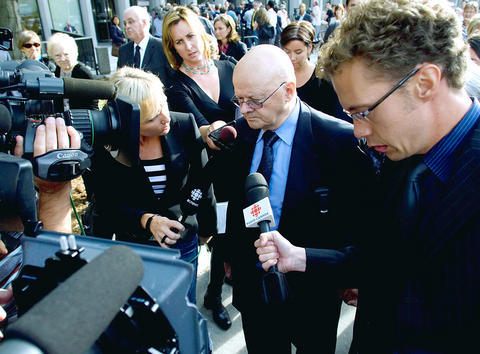
PHOTO: AP
"The allegations of criminal conduct on the part of these men and this corporation were not only unsupported by the evidence, they were disproved," she said.
"The events here were tragic," the judge said. "However, to assign blame where none exists is to compound the tragedy."
James Kreppner, a Toronto lawyer who contracted HIV and hepatitis C from the tainted blood, said he was astounded.
"It was clearly negligent behavior and a company violated its statutory duty and to call that professional conduct, you just can't justify that," he said.
John Plater of the Canadian Hemophilia Society expressed bewilderment at the verdict.
"If you, on the one hand, have a study that says there's a problem, and on the other hand have a study that says maybe there isn't a problem, any reasonable person takes the product off the market. They didn't. People were infected, and people died," Plater said. "How that could be considered reasonable behavior is beyond us."
The case involved blood products produced by New Jersey-based Armour Pharmaceutical Co in the 1980s and early 1990s that turned out to be infected.
Also charged were Roger Perrault of the Canadian Red Cross; John Furesz and Donald Wark Boucher, former officials at the federal agency Health Canada, and Michael Rodell, a former vice president of Armour.
Perrault pleaded not guilty to criminal negligence causing bodily harm for allegedly giving hemophilia patients an HIV-infected blood-clotting product.
The other doctors and the drug company also pleaded not guilty. Lawyers argued that prosecutors did not present enough evidence to prove its case.
Attorney Edward Greenspan called it a complete exoneration of his clients Perrault and Armour Pharmaceutical.
"We could not have hoped for a better result," Greenspan said.
"It was an enormous tragedy, but it does not mean somebody has to be held accountable. The people that made the decisions did nothing criminal," he said.
A second trial for Perrault is set to begin later this year in Hamilton, Ontario, where he will face more criminal charges stemming from allegations that the Red Cross and its senior officials failed to take adequate measures to screen blood donors.
Mina Shah, who lost her 24-year-old brother Karttik Shah to AIDS and hepatitis as a result of the tainted blood, said she could not accept the decision.
"She said it was OK and a great job was done. That doesn't sit well," Shah said. "There should have been some sort of punishment."
The Canadian Red Cross pleaded guilty in 2005 to distributing blood tainted with HIV and hepatitis C and was fined C$5,000 (US$5,000). The Red Cross apologized and dedicated C$1.5 million to a scholarship fund and research project aimed at reducing medical errors.
Responsibility for Canada's blood supply for all provinces except Quebec was later transferred from the Canadian Red Cross to Canadian Blood Services.
Archeologists in Peru on Thursday said they found the 5,000-year-old remains of a noblewoman at the sacred city of Caral, revealing the important role played by women in the oldest center of civilization in the Americas. “What has been discovered corresponds to a woman who apparently had elevated status, an elite woman,” archeologist David Palomino said. The mummy was found in Aspero, a sacred site within the city of Caral that was a garbage dump for more than 30 years until becoming an archeological site in the 1990s. Palomino said the carefully preserved remains, dating to 3,000BC, contained skin, part of the

‘WATER WARFARE’: A Pakistani official called India’s suspension of a 65-year-old treaty on the sharing of waters from the Indus River ‘a cowardly, illegal move’ Pakistan yesterday canceled visas for Indian nationals, closed its airspace for all Indian-owned or operated airlines, and suspended all trade with India, including to and from any third country. The retaliatory measures follow India’s decision to suspend visas for Pakistani nationals in the aftermath of a deadly attack by shooters in Kashmir that killed 26 people, mostly tourists. The rare attack on civilians shocked and outraged India and prompted calls for action against their country’s archenemy, Pakistan. New Delhi did not publicly produce evidence connecting the attack to its neighbor, but said it had “cross-border” links to Pakistan. Pakistan denied any connection to

TRUMP EFFECT: The win capped one of the most dramatic turnarounds in Canadian political history after the Conservatives had led the Liberals by more than 20 points Canadian Prime Minister Mark Carney yesterday pledged to win US President Donald Trump’s trade war after winning Canada’s election and leading his Liberal Party to another term in power. Following a campaign dominated by Trump’s tariffs and annexation threats, Carney promised to chart “a new path forward” in a world “fundamentally changed” by a US that is newly hostile to free trade. “We are over the shock of the American betrayal, but we should never forget the lessons,” said Carney, who led the central banks of Canada and the UK before entering politics earlier this year. “We will win this trade war and

Armed with 4,000 eggs and a truckload of sugar and cream, French pastry chefs on Wednesday completed a 121.8m-long strawberry cake that they have claimed is the world’s longest ever made. Youssef El Gatou brought together 20 chefs to make the 1.2 tonne masterpiece that took a week to complete and was set out on tables in an ice rink in the Paris suburb town of Argenteuil for residents to inspect. The effort overtook a 100.48m-long strawberry cake made in the Italian town of San Mauro Torinese in 2019. El Gatou’s cake also used 350kg of strawberries, 150kg of sugar and 415kg of


 RSS
RSS