


The state central bank announced measures on Monday that it said would help to restock empty store shelves by the end of the month.
Among the planned programs were cheap loans to manufacturers to restore productivity, and hard currency payments to farmers to keep them in business.
"I leave you with a promise most basic goods should and will return to the shelves in the next three weeks," Zimbabwean Reserve Bank Governor Gideon Gono said on state television.
Gono said the bank also planned to change the nation's currency, striking more zeros off bank notes for the second time since August last year.
In June, the government issued an edict to slash prices on all goods and services by about half. This included a crackdown on overcharging in which more than 7,000 corporate executives, business managers, traders and bus drivers were arrested, jailed and fined for price violations.
The price cuts were meant to tame the world's highest official inflation of nearly 7,000 percent. Instead, the effect was to worsen already acute shortages of food and basic goods in the crumbling economy.
Under a new central bank loan program, producers and rural stores hard hit by supply shortages would be able to borrow funds to restore their businesses at the country's lowest interest rate of 25 percent over nine months.
To boost production of staple foods, the bank would help the government pay the world parity price of around US$200 a tonne for corn and wheat, half in local currency and half in hard currency that could be used by farmers to buy their own gasoline, fertilizer and imported materials, Gono said.
He said the price crackdown had caused fear and mistrust between the government and businesses and called for what he called for "a spirit of reconciliation and healing" in the economy.
He said many of the nation's economic difficulties were self-inflicted, including the price cuts and a program to seize white and foreign-owned businesses.
In August last year, the central bank slashed three zeros from the currency and issued new denominations of notes after basic transactions became unmanageable and calculators and accounting systems could no longer cope with amounts traded.
Independent estimates put real inflation closer to 25,000 percent and the IMF has forecast it reaching 100,000 percent by the end of the year. Bundles of bank notes are again common in basic purchases.
Gono said the zeros had now returned, again making transactions unwieldy. He said a new currency would be issued possibly in the next two weeks.
"It's a process that could turn into a hurricane for those who keep cash outside the banking system," Gono said. In the rampant black market, "cash barons and dealers are in the habit of creating mini central banks in their homes."
Gono said the printing of extra money, now a routine practice, contributed to inflation and was against "basic textbook economics."
"We are living in extraordinary times and extraordinary measures are needed. Once we are out of the corner, we will have no problem formulating policy playing by the book. But for now, the game is one of survival," he said.

VAGUE: The criteria of the amnesty remain unclear, but it would cover political violence from 1999 to today, and those convicted of murder or drug trafficking would not qualify Venezuelan Acting President Delcy Rodriguez on Friday announced an amnesty bill that could lead to the release of hundreds of prisoners, including opposition leaders, journalists and human rights activists detained for political reasons. The measure had long been sought by the US-backed opposition. It is the latest concession Rodriguez has made since taking the reins of the country on Jan. 3 after the brazen seizure of then-Venezuelan president Nicolas Maduro. Rodriguez told a gathering of justices, magistrates, ministers, military brass and other government leaders that the ruling party-controlled Venezuelan National Assembly would take up the bill with urgency. Rodriguez also announced the shutdown
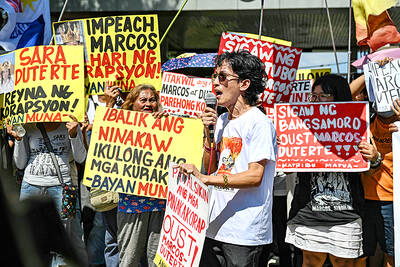
Civil society leaders and members of a left-wing coalition yesterday filed impeachment complaints against Philippine Vice President Sara Duterte, restarting a process sidelined by the Supreme Court last year. Both cases accuse Duterte of misusing public funds during her term as education secretary, while one revives allegations that she threatened to assassinate former ally Philippine President Ferdinand Marcos Jr. The filings come on the same day that a committee in the House of Representatives was to begin hearings into impeachment complaints against Marcos, accused of corruption tied to a spiraling scandal over bogus flood control projects. Under the constitution, an impeachment by the
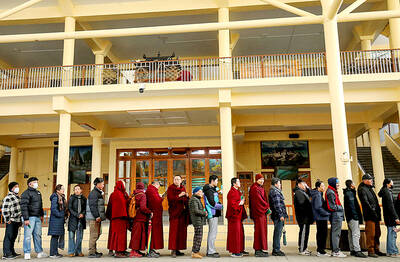
Exiled Tibetans began a unique global election yesterday for a government representing a homeland many have never seen, as part of a democratic exercise voters say carries great weight. From red-robed Buddhist monks in the snowy Himalayas, to political exiles in megacities across South Asia, to refugees in Australia, Europe and North America, voting takes place in 27 countries — but not China. “Elections ... show that the struggle for Tibet’s freedom and independence continues from generation to generation,” said candidate Gyaltsen Chokye, 33, who is based in the Indian hill-town of Dharamsala, headquarters of the government-in-exile, the Central Tibetan Administration (CTA). It

A Virginia man having an affair with the family’s Brazilian au pair on Monday was found guilty of murdering his wife and another man that prosecutors say was lured to the house as a fall guy. Brendan Banfield, a former Internal Revenue Service law enforcement officer, told police he came across Joseph Ryan attacking his wife, Christine Banfield, with a knife on the morning of Feb. 24, 2023. He shot Ryan and then Juliana Magalhaes, the au pair, shot him, too, but officials argued in court that the story was too good to be true, telling jurors that Brendan Banfield set


 RSS
RSS