


The UN Security Council failed to agree on a formal condemnation of a surprise attack that killed 10 African Union (AU) peacekeepers in Sudan's Darfur region because of a disagreement over whether to call it a terrorist act perpetrated by rebels.
Ghana's UN Ambassador Leslie Christian said the council would meet again yesterday to work on a presidential statement -- which becomes part of the official council record.
He told reporters in a brief press statement -- which does not become part of the council's official record -- that members condemn the attack, deplore the 10 deaths and injuries to 14 peacekeepers, and want the perpetrators identified and brought to justice.
"The reason we couldn't come to an agreement," South Africa's UN Ambassador Dumisani Kumalo said on Monday, "was because most of us feel that this was a terrorist act" and every report says it was done by rebels, but some council members argued that they wanted to wait for the results of an investigation to find out what happened.
The rebels first attacked the AU peacekeepers' camp at 7:30pm on Saturday and then returned at 4am the next day, overruning it.?Most of the 157 peacekeepers on the base were Nigerian but there were also military observers from Botswana, Senegal and Mali.
"In all descriptions that's a very cruel terrorist attack," Kumalo said, "so we wanted very strong language that said that -- but others were feeling that we had to be cautious."
Sudan's UN Ambassador Abdelmahmood Abdalhaleem Mohamed said the AU has already named some elements of the rebel Justice and Equality Movement and Sudan Liberation Movement who had been "very visible" in the area as the perpetrators of the attack.
US Ambassador Zalmay Khalilzad said "the AU is still not able to say which group is responsible at this point."
Undersecretary-General for Peacekeeping Jean-Marie Guehenno, who briefed the closed-door emergency council meeting, also told several reporters afterwards that very often first reports are incomplete and sometimes misleading. He said the AU and the UN would be conducting a joint investigation of the attack.
The attack "really shows how important it is to have a very robust force and a very mobile force because this tragedy would not have happened if the African Union had the capacity to quickly reinforce this threatened position," he said.
The AU force had no capacity to call in reinforcements after the first attack, he explained.
Darfur rebels have grown increasingly hostile to the AU force, saying it favors the Sudanese government and has failed to protect Darfur civilians.
More than 200,000 people have died in Darfur since ethnic African rebels took up arms against the Arab-dominated central government, accusing it of discrimination.
Khartoum is accused of retaliating by unleashing janjaweed militias, which are blamed for the worst atrocities against civilians in a conflict that has displaced more than 2.5 million people.
The UN Security Council has approved a 26,000-strong joint AU-UN force to replace the 6,000 AU troops who are ill-equipped and have gone for months without being paid.
Guehenno said he hopes the attack does not affect contributions to the AU-UN hybrid force and its deployment.
"I hope this tragedy really strengthens the hand of all those who see the importance of having very quickly a very strong force which will have a predominantly African character, but which needs actually to have all the capacities" to respond quickly, including helicopters and other heavy equipment which the AU force does not have, he said.
Khalilzad, the US ambassador, called for the speedy deployment of a UN heavy support package that was authorized by the Security Council to beef up the AU force and lay the groundwork for deployment of the hybrid force.
It includes 3,000 UN troops, police and civilian personnel along with aircraft and other equipment.
"This incident highlights the need to have an effective hybrid force on the ground," Khalilzad said. "This force has to be capable and some of this capability can only come from outside Africa."
The Sudanese government wants the hybrid force to be almost entirely African, though the council resolution authorizing it calls for it to be "predominantly African."
Guehenno and key Western nations including the US are now likely to insist that key units in the hybrid force -- including helicopters and other transport and logistics units -- come from outside Africa.
The UN has not been in touch with potential troop contributors to the hybrid force since the attack, Guehenno said, but when they meet "we will just reinforce our point that the troops have to come well-equipped and ready for a very tough situation."
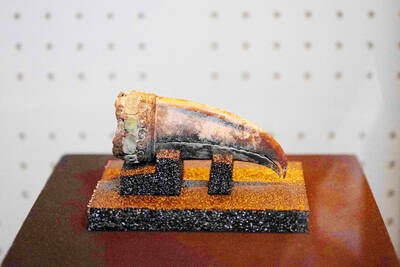
Archeologists in Peru on Thursday said they found the 5,000-year-old remains of a noblewoman at the sacred city of Caral, revealing the important role played by women in the oldest center of civilization in the Americas. “What has been discovered corresponds to a woman who apparently had elevated status, an elite woman,” archeologist David Palomino said. The mummy was found in Aspero, a sacred site within the city of Caral that was a garbage dump for more than 30 years until becoming an archeological site in the 1990s. Palomino said the carefully preserved remains, dating to 3,000BC, contained skin, part of the
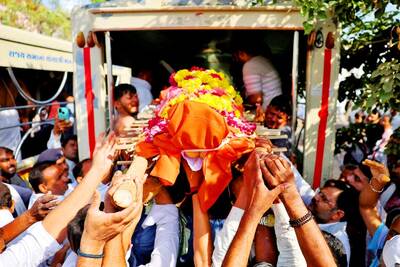
‘WATER WARFARE’: A Pakistani official called India’s suspension of a 65-year-old treaty on the sharing of waters from the Indus River ‘a cowardly, illegal move’ Pakistan yesterday canceled visas for Indian nationals, closed its airspace for all Indian-owned or operated airlines, and suspended all trade with India, including to and from any third country. The retaliatory measures follow India’s decision to suspend visas for Pakistani nationals in the aftermath of a deadly attack by shooters in Kashmir that killed 26 people, mostly tourists. The rare attack on civilians shocked and outraged India and prompted calls for action against their country’s archenemy, Pakistan. New Delhi did not publicly produce evidence connecting the attack to its neighbor, but said it had “cross-border” links to Pakistan. Pakistan denied any connection to

TRUMP EFFECT: The win capped one of the most dramatic turnarounds in Canadian political history after the Conservatives had led the Liberals by more than 20 points Canadian Prime Minister Mark Carney yesterday pledged to win US President Donald Trump’s trade war after winning Canada’s election and leading his Liberal Party to another term in power. Following a campaign dominated by Trump’s tariffs and annexation threats, Carney promised to chart “a new path forward” in a world “fundamentally changed” by a US that is newly hostile to free trade. “We are over the shock of the American betrayal, but we should never forget the lessons,” said Carney, who led the central banks of Canada and the UK before entering politics earlier this year. “We will win this trade war and

Armed with 4,000 eggs and a truckload of sugar and cream, French pastry chefs on Wednesday completed a 121.8m-long strawberry cake that they have claimed is the world’s longest ever made. Youssef El Gatou brought together 20 chefs to make the 1.2 tonne masterpiece that took a week to complete and was set out on tables in an ice rink in the Paris suburb town of Argenteuil for residents to inspect. The effort overtook a 100.48m-long strawberry cake made in the Italian town of San Mauro Torinese in 2019. El Gatou’s cake also used 350kg of strawberries, 150kg of sugar and 415kg of


 RSS
RSS