


A suicide bomber wearing an army uniform blew up a bus carrying Afghan soldiers in Kabul yesterday, killing at least 31 people and wounding many others, the health and defense ministries said.
Most of the dead military personnel were soldiers and officers going to work at the defense ministry, but several passers-by were also believed to have been killed, officials and witnesses said.
The insurgent Taliban movement claimed responsibility for the early morning attack, the deadliest in the city since a similar explosion on a police bus in June killed about 35 people.
The force of the explosion blew off the roof and sides of the large bus, which was reduced to mangled metal.
Television pictures showed the bodies of men who appeared to be Afghan National Army soldiers being pulled from the wreckage. Some of the dead were still in their seats. Debris was scattered across a wide area.
"At this time I can tell you that 31, almost all of them military personnel, have been martyred," said Public Health Minister Sayed Mohammad Amin Fatemi.
Seventeen of the wounded were in a critical condition, he said during a visit to the city's main military hospital where many of the casualties were taken.
The defense ministry said at least 27 national army personnel were killed and 21 others injured.
The suicide attacker, who had been wearing an army uniform, detonated explosives strapped to his body as he approached the bus, the ministry said in a statement.
The vehicle was attacked in a residential suburb just northwest of the city center.
The Taliban, behind a wave of suicide attacks in Afghanistan this year, claimed responsibility.
Spokesman Zabihullah Mujahed said the attack was part of a Taliban "operation" of attacks planned for the holy month of Ramadan.
There have been more than 100 suicide attacks in Afghanistan this year, most blamed on the Taliban.
While most of insurgency-linked attacks are in remote areas in the south and east of Afghanistan, there have been a series of strikes inside Kabul this year.
Yesterday's was the first inside the heavily patrolled capital since a suicide bomb on Sept. 21 struck a NATO armored vehicle, killing a French soldier and wounding several Afghans.
The deadliest attack was on a police bus on June 17. Officials said at the time that 35 policemen were killed, making it the worst such attack since the Taliban launched its insurgency after being driven from government six years ago.
On Aug. 15, three German security officers attached to the embassy were killed when their vehicle struck a bomb just outside the capital.
The Taliban was ousted from government in late 2001 in a US-led invasion launched weeks after the 9/11 attacks blamed on al-Qaeda, which was sheltered by the Taliban government.
They took Kabul in September 1996, ending a civil war but imposing an austere version of Islam on the battered country.
The rebels' insurgency has grown steadily, with almost daily attacks in the south and east.
The violence has killed more than 5,000 people this year, most of them rebels but including more than 700 civilians.

‘CROSSING THE LINE’: China’s embassy in Seoul criticized US Forces Korea Commander General Xavier Brunson, asking if his ‘hostile’ remarks were authorized by Washington South Korea and the US are in talks over recent public remarks by the commander of US Forces Korea, Seoul’s presidential office said yesterday, after the comments drew sharp criticism from China. In a recent podcast interview, US Forces Korea Commander General Xavier Brunson described South Korea as “the dagger in the heart of Asia” from China’s east coast, prompting the Chinese embassy in Seoul to say that he had “truly crossed the line.” The interview came amid growing speculation that Washington might seek to expand the role of US Forces Korea in countering the growing regional influence of China, a key

Through the noise of rushing papers and whirring belts at a print factory in Kyoto, two creators watch their photo essay come to life in broadsheet form — part of an effort to win new audiences in the age of artificial intelligence (AI). Despite the decline of the publishing industry, self-publication and handmade “zine” magazines are growing in popularity in Japan, reflecting the nation’s enduring love of paper in the digital era. While speaking to Agence France-Presse at the plant, his hands black with ink, one of the creators, Kazuma Obara, said: “I think [paper] is a medium that engages all five

Australian researchers have trained lab-grown brain cells on a silicon computer chip to play the 1990s shooter game Doom and said they are just scratching the surface of what the neurons could be capable of doing. It is the science-fiction work of biotech boffins at Cortical Labs, who researched and developed the technology that harnesses the workings of the brain’s networking system. Each so-called “biological computer” contains about 200,000 living human brain cells, grown from stem cells that were harvested from blood donations. Having mastered the simple computer game Pong, where a paddle is moved up and down to send a ball
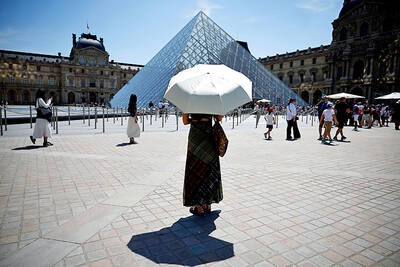
France experienced its hottest spring on record, the French weather service said on Tuesday, after an exceptional early heat wave that also broke highs for the season in England and Wales. Meteo-France said the average nationwide temperature over March to May was 13.8°C — about 1.7°C above the norm, and surpassing records set in 2011 and 2020. “The warmest spring since records began in 1900,” it said in a bulletin. All three months were warmer than average, but the onset of an “unprecedented heatwave” late last month pushed the mercury to highs typically seen at the height of the summer. “Our country had never


 RSS
RSS