


The US Episcopal Church has agreed to halt the ordination of gay bishops and the blessing of same-sex unions, straining to try to prevent a painful split in the global Anglican Communion.
The Church leaders who bowed to international pressure on those issues, however, also vowed late on Tuesday to continue to fight for the recognition of the civil rights of homosexuals.
"I have no doubt that the General Convention [in 2009] will revisit these issues," Presiding Bishop Katherine Jefferts Schori said.
The more liberal stance of the Episcopalian leadership has divided congregations within the US and threatened a split within the 77 million-member worldwide communion.
"This resolution really is the result of finding common ground to stand on," Jefferts Schori said. "Not everyone was 100 percent happy with every word in this document, as you might imagine. But together we believe that we have found a place that all of us can stand together."
Tuesday's decision came just days before a deadline imposed by global leaders who had threatened that relations would be "damaged at best" if the US Church did not reverse its liberal stance on the homosexuality issue.
The leaders of the 2.3 million US Episcopalians said they made the decision "with the hope of mending the tear in the fabric" of the communion.
The Episcopal House of Bishops reaffirmed its decision to "exercise restraint by not consenting to the consecration of any candidate to the episcopate whose manner of life presents a challenge to the wider church and will lead to further strains on communion."
The Church's leaders also pledged "not to authorize or use in our dioceses any public rites of blessing of same-sex unions until a broader consensus emerges in the Communion or until [the] General Convention takes further action."
But it was not clear whether clergy would be allowed to carry out unauthorized blessings of same-sex unions.
The statement noted that clergy have a pastoral duty to "respond with love and understanding to the people of all sexual orientations ... [and] maintain a breadth of private responses to situations of individual pastoral care."
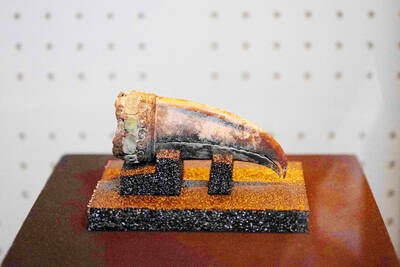
Archeologists in Peru on Thursday said they found the 5,000-year-old remains of a noblewoman at the sacred city of Caral, revealing the important role played by women in the oldest center of civilization in the Americas. “What has been discovered corresponds to a woman who apparently had elevated status, an elite woman,” archeologist David Palomino said. The mummy was found in Aspero, a sacred site within the city of Caral that was a garbage dump for more than 30 years until becoming an archeological site in the 1990s. Palomino said the carefully preserved remains, dating to 3,000BC, contained skin, part of the
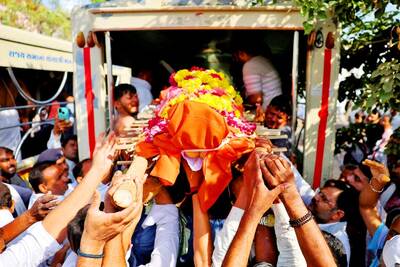
‘WATER WARFARE’: A Pakistani official called India’s suspension of a 65-year-old treaty on the sharing of waters from the Indus River ‘a cowardly, illegal move’ Pakistan yesterday canceled visas for Indian nationals, closed its airspace for all Indian-owned or operated airlines, and suspended all trade with India, including to and from any third country. The retaliatory measures follow India’s decision to suspend visas for Pakistani nationals in the aftermath of a deadly attack by shooters in Kashmir that killed 26 people, mostly tourists. The rare attack on civilians shocked and outraged India and prompted calls for action against their country’s archenemy, Pakistan. New Delhi did not publicly produce evidence connecting the attack to its neighbor, but said it had “cross-border” links to Pakistan. Pakistan denied any connection to

TRUMP EFFECT: The win capped one of the most dramatic turnarounds in Canadian political history after the Conservatives had led the Liberals by more than 20 points Canadian Prime Minister Mark Carney yesterday pledged to win US President Donald Trump’s trade war after winning Canada’s election and leading his Liberal Party to another term in power. Following a campaign dominated by Trump’s tariffs and annexation threats, Carney promised to chart “a new path forward” in a world “fundamentally changed” by a US that is newly hostile to free trade. “We are over the shock of the American betrayal, but we should never forget the lessons,” said Carney, who led the central banks of Canada and the UK before entering politics earlier this year. “We will win this trade war and

Armed with 4,000 eggs and a truckload of sugar and cream, French pastry chefs on Wednesday completed a 121.8m-long strawberry cake that they have claimed is the world’s longest ever made. Youssef El Gatou brought together 20 chefs to make the 1.2 tonne masterpiece that took a week to complete and was set out on tables in an ice rink in the Paris suburb town of Argenteuil for residents to inspect. The effort overtook a 100.48m-long strawberry cake made in the Italian town of San Mauro Torinese in 2019. El Gatou’s cake also used 350kg of strawberries, 150kg of sugar and 415kg of


 RSS
RSS