


Researchers in Singapore have created a handheld device that can detect the H5N1 bird flu virus from throat swab samples in under 30 minutes, raising hopes it will lead to rapid detection and containment of the virus.
The palm-sized "lab-on-a-chip" device is able to quickly detect the presence of the H5N1 virus from samples from humans and poultry,said Masafumi Inoue, a researcher from the Singapore-based Institute of Molecular and Cell Biology.
The instrument uses a magnetic force to manipulate reagents to rapidly determine whether samples are positive for the H5N1 strain, Inoue said yesterday.
Conventional laboratory tests take around four hours, and require machines to first isolate and amplify the virus before it is tested.
Writing in the latest issue of Nature Medicine, the scientists said the new device would allow decentralized testing of the H5N1 virus, especially in countries that lack basic public health resources.
H5N1, a disease found mostly in birds, is endemic in many parts of Asia and experts have warned for years that it could spark a pandemic, killing millions of people, if it learns to jump from person to person.
"The World Health Organization containment plan aims to stop an epidemic locally in order to prevent a global disaster," the scientists said in an advance online edition of the journal.
"In the event of a flu epidemic, its rapid containment would depend on the prompt identification of the first cases," they wrote.
"But as routine surveillance may be problematic in countries with limited public health resources, low-cost, easy-to-use detection [procedures] would be advantageous," they wrote.
The all-in-one device is able to isolate, purify and amplify the viral DNA from raw throat swab samples and put it through an H5N1 detection test.
"The answers you will get is: Am I infected? If yes, how `severe' is it?" project leader Juergen Pipper of Singapore's Institute of Bioengineering and Nanotechnology, wrote in an e-mail.
The team ran several hundred tests on the device.
"The accuracy is comparable to conventional equipment, although we are faster and cheaper," Pipper said.
The scientists hope to use the device to test for other viruses, such as SARS, AIDS and hepatitis B.
"In addition, it may be applicable not only to the flu virus, but could be adapted to other infectious agents, and to other bodily fluids like blood, urine or saliva," they said.
Archeologists in Peru on Thursday said they found the 5,000-year-old remains of a noblewoman at the sacred city of Caral, revealing the important role played by women in the oldest center of civilization in the Americas. “What has been discovered corresponds to a woman who apparently had elevated status, an elite woman,” archeologist David Palomino said. The mummy was found in Aspero, a sacred site within the city of Caral that was a garbage dump for more than 30 years until becoming an archeological site in the 1990s. Palomino said the carefully preserved remains, dating to 3,000BC, contained skin, part of the

TRUMP EFFECT: The win capped one of the most dramatic turnarounds in Canadian political history after the Conservatives had led the Liberals by more than 20 points Canadian Prime Minister Mark Carney yesterday pledged to win US President Donald Trump’s trade war after winning Canada’s election and leading his Liberal Party to another term in power. Following a campaign dominated by Trump’s tariffs and annexation threats, Carney promised to chart “a new path forward” in a world “fundamentally changed” by a US that is newly hostile to free trade. “We are over the shock of the American betrayal, but we should never forget the lessons,” said Carney, who led the central banks of Canada and the UK before entering politics earlier this year. “We will win this trade war and
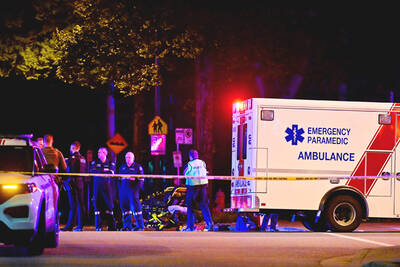
‘BODIES EVERYWHERE’: The incident occurred at a Filipino festival celebrating an anti-colonial leader, with the driver described as a ‘lone suspect’ known to police Canadian police arrested a man on Saturday after a car plowed into a street party in the western Canadian city of Vancouver, killing a number of people. Authorities said the incident happened shortly after 8pm in Vancouver’s Sunset on Fraser neighborhood as members of the Filipino community gathered to celebrate Lapu Lapu Day. The festival, which commemorates a Filipino anti-colonial leader from the 16th century, falls this year on the weekend before Canada’s election. A 30-year-old local man was arrested at the scene, Vancouver police wrote on X. The driver was a “lone suspect” known to police, a police spokesperson told journalists at the

North Korean leader Kim Jong-un has unveiled a new naval destroyer, claiming it as a significant advancement toward his goal of expanding the operational range and preemptive strike capabilities of his nuclear-armed military, state media said yesterday. North Korea’s state-run Korean Central News Agency (KCNA) said Kim attended the launching ceremony for the 5,000-tonne warship on Friday at the western port of Nampo. Kim framed the arms buildup as a response to perceived threats from the US and its allies in Asia, who have been expanding joint military exercises amid rising tensions over the North’s nuclear program. He added that the acquisition


 RSS
RSS