


Drawn by a case tinged with one of the most hated symbols of Old South racism -- a hangman's noose tied in an oak tree -- thousands of protesters rallied in this small Louisiana town against what they see as a double standard of prosecution for blacks and whites.
The plight of the so-called "Jena Six," a group of black teens -- five of whom were initially charged with attempted murder in the beating of a white classmate -- became a flashpoint for one the biggest civil-rights demonstrations in years.
Veteran rights activists like Jesse Jackson and Al Sharpton on Thursday joined scores of college students bused in from across the US who said they wanted to make a stand for racial equality just as their parents did in the 1950s and 1960s.
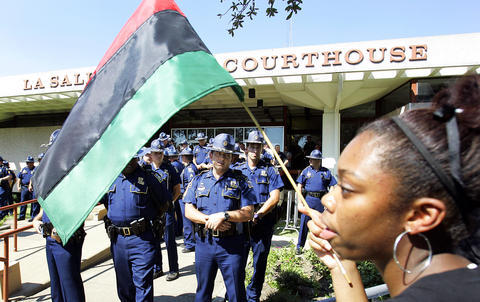
PHOTO: AP
"It's not just about Jena, but about inequalities and disparities around the country," said Stephanie Brown, 26, national youth director for the National Association for the Advancement of Colored People, which estimated about 2,000 college students were among the throngs of mostly black protesters who overwhelmed Jena, a town of about 3,000.
But the teens' case galvanized demonstrators as few legal cases in recent years.
The cause of Thursday's demonstrations dates to August last year, when a black Jena High School student asked the principal whether blacks could sit under a shade tree that was a frequent gathering place for whites. The student was told yes, but nooses appeared in the tree the next day. Three white students were suspended but not prosecuted.
LaSalle Parish District Attorney Reed Walters said this week he could find no state law covering the act.
Brown said the Jena case resonated with the college-aged crowd because they are not much older than the six youths charged. Many of the student protesters had been sharing information about the case through Facebook, MySpace and other social-networking Web sites.
Jackson, who led a throng of people three blocks long to the courthouse with a US flag resting on his shoulder, likened the demonstration to the marches on Selma, Alabama, and the Montgomery, Alabama, bus boycott. But even he was not entirely sure why Jena became the focal point.
"You can never quite tell," he said. "Rosa Parks was not the first to sit in the front of the bus. But the sparks hit a dry field."
Parks became a civil rights icon after refusing to give up her seat on a bus in December 1955 and her stand sparked the boycott in Montgomery.
The noose incident in Jena was followed by fights between blacks and whites, culminating in December's attack on white student Justin Barker, who was knocked unconscious.
Court testimony said his face was swollen and bloodied, but he was able to attend a school function that same night.
Six black teens were arrested. Five were originally charged with attempted second-degree murder -- charges that have since been reduced for four of them. The sixth was booked as a juvenile on sealed charges.
Martin Luther King III, son of the slain civil rights leader, said punishment of some sort may be in order for the six defendants, but added that "the justice system isn't applied the same to all crimes and all people."
People began massing for the demonstrations before dawn on Thursday. Police estimated the crowd at up to 20,000. Organizers said it drew as many as 50,000.
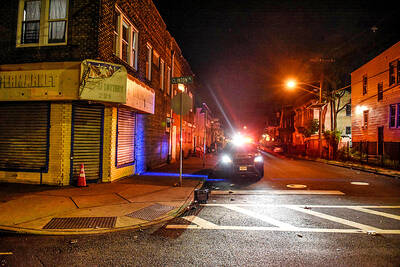
DOUBLE-MURDER CASE: The officer told the dispatcher he would check the locations of the callers, but instead headed to a pizzeria, remaining there for about an hour A New Jersey officer has been charged with misconduct after prosecutors said he did not quickly respond to and properly investigate reports of a shooting that turned out to be a double murder, instead allegedly stopping at an ATM and pizzeria. Franklin Township Police Sergeant Kevin Bollaro was the on-duty officer on the evening of Aug. 1, when police received 911 calls reporting gunshots and screaming in Pittstown, about 96km from Manhattan in central New Jersey, Hunterdon County Prosecutor Renee Robeson’s office said. However, rather than responding immediately, prosecutors said GPS data and surveillance video showed Bollaro drove about 3km
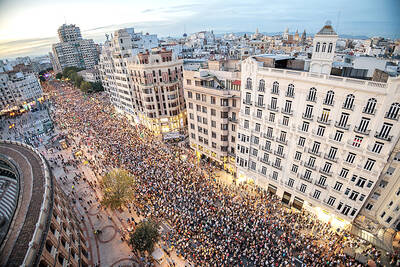
Tens of thousands of people on Saturday took to the streets of Spain’s eastern city of Valencia to mark the first anniversary of floods that killed 229 people and to denounce the handling of the disaster. Demonstrators, many carrying photos of the victims, called on regional government head Carlos Mazon to resign over what they said was the slow response to one of Europe’s deadliest natural disasters in decades. “People are still really angry,” said Rosa Cerros, a 42-year-old government worker who took part with her husband and two young daughters. “Why weren’t people evacuated? Its incomprehensible,” she said. Mazon’s
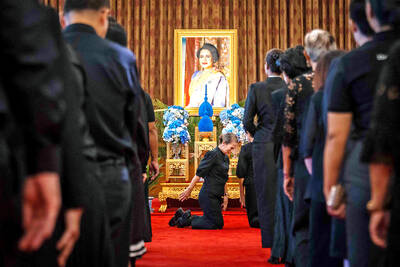
‘MOTHER’ OF THAILAND: In her glamorous heyday in the 1960s, former Thai queen Sirikit mingled with US presidents and superstars such as Elvis Presley The year-long funeral ceremony of former Thai queen Sirikit started yesterday, with grieving royalists set to salute the procession bringing her body to lie in state at Bangkok’s Grand Palace. Members of the royal family are venerated in Thailand, treated by many as semi-divine figures, and lavished with glowing media coverage and gold-adorned portraits hanging in public spaces and private homes nationwide. Sirikit, the mother of Thai King Vajiralongkorn and widow of the nation’s longest-reigning monarch, died late on Friday at the age of 93. Black-and-white tributes to the royal matriarch are being beamed onto towering digital advertizing billboards, on
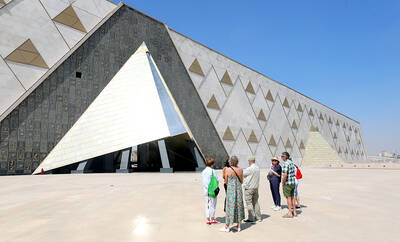
With much pomp and circumstance, Cairo is today to inaugurate the long-awaited Grand Egyptian Museum (GEM), widely presented as the crowning jewel on authorities’ efforts to overhaul the country’s vital tourism industry. With a panoramic view of the Giza pyramids plateau, the museum houses thousands of artifacts spanning more than 5,000 years of Egyptian antiquity at a whopping cost of more than US$1 billion. More than two decades in the making, the ultra-modern museum anticipates 5 million visitors annually, with never-before-seen relics on display. In the run-up to the grand opening, Egyptian media and official statements have hailed the “historic moment,” describing the


 RSS
RSS