


Turkish Prime Minister Recep Tayyip Erdogan refused on Tuesday to rule out the possibility of military operations into northern Iraq to root out armed Kurdish separatist groups that he said had taken refuge in the border region.
Erdogan also criticized some Western countries for what he called an increasingly hawkish stance against Iran.
Meeting with a group of foreign journalists on Tuesday ahead of his trip to the US to meet with US President George W. Bush and others attending the UN General Assembly next week, Erdogan said that despite the relative calm in the northern region of Iraq bordering Turkey, all options remained open in his country's struggle against Kurdish separatist militants.
"No country can continue living under the constant threat of terrorism," Erdogan said in his office at his party headquarters in Ankara. "This struggle has the same legitimacy for Turkey as it has for the US, Spain or United Kingdom."
The PKK, or Kurdistan Workers' Party, has been operating in Turkey since the 1980s, pressing demands for a separate Kurdish state in a conflict that has taken more than 30,000 lives.
There are around 3,500 armed rebels taking shelter in the mountains of northern Iraq and launching hit-and-run attacks inside Turkey according to Turkish officials. These attacks, which have been more frequent in recent months, have led the Turkish military to insist on an active operation to counter them.
"We have done our part in joint struggle against terrorism in Afghanistan as requested by the US," Erdogan said. "Now, we expect the same approach from the US when we expect a three pronged approach -- US, Iraq and Turkey -- to function against the terror organization settled in Northern Iraq."
Turkey has unilaterally entered northern Iraq three times since the 1990s with large numbers of troops and so-called hot pursuits by special army units have become common along the Iraqi border throughout the years.
A large-scale Turkish military operation now, however, could complicate matters in Iraq. US Secretary of State Condoleezza Rice and US Defense Secretary Robert Gates have warned Turkey against such military action, urging a political resolution.
The general elections and presidential election in Turkey this summer stalled any activity against the PKK, but the issue continues to simmer as Kurdish separatist attacks take lives in the predominantly Kurdish southeast.
The growing international tension surrounding Iran's nuclear ambitions has added another layer of complexity to Turkey's relationship with the US and Europe, which have accused the Iranians of trying to develop nuclear weapons. Iran says its nuclear program is for civilian energy.
Erdogan has strongly opposed the idea of military action against Iran, calling instead for an objective analysis of the Iranian nuclear program.
He questioned the accusations against Iran, saying, "We have to trust their word that they are using nuclear power for peaceful humanitarian needs until otherwise is proven."
Turkey has signed a memorandum of understanding on cooperation on natural gas with Iran, Turkey's second-largest provider of natural gas. That agreement was criticized by Nicholas Burns, the US undersecretary of state for political affairs, in a conference in Washington last week.
Burns arrived in Turkey on Tuesday for a two-day official visit and was scheduled to meet the newly appointed president, Abdullah Gul; the prime minister; and other officials in Ankara yesterday.
Erdogan brushed off the US criticism and said that Turkey would determine its own policies.
"Our foreign policy is based on gaining friends, not enemies," Erdogan said.
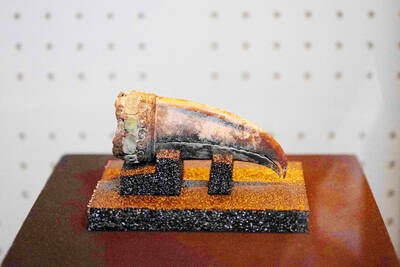
Archeologists in Peru on Thursday said they found the 5,000-year-old remains of a noblewoman at the sacred city of Caral, revealing the important role played by women in the oldest center of civilization in the Americas. “What has been discovered corresponds to a woman who apparently had elevated status, an elite woman,” archeologist David Palomino said. The mummy was found in Aspero, a sacred site within the city of Caral that was a garbage dump for more than 30 years until becoming an archeological site in the 1990s. Palomino said the carefully preserved remains, dating to 3,000BC, contained skin, part of the
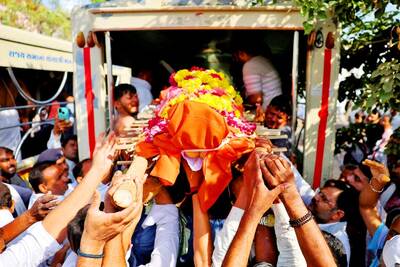
‘WATER WARFARE’: A Pakistani official called India’s suspension of a 65-year-old treaty on the sharing of waters from the Indus River ‘a cowardly, illegal move’ Pakistan yesterday canceled visas for Indian nationals, closed its airspace for all Indian-owned or operated airlines, and suspended all trade with India, including to and from any third country. The retaliatory measures follow India’s decision to suspend visas for Pakistani nationals in the aftermath of a deadly attack by shooters in Kashmir that killed 26 people, mostly tourists. The rare attack on civilians shocked and outraged India and prompted calls for action against their country’s archenemy, Pakistan. New Delhi did not publicly produce evidence connecting the attack to its neighbor, but said it had “cross-border” links to Pakistan. Pakistan denied any connection to

TRUMP EFFECT: The win capped one of the most dramatic turnarounds in Canadian political history after the Conservatives had led the Liberals by more than 20 points Canadian Prime Minister Mark Carney yesterday pledged to win US President Donald Trump’s trade war after winning Canada’s election and leading his Liberal Party to another term in power. Following a campaign dominated by Trump’s tariffs and annexation threats, Carney promised to chart “a new path forward” in a world “fundamentally changed” by a US that is newly hostile to free trade. “We are over the shock of the American betrayal, but we should never forget the lessons,” said Carney, who led the central banks of Canada and the UK before entering politics earlier this year. “We will win this trade war and
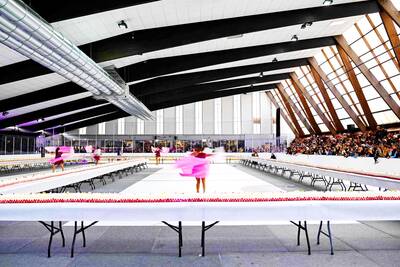
Armed with 4,000 eggs and a truckload of sugar and cream, French pastry chefs on Wednesday completed a 121.8m-long strawberry cake that they have claimed is the world’s longest ever made. Youssef El Gatou brought together 20 chefs to make the 1.2 tonne masterpiece that took a week to complete and was set out on tables in an ice rink in the Paris suburb town of Argenteuil for residents to inspect. The effort overtook a 100.48m-long strawberry cake made in the Italian town of San Mauro Torinese in 2019. El Gatou’s cake also used 350kg of strawberries, 150kg of sugar and 415kg of


 RSS
RSS