


Ehsan Jami knew he was making himself a target for radical Islamists when he decided to launch a Dutch organization for Muslims who renounce their religion.
Five months and three physical assaults later, his "Committee for Ex-Muslims" was to be launched yesterday, joining similar groups that have sprung up around Europe.
These groups hope to add a new voice to the debate about -- and within -- Europe's Muslim communities, presenting themselves as diametrically different to the disenchanted and sometimes violent youth who grab headlines, or to immigrants who live cloistered among their own.
Instead, they seek recognition from the Muslim mainstream for "freethinkers," empowered Muslim women, homosexuals and those who want to renounce their religion without fear.
Under some fundamentalist interpretations of Islam, apostasy is forbidden, or is a heresy punishable by death.
"We want to support people who want to change their religion, but their parents, their society have them clasped in it and won't let them out," Jami, 22, said in an interview on Monday.
The latest attack on Jami last month, when he was struck and pushed to the ground at a shopping center by three youths, was widely publicized in the Netherlands. The assailants were arrested, but Jami was forced into hiding, and receives police protection.
Leaders of ex-Muslim groups from Germany and England were to attend yesterday's launch, before meeting the European Commission in Brussels today.
"Very clearly our intent is to break the taboo" in Islam against renouncing religion, said Maryam Namazie, who in June founded the British Council of Ex-Muslims.
"The first step is making it easier to do that. You could compare it to when the first gays came out of the closet," she said.
Other groups have formed in the Scandinavian countries. Altogether, the European groups have total membership of no more than several hundred.
But the ex-Muslims say they are determined to show that "not all people from Muslim countries are religious," said Arzu Toker, vice president of Germany's Council of Ex-Muslims, the first and largest of the organizations.
"If we don't show it, many people will think `all these people are just the same,' and that's simply not true," she said.
Toker, a Turkish-born journalist, says membership in Germany has grown to more than 100 from 18 founders in January. Hundreds more have written to show their support, but are unwilling, unable or afraid to join.
Akbar Ahmed, who chairs the Islamic Studies department at American University in Washington, said the advent of such groups is not surprising.
He said it is wrong to say Islam endorses killing apostates, though some of the Hadith, or sayings of Mohammed, appear to endorse it -- when taken out of context.
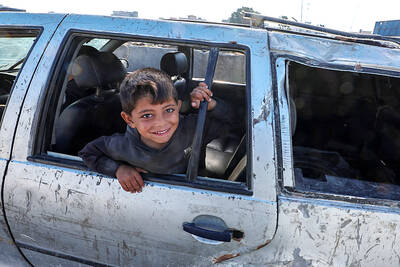
Gaza is rapidly running out of its limited fuel supply and stocks of food staples might become tight, officials said, after Israel blocked the entry of fuel and goods into the war-shattered territory, citing fighting with Iran. The Israeli military closed all Gaza border crossings on Saturday after announcing airstrikes on Iran carried out jointly with the US. Israeli authorities late on Monday night said that they would reopen the Kerem Shalom crossing from Israel to Gaza yesterday, for “gradual entry of humanitarian aid” into the strip, without saying how much. Israeli authorities previously said the crossings could not be operated safely during
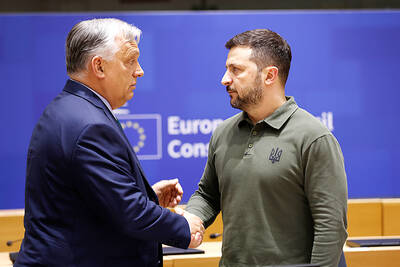
Hungarian authorities temporarily detained seven Ukrainian citizens and seized two armored cars carrying tens of millions of euros in cash across Hungary on suspicion of money laundering, officials said on Friday. The Ukrainians were released on Friday, following their detention on Thursday, but Hungarian officials held onto the cash, prompting Ukraine to accuse Hungary’s Russia-friendly government of illegally seizing the money. “We will not tolerate this state banditism,” Ukrainian Minister of Foreign Affairs Andrii Sybiha said. The seven detained Ukrainians were employees of the Ukrainian state-owned Oschadbank, who were traveling in the two armored cars that were carrying the money between Austria and
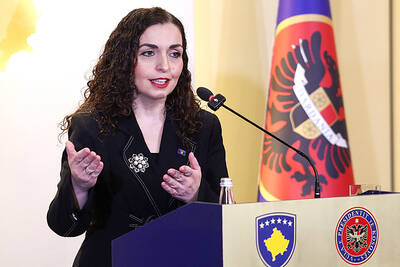
Kosovar President Vjosa Osmani on Friday after dissolving the Kosovar parliament said a snap election should be held as soon as possible to avoid another prolonged political crisis in the Balkan country at a time of global turmoil. Osmani said it is important for Kosovo to wrap up the upcoming election process and form functional institutions for political stability as the war rages in the Middle East. “Precisely because the geopolitical situation is that complex, it is important to finish this electoral process which is coming up,” she said. “It is very hard now to imagine what will happen next.” Kosovo, which declared

MORE BANS: Australia last year required sites to remove accounts held by under-16s, with a few countries pushing for similar action at an EU level and India considering its own ban Indonesia on Friday said it would ban social media access for children under 16, citing threats from online pornography, cyberbullying, online fraud and Internet addiction. “Accounts belonging to children under 16 on high-risk platforms will start to be deactivated, beginning with YouTube, TikTok, Facebook, Instagram, Threads, X, Bigo Live and Roblox,” Indonesian Minister of Communications and Digital Meutya Hafid said. “The government is stepping in so that parents no longer have to fight alone against the giants of the algorithm. Implementation will begin on March 28, 2026,” she said. The social media ban would be introduced in stages “until all platforms fulfill their


 RSS
RSS