


Thirty years after dying in prison in apartheid South Africa, Steve Biko remains a historical icon, even if his "Black Consciousness Movement" no longer carries political weight.
A fervent anti-apartheid and freedom activist, Biko's popularity in the new South Africa is rooted in culture, providing ideas for the shaping of the identity of young blacks rather than formal politics.
"Steve Biko is on T-shirts, in music, in the newspapers," said Kopano Ratele, a researcher with the University of South Africa's Institute of Social and Health Sciences.
"People who were teenagers or in their twenties in the 1970s still remember Biko with nostalgia and they credit him for giving them a sense of pride in themselves," Ratele said.
In 1971, Biko explained that Black Consciousness was the realization that blacks should rally together against the cause of their oppression.
"It seeks to infuse the black community with a new-found pride in themselves, their efforts, their value systems, their culture, their religion and their outlook to life," Ratele said.
To mark the 30th anniversary of his death tomorrow, the Steve Biko Foundation has put on a series of events across the country since June, which will culminate in a lecture by South Africa President Thabo Mbeki in Cape Town.
"In popular culture, he is a very powerful symbol of hope ... an icon of change. He helped to articulate our understanding, our own identity that continues to resonate in young South Africans to this day," said Biko's son Nkosinathi, who manages the foundation.
Ratele said if Biko were still alive he would be disappointed to see his ideas compromised by poverty and inequality still evident in South African society 13 years after the demise of apartheid.
"If you are unemployed and poorly paid and you see the rich blacks, of what use is your pride?" he said.
However, the younger Biko feels his father's ideas are still relevant to black South Africans and should be used by leaders to propel the country forward.
"People who are entrusted [to] a position of power do not recognize the extent to which they can give direction to change in this country," he said.
"In that extent his ideas are still relevant, there is a need to link consciousness of self to development programm," he said.
On Aug. 18, 1977, 30-year-old Biko was arrested by police under the white minority apartheid government and taken to a prison in Port Elizabeth. He was transferred to Pretoria on Sept. 11 and was found dead in his cell the following day, becoming the 20th person to die in the prison in 18 months.
While authorities said that he died after going on a hunger strike, South African newspapers did extensive investigations, revealing he had died from brain injuries.
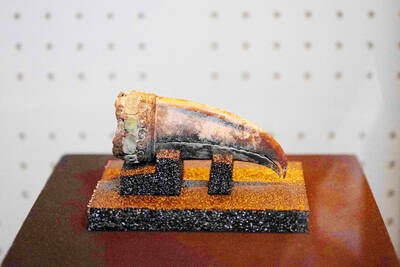
Archeologists in Peru on Thursday said they found the 5,000-year-old remains of a noblewoman at the sacred city of Caral, revealing the important role played by women in the oldest center of civilization in the Americas. “What has been discovered corresponds to a woman who apparently had elevated status, an elite woman,” archeologist David Palomino said. The mummy was found in Aspero, a sacred site within the city of Caral that was a garbage dump for more than 30 years until becoming an archeological site in the 1990s. Palomino said the carefully preserved remains, dating to 3,000BC, contained skin, part of the
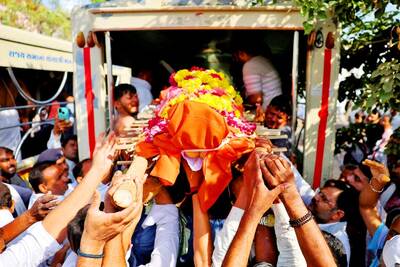
‘WATER WARFARE’: A Pakistani official called India’s suspension of a 65-year-old treaty on the sharing of waters from the Indus River ‘a cowardly, illegal move’ Pakistan yesterday canceled visas for Indian nationals, closed its airspace for all Indian-owned or operated airlines, and suspended all trade with India, including to and from any third country. The retaliatory measures follow India’s decision to suspend visas for Pakistani nationals in the aftermath of a deadly attack by shooters in Kashmir that killed 26 people, mostly tourists. The rare attack on civilians shocked and outraged India and prompted calls for action against their country’s archenemy, Pakistan. New Delhi did not publicly produce evidence connecting the attack to its neighbor, but said it had “cross-border” links to Pakistan. Pakistan denied any connection to

TRUMP EFFECT: The win capped one of the most dramatic turnarounds in Canadian political history after the Conservatives had led the Liberals by more than 20 points Canadian Prime Minister Mark Carney yesterday pledged to win US President Donald Trump’s trade war after winning Canada’s election and leading his Liberal Party to another term in power. Following a campaign dominated by Trump’s tariffs and annexation threats, Carney promised to chart “a new path forward” in a world “fundamentally changed” by a US that is newly hostile to free trade. “We are over the shock of the American betrayal, but we should never forget the lessons,” said Carney, who led the central banks of Canada and the UK before entering politics earlier this year. “We will win this trade war and

Armed with 4,000 eggs and a truckload of sugar and cream, French pastry chefs on Wednesday completed a 121.8m-long strawberry cake that they have claimed is the world’s longest ever made. Youssef El Gatou brought together 20 chefs to make the 1.2 tonne masterpiece that took a week to complete and was set out on tables in an ice rink in the Paris suburb town of Argenteuil for residents to inspect. The effort overtook a 100.48m-long strawberry cake made in the Italian town of San Mauro Torinese in 2019. El Gatou’s cake also used 350kg of strawberries, 150kg of sugar and 415kg of


 RSS
RSS