


An Indian judge, remembered by fewer and fewer of his own countrymen 40 years after his death, is still big in Japan.
In recent weeks alone, NHK, the public broadcaster, devoted 55 minutes of prime time to his life, and a scholar came out with a 309-page book exploring his thinking and its impact on Japan. Capping it all, Prime Minister Shinzo Abe, during a visit to India last week, paid tribute to him in a speech to the Indian Parliament in New Delhi and then traveled to Calcutta to meet the judge's 81-year-old son.
A monument to the judge -- erected two years ago at the Yasukuni shrine, the memorial to Japan's war dead and a rallying point for Japanese nationalists -- provides a clue to his identity: Radhabinod Pal, the only one out of 11 Allied justices who handed down a not-guilty verdict for Japan's top wartime leaders at the post-World War II International Military Tribunal for the Far East, or the Tokyo Trials.
"Justice Pal is highly respected even today by many Japanese for the noble spirit of courage he exhibited during the International Military Tribunal for the Far East," Abe told the Indian Parliament.
Many of postwar Japan's nationalist leaders and thinkers have long upheld Pal as a hero, seizing on -- and often distorting -- his dissenting opinion at the Tokyo Trials to argue that Japan did not wage a war of aggression in Asia but rather one of self-defense and liberation.
As nationalist politicians like Abe have gained power in recent years, and as like-minded academics and journalists have pushed forward a revisionist view of Japan's wartime history, Pal has stepped back into the spotlight.
Abe, who has cast doubt on the validity of the Tokyo Trials in the past, avoided elaborating on his views in the Indian Parliament or during his 20-minute meeting with Pal's son, Prasanta. But the meeting's subtext was not lost on some Japanese newspapers, which warned that it would hardly help repair Japan's poor image among its neighbors.
After the war, conventional war crimes by the Japanese, categorized as Class B and Class C, were handled in local trials throughout Asia. Twenty-five top leaders were charged with Class A crimes -- of waging aggressive wars and committing crimes against peace and humanity -- and tried in Tokyo by justices from 11 countries.
It was not clear why the British and US authorities selected Pal, who had served in Calcutta's high court and strongly sympathized with the anti-colonial struggle in India. As an Asian nationalist, he saw things very differently from the other judges.
In colonizing parts of Asia, Japan had merely aped the Western powers, he said.
While he fully acknowledged Japan's war atrocities -- including the Nanjing massacre -- he said they were covered in the Class B and C trials.
Pal also described the atomic bombings of Hiroshima and Nagasaki by the US as the worst atrocities of the war, comparable with Nazi crimes.
The US occupation of Japan ended in 1952, after Tokyo signed the San Francisco Peace Treaty and accepted the Tokyo Trials' verdict.
But the end of the occupation also lifted a ban on the publication of Pal's 1,235-page dissent, which Japanese nationalists brandished and began using as the basis of their argument that the Tokyo trials were a sham.
Takeshi Nakajima, an associate professor at the Hokkaido University Public Policy School whose book Judge Pal, was published last month, said that Japanese critics of the trials selectively chose passages from his dissent.
"Pal was very hard on Japan, though he of course spoke very severely of the United States," Nakajima said.

Hungarian authorities temporarily detained seven Ukrainian citizens and seized two armored cars carrying tens of millions of euros in cash across Hungary on suspicion of money laundering, officials said on Friday. The Ukrainians were released on Friday, following their detention on Thursday, but Hungarian officials held onto the cash, prompting Ukraine to accuse Hungary’s Russia-friendly government of illegally seizing the money. “We will not tolerate this state banditism,” Ukrainian Minister of Foreign Affairs Andrii Sybiha said. The seven detained Ukrainians were employees of the Ukrainian state-owned Oschadbank, who were traveling in the two armored cars that were carrying the money between Austria and

Kosovar President Vjosa Osmani on Friday after dissolving the Kosovar parliament said a snap election should be held as soon as possible to avoid another prolonged political crisis in the Balkan country at a time of global turmoil. Osmani said it is important for Kosovo to wrap up the upcoming election process and form functional institutions for political stability as the war rages in the Middle East. “Precisely because the geopolitical situation is that complex, it is important to finish this electoral process which is coming up,” she said. “It is very hard now to imagine what will happen next.” Kosovo, which declared

MORE BANS: Australia last year required sites to remove accounts held by under-16s, with a few countries pushing for similar action at an EU level and India considering its own ban Indonesia on Friday said it would ban social media access for children under 16, citing threats from online pornography, cyberbullying, online fraud and Internet addiction. “Accounts belonging to children under 16 on high-risk platforms will start to be deactivated, beginning with YouTube, TikTok, Facebook, Instagram, Threads, X, Bigo Live and Roblox,” Indonesian Minister of Communications and Digital Meutya Hafid said. “The government is stepping in so that parents no longer have to fight alone against the giants of the algorithm. Implementation will begin on March 28, 2026,” she said. The social media ban would be introduced in stages “until all platforms fulfill their
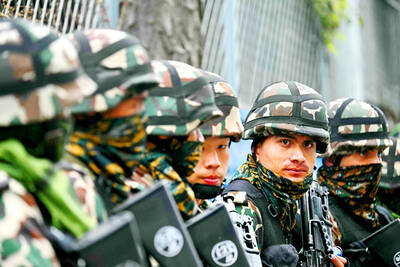
Counting was under way in Nepal yesterday, after a high-stakes parliamentary election to reshape the country’s leadership following protests last year that toppled the government. Key figures vying for power include former Nepalese prime minister K. P. Sharma Oli, rapper-turned-mayor Balendra Shah, who is bidding for the youth vote, and newly elected Nepali Congress party leader Gagan Thapa. In Kathmandu’s tea shops and city squares, people were glued to their phones, checking results as early trends flashed up — suggesting Shah’s centrist Rastriya Swatantra Party (RSP) was ahead. Nepalese Election Commission spokesman Prakash Nyupane said the counting was ongoing “in a peaceful manner”


 RSS
RSS