

US President George W. Bush raised the specter of a "nuclear holocaust" in the Middle East if Iran gets atomic weapons, and vowed he would not let that happen.
"Iran's actions threaten the security of nations everywhere, and the United States is rallying friends and allies to isolate Iran's regime, to impose economic sanctions," he said in a speech to the American Legion veterans group on Tuesday.
"We will confront this danger before it is too late," vowed Bush, who has pressed for tougher international sanctions and said he hopes for a diplomatic solution but has repeatedly refused to rule out the use of force.
Hours after Bush's speech, US forces swooped on a Baghdad hotel and detained eight Iranians.
The group was released early yesterday and taken to Iraqi Prime Minister Nuri al-Maliki's office, a diplomat at Tehran's mission in Baghdad said.
A media adviser to Maliki, Yasin Majid, said the men had been members of an Iranian delegation invited to Iraq by the Ministry of Electricity to discuss construction of a new power plant.
With his speech billed as a defense of the Iraq war, Bush also branded Iran as "the world's leading state sponsor of terrorism," and accused it of backing such militant groups as Hamas, Hezbollah, Islamic Jihad as well as Shiite fighters killing US troops in Iraq.
He accused Iran of fomenting instability in the Middle East, and said one way to counter Tehran's ambitions was to win the Iraq war.
He also warned that extremist forces would be emboldened if the US were driven out of the region, leaving Iran to pursue a nuclear weapon and set off an arms race.
"Iran could conclude that we were weak and could not stop them from gaining nuclear weapons," Bush said.
"And Iran's active pursuit of technology that could lead to nuclear weapons threatens to put a region already known for instability and violence under the shadow of a nuclear holocaust," he said.
The US accuses Iran of seeking to make nuclear weapons under the guise of a civilian energy drive. Iran insists that the drive is entirely peaceful and that it will need nuclear power as fossil fuels dry up.
White House spokesman Scott Stanzel said there was no change in US policy toward Iran.
The US is leading efforts to isolate Iran over its nuclear program, which the West contends is aimed at building bombs. Iran denies the charges and says it is only seeking nuclear-generated electricity.
Bush's verbal attack on Iran came just hours after Iranian President Mahmoud Ahmadinejad said the power of the US was rapidly collapsing in Iraq and that Tehran was ready to step in to help fill the vacuum.
Iran blames the US-led invasion of Iraq in 2003 for the violence that is threatening to tear the country apart and has repeatedly called on US forces, now numbering about 160,000, to leave the country.
Yesterday, Iran rejected Bush's accusations and called on the US to change its policies in the region.
"They [the accusations] are not true," Iranian Foreign Ministry spokesman Mohammad Ali Hosseini said by phone, saying Bush was repeating them "again and again."
He did not comment on Bush's remarks that Iran's pursuit of the atomic bomb could lead to a nuclear holocaust in the Middle East.
Hosseini said the US path was neither "useful or fruitful," adding: "It is better for him [Bush] to change his point of view and political decisions."

The US Department of Agriculture and the FBI were breached by hackers in cyberattacks, US media reported on Friday, as concerns deepened over the recent spate of tech outages at key US institutions. The incidents were first reported by NBC News and CNN respectively, and it remained unclear whether they were related and who was responsible. Major outages over the past few weeks have disrupted travel, communications and e-commerce for countless users across the US, even affecting a top-secret network at the US National Security Agency. US President Donald Trump has sought to calm the public and urged people to
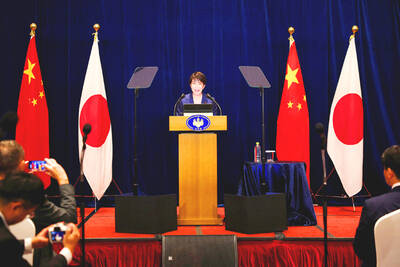
Japan must “correct its wrong words” on Taiwan and change its “attitude,” China said yesterday, after Chinese President Xi Jinping (習近平) snubbed Japanese Prime Minister Sanae Takaichi at a regional meeting in Shenzhen, China. “For the Japanese side, the most urgent task is to correct its wrong words and actions on the Taiwan issue as soon as possible,” Chinese Ministry of Foreign Affairs spokesman Guo Jiakun (郭嘉昆) told a briefing. “The important thing is to adopt a correct attitude on historical issues, and fundamentally, truly achieve an objective and rational understanding of China.” Takaichi’s China trip this week was her first since
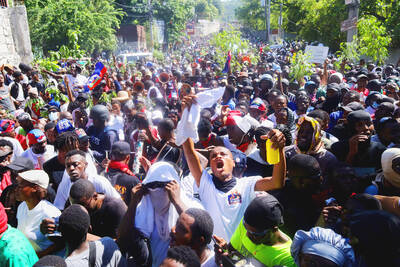
’VIVA BUKELE’: Supporters urged the Salvadoran leader to do whatever it takes to end the violence in Haiti that has resulted in 4,595 deaths so far this year, the UN says Haiti on Tuesday announced that it formalized a “cooperation agreement” with El Salvador, the same day thousands of Haitians showed support in the streets of Port-au-Prince for soldiers sent by Salvadoran President Nayib Bukele to confront armed gangs in the capital. “The Council of Ministers has approved the Cooperation agreement between the Republic of Haiti and the Republic of El Salvador,” Bukele wrote on Facebook, calling it “a new stage in strengthening bilateral relations and cooperation.” Signs carried by the demonstrators on Tuesday read “Thank you, Bukele,” and “Long live Bukele.” “Bukele, the country belongs to you. Do whatever you want with it,”
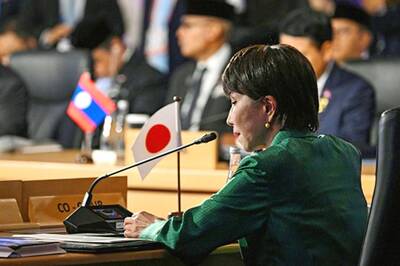
Japan yesterday said that Southeast Asian nations would be able to access its crude oil storage facilities as part of efforts to prepare the region for a future energy crisis. The announcement came as ASEAN leaders met in Manila, where energy security has been high on the agenda. Addressing regional leaders, Japanese Prime Minister Sanae Takaichi said her country’s “hydro-tanks” would be available for use under the proposed initiative for cooperation on oil stockpiling. ASEAN members have been grappling with fuel shortages and price hikes after the Middle East conflict squeezed the flow of crude to the region. The regional bloc has


 RSS