


The fires that tore omnivorously through scores of villages and olive groves here may now also be changing Greece's political landscape: The government of Greek Prime Minister Kostas Karamanlis, facing national elections next month, came under increasing criticism on Tuesday, not only over its handling of the fires but also over whether it stoked Greeks' fears about who might be to blame.
It is unclear whether the criticism will be enough to alter the outcome of the national elections on Sept. 16. But a new national poll showed the gap narrowing to less than 1 percent between Karamanlis' New Democracy party and the socialist opposition party, Pasok.
The opposition leader, George Papandreou, is seizing on the anger, in an effort to sway the many undecided voters in a close race.
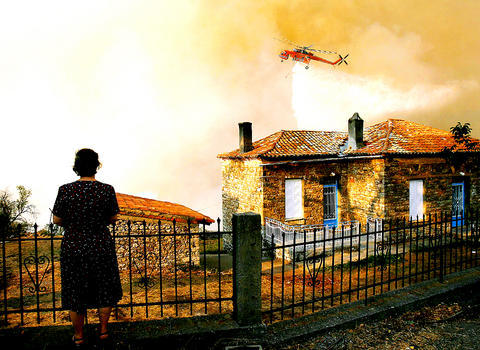
PHOTO: AP
"Unfortunately, the government has proven ineffective," he told reporters on Tuesday. "It continues to act irresponsibly. It is busy fabricating conspiracy terror theories. The result: Greeks are being ridiculed abroad."
He added, "Our nation cannot tolerate a government propped up on fear."
In Evia, the island to the north of Athens, four planes and a helicopter were being used to extinguish the flames.
More than 30 fires were blazing across the country, but a drop in the high winds which have fanned the flames was helping firefighters.
More than 2,000 soldiers and at least 800 firefighters were being assisted by aircraft from more than a dozen countries.
The death toll now stands at 64 since Friday.
"The picture we have today gives us some relative optimism," Nikolaos Diamantis, a fire service spokesman, told reporters on Tuesday. "We hope there's nothing unexpected which will change our operational planning or cause problems. We believe we will have good results."
On Saturday, as the death toll rose and Greek television broadcast live interviews with people trapped by fires -- and with no immediate help -- Karamanlis declared a national state of emergency. He also stated that he believed arson was the cause, saying that it "cannot be a coincidence" that so many fires started at the same time.
Then his public order minister, Vyron Polydoras, said Greece faced an "asymetrical threat" -- a term that usually refers to small terrorist groups attacking a far larger target.
Past forest fires have indeed been set by arsonists, often property owners wanting to develop land set aside as forest. And without doubt, New Democracy's suggestions dovetailed with conspiracy theories mouthed by many Greeks, in a political culture full of conspiracy.
Some speculated that it might be the work of Greece's age-old nemesis Turkey or a home-grown, or possibly even foreign, terrorist group. One man in the hard-hit western Peloponnesian peninsula even suggested that it was a conspiracy between the government and makers of particle board for cheap wood.
HELP FROM NATURE
Meanwhile, improved weather conditions yesterday helped thousands of firefighters, including hundreds from neighboring countries, bring under control dozens of fires.
Hundreds of people who lost homes, property, farms and livestock crowded into banks in southern Greece to receive up to 13,000 euros (US$18,000) in aid promised immediately by the government.
The fire department said at least two fires were burning out of control near the northern border with Albania, while on the hard-struck island of Evia, north of Athens, all fires were under control.
On the southern Peloponnese peninsula, where most of the blazes were concentrated, the fire department said it had managed to contain the fires.
"The work of extinguishing the fires continues inside the containment perimeter," it said.
Cooler temperatures and abating winds allowed firefighters to corral most fires into smaller more controllable blazes, Diamandis said.
There were no initial estimates so far on the cost to Greece's economy from the fires, which began late on Aug. 23 and have so far destroyed a large part of the southern Peloponnese peninsula -- where most of the blazes were concentrated.
"From the first day that these large fires took hold of the country we had emphasized the need for the weather conditions to become our ally, even if only for 24 hours. This alliance took place yesterday," Diamandis said.
Firefighting efforts remained concentrated on the island of Evia and Peloponnese. But Diamandis said all major blazes were "generally receding."
Archeologists in Peru on Thursday said they found the 5,000-year-old remains of a noblewoman at the sacred city of Caral, revealing the important role played by women in the oldest center of civilization in the Americas. “What has been discovered corresponds to a woman who apparently had elevated status, an elite woman,” archeologist David Palomino said. The mummy was found in Aspero, a sacred site within the city of Caral that was a garbage dump for more than 30 years until becoming an archeological site in the 1990s. Palomino said the carefully preserved remains, dating to 3,000BC, contained skin, part of the

‘WATER WARFARE’: A Pakistani official called India’s suspension of a 65-year-old treaty on the sharing of waters from the Indus River ‘a cowardly, illegal move’ Pakistan yesterday canceled visas for Indian nationals, closed its airspace for all Indian-owned or operated airlines, and suspended all trade with India, including to and from any third country. The retaliatory measures follow India’s decision to suspend visas for Pakistani nationals in the aftermath of a deadly attack by shooters in Kashmir that killed 26 people, mostly tourists. The rare attack on civilians shocked and outraged India and prompted calls for action against their country’s archenemy, Pakistan. New Delhi did not publicly produce evidence connecting the attack to its neighbor, but said it had “cross-border” links to Pakistan. Pakistan denied any connection to

TRUMP EFFECT: The win capped one of the most dramatic turnarounds in Canadian political history after the Conservatives had led the Liberals by more than 20 points Canadian Prime Minister Mark Carney yesterday pledged to win US President Donald Trump’s trade war after winning Canada’s election and leading his Liberal Party to another term in power. Following a campaign dominated by Trump’s tariffs and annexation threats, Carney promised to chart “a new path forward” in a world “fundamentally changed” by a US that is newly hostile to free trade. “We are over the shock of the American betrayal, but we should never forget the lessons,” said Carney, who led the central banks of Canada and the UK before entering politics earlier this year. “We will win this trade war and

Armed with 4,000 eggs and a truckload of sugar and cream, French pastry chefs on Wednesday completed a 121.8m-long strawberry cake that they have claimed is the world’s longest ever made. Youssef El Gatou brought together 20 chefs to make the 1.2 tonne masterpiece that took a week to complete and was set out on tables in an ice rink in the Paris suburb town of Argenteuil for residents to inspect. The effort overtook a 100.48m-long strawberry cake made in the Italian town of San Mauro Torinese in 2019. El Gatou’s cake also used 350kg of strawberries, 150kg of sugar and 415kg of


 RSS
RSS