


Afghan opium poppy cultivation has exploded to a new record high this year, with the multibillion dollar trade now fueled by Taliban militants and corrupt officials in Afghan President Hamid Karzai's government, a UN report said.
Afghanistan has opium growing on 193,000 hectares of land, a 17 percent increase from last year's record of 165,000 hectares, an annual survey by the UN's Office of Drugs and Crime (UNODC) said.
The country now accounts for 93 percent of the global production of opium, the raw material for heroin, and has doubled its output over the last two years, the report, released on Monday, said.
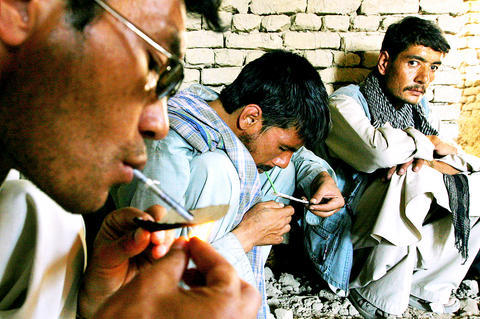
PHOTO: AP
"The situation is dramatic and getting worse by the day," said Antonio Maria Costa, the UNODC's executive director.
"No other country in the world has ever had such a large amount of farmland used for illegal activity, beside China 100 years ago," when it was a major opium producer, Costa said in an interview in Kabul.
The burgeoning drug business casts doubt on the effectiveness of projects funded by the US and other Western donors to battle the illicit trade.
It also adds pressure on Karzai to consider new ways of curbing an expansion that threatens to turn Afghanistan into a "narco-state" where some observers warn that groups such as al-Qaeda could once again find sanctuary.
Karzai last year rejected US offers to spray this year's crop, after Afghans said the herbicide could affect livestock, crops and water supplies -- fears the US calls unfounded.
Costa said the UN supports the government's position, but added that crop eradication was a key element of any strategy to combat its growth.
Afghanistan is on course to produce 9,000 tonnes of opium this year, up 34 percent from 6,724 tonnes last year, Costa said.
The farm-gate value of Afghanistan's annual crop is about US$1 billion, the UN survey said. The street value of the heroin produced from it is many times higher.
While the number of poppy-free provinces in the country's north has increased from six last year to 13 this year, production in the insurgency-hit southern provinces has exploded to unprecedented levels.
The province of Helmand alone, with 102,770 hectares under cultivation, now accounts for over half of the national total.
General Khodaidad, Afghanistan's acting counternarcotics minister, acknowledged that the drugs strategy had failed in the country's south and west, which he blamed on inept local officials and poor policing, but also to open borders with Iran to the west and Pakistan to the east.
Khodaidad said the government needed to review its strategy, and threatened to sack inefficient and corrupt officials and reward those that curbed the production and trade at a national conference scheduled for today.
Costa linked the booming trade primarily to the rise of insurgent activity in the south.
"The government has lost control of this territory because of the presence of the insurgents, because of the presence of the terrorists, whether Taliban or splinter al-Qaeda groups," Costa said.
"It is clearly documented now that insurgents actively promote or allow and then take advantage of the cultivation, refining, and the trafficking of opium," he said.
Taliban militants levy a tax on farmers and also provide protection for convoys smuggling opium into neighboring countries, Costa said.

A US YouTuber who caused outrage for filming himself kissing a statue commemorating Korean wartime sex slaves has been sentenced to six months in prison, a court in Seoul said yesterday. Johnny Somali, 25, gained notoriety several years ago for recording himself doing a series of provocative stunts in South Korea and Japan, and streaming them on platforms such as YouTube and Twitch. South Korean authorities indicted Somali — whose real name is Ramsey Khalid Ismael — in 2024 on public order violations and obstruction of business, and banned him from leaving the country. “The court has sentenced him to six months in

Former Lima mayor Rafael Lopez Aliaga, a Peruvian presidential hopeful, gathered hundreds of supporters in Lima on Tuesday and gave authorities 24 hours to annul the first round of the country’s election over allegations of fraud. Lopez Aliaga is locked in a tight three-way race with two other candidates for second place in Sunday’s vote. The election runner-up wins a ticket to June’s presidential run-off against front-runner Keiko Fujimori. “I am giving them 24 hours to declare this electoral fraud null and void,” said Lopez Aliaga, surrounded by a crowd of several hundred supporters. “If it is not declared null and void tomorrow,
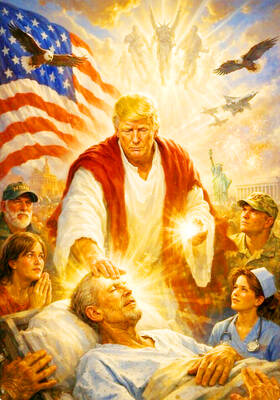
PAPAL RETORT: Pope Leo told reporters that he has ‘no fear, neither of the Trump administration nor speaking out loudly about the message of the Gospel’ US President Donald Trump has feuded with Pope Leo XIV over the Iran conflict — setting off an unholy row that could have serious political implications for the Republican leader back in the US. Trump has drawn barbs even from some allies over the attacks on the US-born pontiff, who has criticized the Trump administration over its immigration crackdown, the intervention in Venezuela and the Iran war. The president risks alienating the religious right in November’s crucial US midterm elections. So far the unprecedented clash between the leader of the most powerful military on Earth and the head of the world’s 1.4 billion

A 16-year-old boy has been charged with murder and aggravated sexual abuse in Florida in the death of his 18-year-old stepsister on a Carnival Cruise ship, the US Department of Justice said on Monday. Timothy Hudson was initially charged in February and subsequently indicted on March 10, but the breadth of the case was not known until a seal was lifted on Friday last week, weeks after US District Judge Beth Bloom in Miami said that he would be prosecuted as an adult at the request of the government. Anna Kepner had been traveling on the Carnival Horizon ship in November last


 RSS
RSS