


Georgia said an aircraft from Russia had violated its airspace, raising tension just weeks after the ex-Soviet republic claimed a plane from Russia launched a missile on its territory near a radar site.
The announcement on Wednesday by Georgia's Foreign Ministry of the incursion on Tuesday into Georgian airspace came as the Georgian and Russian ambassadors to the UN traded accusations about the Aug. 6 incident.
That incident sharply escalated long-standing tensions between Georgia and its giant neighbor over the breakaway regions of South Ossetia -- near where the missile fell -- and Abkhazia.
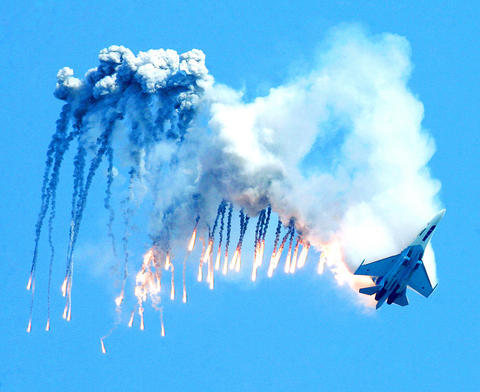
PHOTO: AFP
Russia's UN Ambassador Vitaly Churkin accused Georgia on Tuesday of fabricating claims that a Russian plane entered the country's airspace and dropped a missile on Aug. 6 because it wanted to create "a political tsunami."
Georgia's UN Ambassador Irakli Alasania on Wednesday called the Russian accusation "absurd," saying two groups of international experts who examined the evidence agree that a plane crossed from Russian territory and launched a missile which landed about 5km from a Georgian radar site.
He accused Moscow of attempting on Aug. 6 "to use military force to destabilize a democratic state, and to attempt to influence its domestic and foreign policy."
Alasania said Georgia has concluded that the Aug. 6 incursion was an attempt to "intimidate Georgia and assess Georgian military readiness. It was also an attempt to demonstrate who is ``the major player in the region and ... test how far the international community will go to defend the young Georgian democracy," and to "send a warning message to former Soviet republics and to signal strong support for separatist regimes," he said.
In a possible new Russian provocation, Alasania pointed to the violation of Georgian airspace from Russia on Tuesday and said the Foreign Ministry had sent a note to Moscow "demanding immediate and clear explanations."
Russian air force spokesman Colonel Alexander Drobyshevsky said on Wednesday that no Russian plane had violated Georgia's airspace, the state-run RIA-Novosti news agency reported.
Two groups of independent experts that investigated the Aug. 6 incident agreed that Georgian airspace was violated three times that day by aircraft flying from Russian airspace. The first team was from the US, Sweden, Latvia and Lithuania. The second team, from Estonia, Poland and Britain, said their investigation on Aug. 18 to Aug. 19 found that the last two passes were towards Georgian radar near Gori, and the missile was launched approximately 10km from the radar site.
Churkin told reporters on Tuesday that Russian defense experts who visited Georgia last week concluded there was no evidence of a Russian incursion on Aug. 6.
He cited doubts about Georgia's radar data and its version of the missile launch, suggested that the missile might have been dropped by an SU-25 from the Georgian air force, and asked why Georgia quickly destroyed the central section of the missile with the serial number and year of manufacture and filled in the hole where it landed, two key pieces of evidence.
Russian experts also noted that the remains of the missile included "a small unit with a marking in English" which could not be from a Soviet or Russian missile "as components produced in foreign countries are banned," Churkin said.
Alasania confirmed that two Western-produced electronic chips were found at the site where the missile landed. He said Georgian experts concluded that the missile had been upgraded with these chips so it could detect the country's Soviet radar -- which it could not do with the original Soviet system.
Alasania said he did not know why the hole was covered up but he said the missile was detonated after being extensively photographed because it contained explosives which threatened the lives of Georgian defense experts. The photographs were given to the Russians, he said.

Crowds in Bangladesh are flocking to snap photographs with an unlikely social media star — an albino buffalo with flowing blond hair nicknamed “Donald Trump” that is due to be sacrificed within days. Owner Zia Uddin Mridha, 38, said his brother named the 700kg bull over its flowing helmet of hair resembling the signature look of the US president. “My younger brother picked this name because of the buffalo’s extraordinary hair,” he said at his farm in Narayanganj, just outside the capital, Dhaka. Mridha said that a constant stream of curious visitors — social media fans, onlookers and children — have come throughout
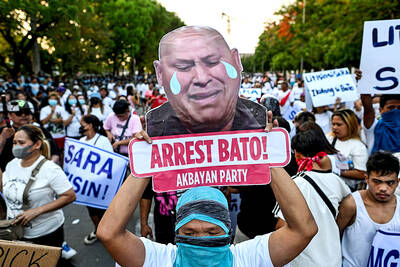
The Philippines said it has asked the country’s Supreme Court to allow it to arrest former Philippine president Rodrigo Duterte’s chief drug war enforcer to stand trial in an international tribunal. The International Criminal Court (ICC) last week unsealed an arrest warrant against Philippine Senator Ronald dela Rosa, accusing him along with Duterte and other “coperpetrators” of the “crime against humanity of murder.” Dela Rosa briefly sought refuge in the Philippine Senate last week while asking the Philippine Supreme Court to stop an ongoing attempt by government agents to arrest him. “By his own conduct, he has placed himself outside the protection of

It began as a satirical online project. Now millions of young people in India are flocking to it as an outlet for their frustration. A parody political party called the Cockroach Janta Party, with the insect as its symbol, has exploded across India’s social media by turning absurdist humor into protest. Memes and short videos mocking corruption, joblessness and political dysfunction have flooded social media sites, where millions of users are embracing the cockroach — known for its ability to survive harsh conditions — as a tongue-in-cheek symbol of endurance. The online movement’s rise has been unusually rapid. The Cockroach Janta Party (CJP)

The researchers in Ireland looked at their computer screen, marveling at a medieval book tracked down in a Roman library. They flipped through its digitized pages and found their sought-after treasure: the oldest surviving English poem. “We were extremely surprised. We were speechless. We couldn’t believe our eyes when we first saw that,” said Elisabetta Magnanti, a visiting research fellow at Trinity College Dublin’s school of English. The poem was also within the main body of Latin text, she said, calling it “extraordinary.” Composed in Old English by a Northumbrian agricultural worker in the 7th century, Caedmon’s Hymn appears within some copies of


 RSS
RSS