


North American leaders wrapped up a two-day summit here on Tuesday, trumpeting consumer protections and other joint efforts, while dismissing charges of plotting to erode national sovereignty.
The trilateral talks were "as cordial as they were constructive," said host Canadian Prime Minister Stephen Harper, flanked by US President George W. Bush and Mexican President Felipe Calderon at a closing press conference.
Canada, the US and Mexico are "independent and interdependent," Harper said. "And we're committed to working together on mutual security, continued economic growth and expanding our unique North American relationship."
The partnership was launched at the first "Three Amigos" summit in Waco, Texas, in March 2005, but has been attacked by activists, labor groups and academics critical of its business focus.
A perceived lack of openness in the negotiations has also provoked the ire of anti-globalization activists, environmentalists, peace activists and civil rights groups -- united in their suspicions of the outcome.
In response, the Canadian prime minister quipped: "A couple of my opposition leaders have speculated on massive water diversions and superhighways on the continent, maybe interplanetary."
And he jabbed at, for example, the different rules for jelly bean contents in Canada and the US, saying: "Is the sovereignty of Canada going to fall apart if we standardize the jelly bean? I don't think so."
The meeting, the third installment of the Security and Prosperity Partnership framework, was aimed at harmonizing rules on trade and security across North America.
Canada, the US and Mexico already form a trading bloc under the 1994 North American Free Trade Agreement (NAFTA). But some academics have called for even greater integration to compete with burgeoning China, India and the EU.
"If you're a US citizen, you want people that live close to you to be prosperous. The more prosperity in your neighborhood, the more hopeful your neighborhood is," Bush said.
NAFTA "has created a lot of political controversy in our respective countries," he conceded, but it "has yielded prosperity."
Trilateral trade had surged from US$293 billion per year to US$883 billion a year, since 1994, he said.
Calderon went further, saying: "We must relaunch in a stronger way the strength of the relationship between the three countries of North America.
"I think this meeting could be the beginning of a new age in the framework of the relationship of the three countries," he said.
The three leaders agreed on joint consumer aegis, following recent recalls of toys, dog food and toothpaste, and growing worries about defective "made in China" goods, imported into North America.
They also broached climate change, upcoming APEC talks, pandemic planning, border security, the Middle East and Haiti "where all three of our countries are working to advance freedom, democracy and development," Harper said.

SPEAKING OUT: After Siranudh Scott’s allegations surfaced, celebrities and public figures took to social media to share their own experiences of sexual misconduct and abuse A high-profile alleged sexual abuse case within a wealthy Thai beer brewing family has prompted a wave of painful accounts from survivors of unconnected abuse in the conservative nation. Siranudh Scott, a member of the billionaire Thai family that founded the ubiquitous Singha beer brand, posted an emotional video this month accusing his elder brother Sunit of repeatedly abusing him when he was a teenager. Sunit, who is in his 30s, later denied the allegations in a video posted online, but Singha parent Boonrawd dismissed him from his executive role with the company on Tuesday last week. “I felt I needed to speak

SEEKING ORDER: Rodrigo Paz said that ‘anyone who wants to destroy the nation will have to deal with this president and the full force of the constitution’ Bolivian President Rodrigo Paz on Wednesday said that the nation was at a “breaking point” after nearly a month of protests that have caused shortages of food, fuel and medicine. Paz, who took office six months ago amid the worst economic crisis there in four decades, is battling a groundswell of fury over his policies. The political capital, La Paz, has been besieged by low-income workers and members of the indigenous majority calling for his resignation. “The country needs order and is reaching breaking point,” the 58-year-old said at a public event in La Paz, renewing his appeal for dialogue. On Tuesday, the Bolivian
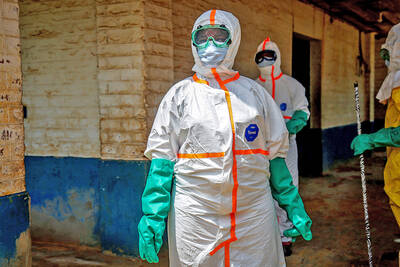
COMMUNITY CONFLICT: Concerns about disease spread from corpses has run up against friends and families’ desire to bury their dead as infection spreads in the area Angry residents of a town at the epicenter of the Ebola outbreak in the Democratic Republic of the Congo (DR Congo) attacked and burned a tent that was part of a health center where people are being treated for the virus, the staff there said Saturday. It was the second such attack in the region in a week. No one was hurt in the attack, according to reports but as patients ran out to escape the fire, 18 people with suspected Ebola infections fled the facility and are unaccounted for, a hospital director said. Angry residents arrived at the clinic in the

Forecasters in Europe yesterday warned of exceptional heat as record temperatures driven by a “heat dome” push temperatures well above seasonal norms across the continent. The surge follows a record-breaking Monday, with France logging its hottest day in the month of May on record, its weather agency said, and the UK also posting unprecedented highs. A so-called “heat dome” of warm air from northern Africa trapped under a high-pressure system over western Europe is behind the high temperatures not usually seen until high summer. Restrictions on outdoor work were imposed in parts of Italy, beaches in southwest France filled earlier than usual and


 RSS
RSS