


Six people were injured and three arrested on Sunday night after clashes between police and climate change protesters near Heathrow airport. No disruption of the airport or major roads was reported, but skirmishes between more than 1,600 police and some 1,400 protesters continued into the night.
Protesters accused the police of using unwarranted force to contain them. Police with truncheons tackled about 100 protesters heading for the offices of the airport operator BAA.
Five people were treated by medical teams for head injuries."It was an unprovoked, unwarranted attack," one spokesman for the Camp for Climate action said.
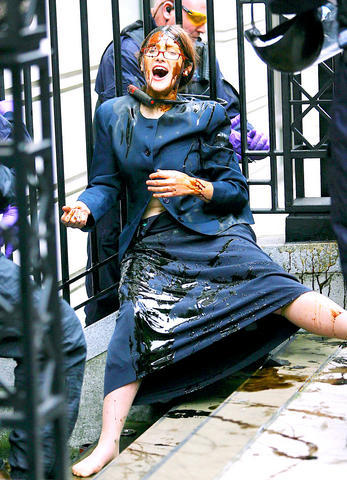
PHOTO: EPA
The police said on Sunday night that no injuries to protesters had been reported but a policeman had been injured after being knocked from his horse. An activist was arrested in connection with the incident.
The activists fanned out to a handful of new locations yesterday, trying to spread their message beyond their camp at BAA's headquarters at Heathrow.
A small group of protesters set up a blockade outside a power station in Suffolk, Camp for Climate organizers said.
A spokesman for British Energy, which runs the Sizewell B plant, confirmed that a small number of protesters were there and said the protest was peaceful.
Police said protesters were demonstrating at the London headquarters of BP Plc. Authorities declined to offer a figure for the number of protesters.
Activists continued to protest outside the administrative offices of BAA at Heathrow yesterday.
BAA said 150 staff members at its administrative offices at Heathrow had been asked not to come to work while the protest continued.
The day of direct action began at noon on Sunday with a peaceful march to the center of Harmondsworth, a village which will be affected by the proposed third runway. It was led by people carrying a large sign saying: "We are armed only with peer reviewed science."
Speakers, including the Guardian columnist George Monbiot and Labout Member of Parliament John McDonnell addressed a crowd of about 300 locals and protesters from the camp. They used a microphone and amplifier powered by a stationary bicycle.
McDonnell criticized his government's policy.
"What we are here for today is first of all to say to this government there will be no third runway. We have been protesting about Heathrow for years. We have got our message across like never before," he said.
Trouble centered on the BAA offices 1km away in Bath road, where several hundred protesters tried to target aviation companies and lay siege to BAA's headquarters.
Using a mixture of carnival and theater, with people dressed as airline staff, clowns, monks, clergy and in business suits, they were mainly contained in the building's car park. Police brought in horses and reinforcements, but there was little disruption of traffic.
Protesters leaving the camp to try to get to the BAA building were met by riot police in a field of oilseed rape. Skirmishes continued for 40 minutes with the police chasing and eventually corralling more than 100 people into a circle. The protesters continued to sing and dance.
A combination of rain and the likelihood of being stopped on terrorism charges is thought to have limited numbers on the demonstrations to about 1,500 people. However, more than 300 local people marched to object to a third runway.
"We said all along that we had no intention of stopping people going on holiday," a camp spokeswoman said. "We have been peaceful at every point. The police have over-responded at every point and we have been continually smeared as potential terrorists."
One man said he was attacked in the field between the camp and the BAA building. Mike Hill, 25, a nursing assistant from Reading, had a bloody nose after clashing with police.
"I was walking along with the group when a lot of riot police rushed up and I got pushed to the ground and kicked in the face. I couldn't see their faces because they were wearing balaclavas and helmets, but I am definitely going to file a complaint with the Independent Police Complaints Commission," he said.

‘CROSSING THE LINE’: China’s embassy in Seoul criticized US Forces Korea Commander General Xavier Brunson, asking if his ‘hostile’ remarks were authorized by Washington South Korea and the US are in talks over recent public remarks by the commander of US Forces Korea, Seoul’s presidential office said yesterday, after the comments drew sharp criticism from China. In a recent podcast interview, US Forces Korea Commander General Xavier Brunson described South Korea as “the dagger in the heart of Asia” from China’s east coast, prompting the Chinese embassy in Seoul to say that he had “truly crossed the line.” The interview came amid growing speculation that Washington might seek to expand the role of US Forces Korea in countering the growing regional influence of China, a key

Through the noise of rushing papers and whirring belts at a print factory in Kyoto, two creators watch their photo essay come to life in broadsheet form — part of an effort to win new audiences in the age of artificial intelligence (AI). Despite the decline of the publishing industry, self-publication and handmade “zine” magazines are growing in popularity in Japan, reflecting the nation’s enduring love of paper in the digital era. While speaking to Agence France-Presse at the plant, his hands black with ink, one of the creators, Kazuma Obara, said: “I think [paper] is a medium that engages all five

Australian researchers have trained lab-grown brain cells on a silicon computer chip to play the 1990s shooter game Doom and said they are just scratching the surface of what the neurons could be capable of doing. It is the science-fiction work of biotech boffins at Cortical Labs, who researched and developed the technology that harnesses the workings of the brain’s networking system. Each so-called “biological computer” contains about 200,000 living human brain cells, grown from stem cells that were harvested from blood donations. Having mastered the simple computer game Pong, where a paddle is moved up and down to send a ball

France experienced its hottest spring on record, the French weather service said on Tuesday, after an exceptional early heat wave that also broke highs for the season in England and Wales. Meteo-France said the average nationwide temperature over March to May was 13.8°C — about 1.7°C above the norm, and surpassing records set in 2011 and 2020. “The warmest spring since records began in 1900,” it said in a bulletin. All three months were warmer than average, but the onset of an “unprecedented heatwave” late last month pushed the mercury to highs typically seen at the height of the summer. “Our country had never


 RSS
RSS