


Health authorities in Peru yesterday battled the spread of infectious diseases in the wake of Wednesday's devastating earthquake as Peruvian President Alan Garcia threatened a curfew to stop looting.
"I have ordered to use the harshest measures and if needed to impose a curfew," Garcia told reporters in Pisco, the town hit hardest by Wednesday's quake, where he has been monitoring rescue efforts since Friday.
Amid increasing reports of looting and assaults, Garcia on Saturday ordered more troops to the quake-stricken area and promised that authorities would keep the peace "whatever the cost."
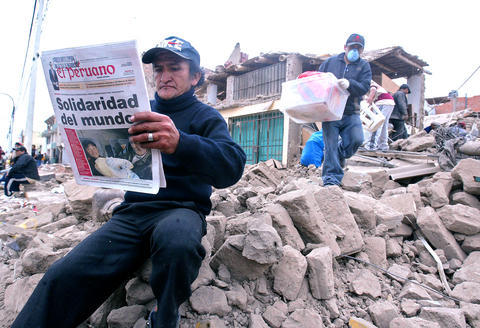
PHOTO: AFP
Garcia played down reports of looting in Pisco and Chincha, saying they were nothing more than "rumors," but a RPP radio reporter in Chincha broke down in tears describing the prevailing lawlessness in the city which he said the earthquake had devastated and left at the mercy of marauding gangs of armed thugs.
A government statement out of Lima, meanwhile, said 1,000 military have been sent to assist 2,000 police in patrolling streets in Pisco, Chincha, Ica and Canete, with orders to "deal firmly" with looting.
A Spanish team helping rescuers was shot at, sparking alarm but resulting in no injuries, a member of the squad said.
Also in this coastal city 240km southeast of Lima, Health Minister Carlos Vallejos said that some 1,500 doctors and nurses were struggling to prevent the spread of epidemic diseases among earthquake victims.
On the third day after Wednesday's massive 8.0 magnitude earthquake, the official toll remained at 500 and more than 1,600 injured.
But the number of missing is still unknown, and lacking official figures, news media estimate the number of people affected by the quake at 200,000.
There was a ray of hope on Pisco on Saturday when a baby was born in a field hospital in the city's main square.
Garcia took the baby in his arms calling it "a breath of life ... a miracle amid crumbling walls and the pain."
Around two-thirds of Pisco was destroyed, leaving many of its 130,000 inhabitants homeless and an unknown number of dead still beneath the rubble of collapsed homes, shops and other buildings.
Desperate survivors tried to raid a Pisco food store. The mob was chased off when the owners fired their weapons into the air.
Mobs looted trucks carrying food and water, and some people tried to break into the air force base where relief efforts have been centralized.
Hours later, close to the provincial capital of Ica, another mob tried to raid a convoy of trucks carrying emergency supplies.
In nearby Chincha, a group of people tried to break into a hospital believing it held emergency food supplies, hospital director Jorge Barrera said.
"People are complaining they're not getting any assistance, but that's not the problem, the problem is lack of security," said firefighter Mario Paredes, who was robbed of all his rescue equipment outside Chincha late on Friday.
At the Pisco air base, Garcia said he was determined to prevent chaos.
"My obligation is to impose order, and order we will impose today, whatever the cost," he said.
Aftershocks continued to keep people on edge. Peru's geophysical institute reported more than 400 tremors following the quake, which was the most devastating to hit the country since 1970.
People attended an open-air mass late on Saturday at the site of Pisco's San Clemente cathedral that collapsed during the earthquake killing an untold number of people inside.
Vallejos said his attention was now turned to the risk of infectious diseases in the quake-stricken areas -- respiratory problems, tetanus and diarrhea and cholera.
"The problem is not only that there are still unfound bodies, the problem is water," and how human waste is being disposed of, he said.
Vallejos said that battlefield hospitals had opened at the base.
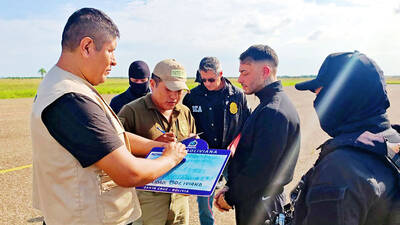
KINGPIN: Marset allegedly laundered the proceeds of his drug enterprise by purchasing and sponsoring professional soccer teams and even put himself in the starting lineups Notorious Latin American narco trafficker Sebastian Marset, who eluded police for years, was handed over to US authorities after his arrest on Friday in Bolivia. Marset, a Uruguayan national who was on the US most-wanted list, was passed to agents of the US Drug Enforcement Administration at Santa Cruz airport in Bolivia, then put on a US airplane, Bolivian state television showed. “The arrest and deportation were carried out pursuant to a court order issued by the US justice system,” Bolivian Minister of Government Marco Antonio Oviedo told reporters. The alleged kingpin was arrested in an upscale neighborhood of Santa
ACTIONABLE ADVICE: The majority of chatbots tested provided guidance on weapons, tactics and target selections, with Perplexity and Meta AI deemed to be the least safe From school shootings to synagogue bombings, leading artificial intelligence (AI) chatbots helped researchers plot violent attacks, according to a study published on Wednesday that highlighted the technology’s potential for real-world harm. Researchers from the nonprofit watchdog Center for Countering Digital Hate and CNN posed as 13-year-old boys in the US and Ireland to test 10 chatbots, including ChatGPT, Google Gemini, Perplexity, Deepseek and Meta AI. Eight of the chatbots assisted the make-believe attackers in more than half the responses, providing advice on “locations to target” and “weapons to use” in an attack, the study said. The chatbots had become a “powerful accelerant for
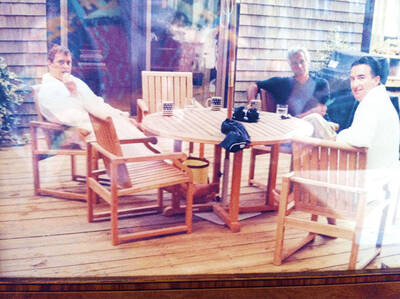
SCANDAL: Other images discovered earlier show Andrew bent over a female and lying across the laps of a number of women, while Mandelson is pictured in his underpants A photograph of former British prince Andrew and veteran politician Peter Mandelson sitting in bathrobes alongside late sex offender Jeffrey Epstein was unearthed on Friday in previously published documents. The image is believed to be the first known photograph of the two men with Epstein. They are currently engulfed in scandal in the UK over their ties to their mutual friend. The undated photograph, first reported by ITV News, shows King Charles III’s disgraced brother and former British ambassador to the US sitting barefoot outside on a wooden deck. They appear to have mugs with a US flag on them
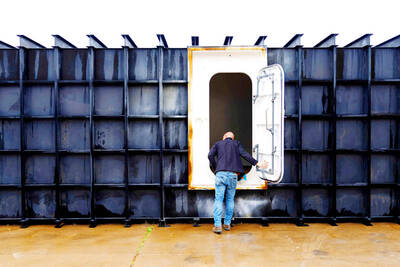
Since the war in the Middle East began nearly two weeks ago, the telephone at Ron Hubbard’s bomb shelter company in Texas has not stopped ringing. Foreign and US clients are rushing to buy his bunkers, seeking refuge in case of air raids, nuclear fallout or apocalypse. With the US and Israel pounding Iran, and Tehran retaliating with strikes across the region, Hubbard has seen demand for his product soar, mostly from Gulf nation customers in Bahrain, Qatar, Kuwait and the United Arab Emirates. “You can imagine how many people are thinking: ‘I wish I had a bomb shelter,’” Hubbard, 63, said in


 RSS
RSS