


The presidents of Russia, China and four Central Asian states attended unprecedented joint military exercises yesterday, intended as a display of strength before the Western world.
The vast show of firepower at a training ground in the Russian province of Chelyabinsk near the Kazakh border was the culmination of a nine-day exercise dubbed "Peace Mission 2007" that began in northwest China.
It involved some 6,000 personnel from the six countries of the Shanghai Cooperation Organization (SCO): China, Kazakhstan, Kyrgyzstan, Russia, Tajikistan and Uzbekistan.
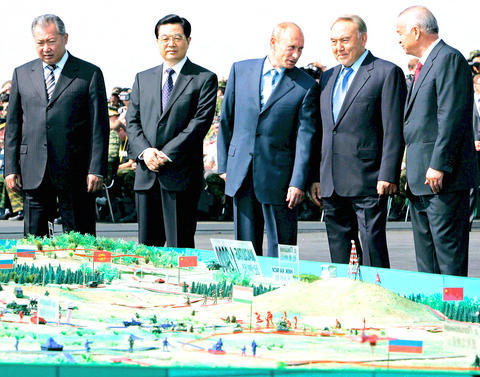
PHOTO: EPA
A lone bugle player formally opened the exercises and helicopters, fighter jets and ground forces began using mock munitions to pound some 1,000 "terrorists" who had taken over a village fabricated for the exercises.
While Russia footed most of the bill for its phase of the exercises, spending some US$80 million, they marked a new level of military cooperation with China after the two countries held their first-ever joint maneuvers two years ago.
Beijing contributed 1,700 personnel and has sent war planes and helicopters to the Chebarkul training ground in the rolling Urals countryside.
The SCO grew out of a regional effort in the mid-1990s to reduce military forces along common borders and has evolved into military and economic cooperation, with the focus on Central Asia.
A glistening podium had been set up for the presidents overlooking the mock village at the center of the assault, from which surviving "insurgents" were later to try to flee across a hypothetical national border.
The exercises come after Thursday's summit where SCO leaders underlined their common opposition to perceived US hegemony. The summit was held in the former Soviet state of Kyrgyzstan, with Iranian President Mahmoud Ahmadinejad observing.
Russian media have highlighted the exercises' resemblance to an uprising in the Central Asian state of Uzbekistan in 2005. The Uzbek security forces' heavy-handed response has been called a massacre by human rights researchers, and hundreds were allegedly killed.
Russian President Vladimir Putin rallied to Uzbekistan's side on that occasion and has likened US moves to foster democracy in Central Asia to "a bull in a china shop."
China meanwhile still views Central Asia's Fergana Valley as "virtually the main breeding ground for instability in the region," commented Russia's Kommersant newspaper on Thursday.

‘CROSSING THE LINE’: China’s embassy in Seoul criticized US Forces Korea Commander General Xavier Brunson, asking if his ‘hostile’ remarks were authorized by Washington South Korea and the US are in talks over recent public remarks by the commander of US Forces Korea, Seoul’s presidential office said yesterday, after the comments drew sharp criticism from China. In a recent podcast interview, US Forces Korea Commander General Xavier Brunson described South Korea as “the dagger in the heart of Asia” from China’s east coast, prompting the Chinese embassy in Seoul to say that he had “truly crossed the line.” The interview came amid growing speculation that Washington might seek to expand the role of US Forces Korea in countering the growing regional influence of China, a key

SEEKING ORDER: Rodrigo Paz said that ‘anyone who wants to destroy the nation will have to deal with this president and the full force of the constitution’ Bolivian President Rodrigo Paz on Wednesday said that the nation was at a “breaking point” after nearly a month of protests that have caused shortages of food, fuel and medicine. Paz, who took office six months ago amid the worst economic crisis there in four decades, is battling a groundswell of fury over his policies. The political capital, La Paz, has been besieged by low-income workers and members of the indigenous majority calling for his resignation. “The country needs order and is reaching breaking point,” the 58-year-old said at a public event in La Paz, renewing his appeal for dialogue. On Tuesday, the Bolivian

Through the noise of rushing papers and whirring belts at a print factory in Kyoto, two creators watch their photo essay come to life in broadsheet form — part of an effort to win new audiences in the age of artificial intelligence (AI). Despite the decline of the publishing industry, self-publication and handmade “zine” magazines are growing in popularity in Japan, reflecting the nation’s enduring love of paper in the digital era. While speaking to Agence France-Presse at the plant, his hands black with ink, one of the creators, Kazuma Obara, said: “I think [paper] is a medium that engages all five

Australian researchers have trained lab-grown brain cells on a silicon computer chip to play the 1990s shooter game Doom and said they are just scratching the surface of what the neurons could be capable of doing. It is the science-fiction work of biotech boffins at Cortical Labs, who researched and developed the technology that harnesses the workings of the brain’s networking system. Each so-called “biological computer” contains about 200,000 living human brain cells, grown from stem cells that were harvested from blood donations. Having mastered the simple computer game Pong, where a paddle is moved up and down to send a ball


 RSS
RSS