


The Pentagon cannot account for 190,000 AK-47 rifles and pistols given to Iraqi security forces in 2004 and 2005, or about half the weapons earmarked for soldiers and police, according to a government report.
The Government Accountability Office (GAO), the investigative arm of the US Congress, said in a July 31 report that 135,000 items of body armor were missing out of a total of 215,000, despite the fact that even some US soldiers lacked this life-saving equipment, particularly in the early stages of the war.
Assessing the causes of the problem, congressional investigators cited the Pentagon's inadequate accountability procedures and "the lack of a fully developed network to distribute the equipment."
The GAO said the Pentagon concurred with its findings and has begun a review to ensure full accountability for the program to train and equip Iraqi forces.
The report raised concerns that weapons provided by the US could be falling into the hands of Iraqi insurgents, just as lawmakers and policymakers in Washington await next month's report on the success of US President George W. Bush's surge strategy for stabilizing Baghdad.
One senior Pentagon official told the Washington Post some weapons probably were being used against US troops. He said an Iraqi brigade created in Fallujah disintegrated in 2004 and began fighting US soldiers.
Many in Washington view the development of effective Iraqi army and police forces as a vital step toward reducing the number of US troops in Iraq.
Congress funded the program for Iraqi security forces outside traditional security assistance programs, providing the Pentagon with a large degree of flexibility in managing the effort, the GAO said.
"Officials stated that since the funding did not go through traditional security assistance programs, the DOD [Department of Defense] accountability requirements normally applicable to these programs did not apply," the GAO report said.
Military officials in Iraq reported issuing 355,000 weapons to Iraqi security forces from June 2004 through September 2005, including 185,000 rifles and 170,000 pistols, the GAO said.
But the DOD could not account for 110,000 rifles and 80,000 pistols, the GAO said. Those sums amount to about 54 percent of the total weapons distributed to the Iraqi forces.
The GAO quoted officials as saying the agency responsible for handling weapons distribution was too short-staffed to record information on individual items given to Iraqi forces.
Accountability procedures also could not be fully implemented because of the need to equip Iraqi forces rapidly for combat operations, the GAO found.
The disclosure, made in a report released by the GAO, comes ahead of a crucial review of US military operations that may pave the way for a reassessment of the US role in the violence-ravaged country.
The top US military commander in the country, General David Petraeus, and US Ambassador Ryan Crocker are scheduled to report to Congress by the middle of next month on whether efforts to halt sectarian violence and return Iraq to viable self-governance were bearing fruit.
Creating efficient security forces capable of taking over counterinsurgency operation from the US has been a linchpin of this strategy.
The US has spent about US$19.2 billion since the beginning of the war to equip and train Iraqi security forces that are supposed to gradually replace US troops in providing security for the country.
This total, according to the GAO, included at least US$2.8 billion used to purchase and transport weapons and other military equipment necessary to improve the Iraqi arsenal.
Deputy Assistant Defense Secretary Mark Kimmitt said in response that the defense department was "reviewing policies and procedures to ensure US-funded equipment reaches the intended Iraqi security forces under the Iraq program."
But both the GAO and the Pentagon have sidestepped the larger question of what has happened to the unaccounted weapons -- and whether some of them could have found their way into the hands of anti-US insurgents.
Meanwhile, Rhea Myerscough and Rachel Stohl, security analysts with the Center for Defense Information, a local think tank, pointed out that this indeed was likely to have been the case.
They noted in a recent study that black market sales of small arms have increased in Iraq, most noticeably right before the 2005 elections.
"The US military has also noted that weapons originally supplied by the US and its allies to the Iraqi police have been showing up on the streets and on the black market, likely diverted by theft, loss, or by officers who kept their weapons after quitting the police force," Myerscough and Stohl wrote.

Australians were downloading virtual private networks (VPNs) in droves, while one of the world’s largest porn distributors said it was blocking users from its platforms as the country yesterday rolled out sweeping online age restriction. Australia in December became the first country to impose a nationwide ban on teenagers using social media. A separate law now requires artificial intelligence (AI)-powered chatbot services to keep certain content — including pornography, extreme violence and self-harm and eating disorder material — from minors or face fines of up to A$49.5 million (US$34.6 million). The country also joined Britain, France and dozens of US states requiring
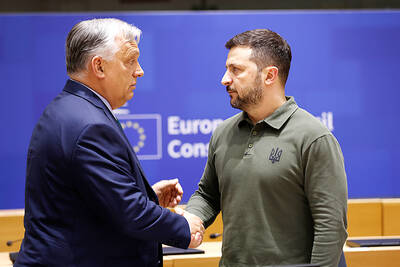
Hungarian authorities temporarily detained seven Ukrainian citizens and seized two armored cars carrying tens of millions of euros in cash across Hungary on suspicion of money laundering, officials said on Friday. The Ukrainians were released on Friday, following their detention on Thursday, but Hungarian officials held onto the cash, prompting Ukraine to accuse Hungary’s Russia-friendly government of illegally seizing the money. “We will not tolerate this state banditism,” Ukrainian Minister of Foreign Affairs Andrii Sybiha said. The seven detained Ukrainians were employees of the Ukrainian state-owned Oschadbank, who were traveling in the two armored cars that were carrying the money between Austria and
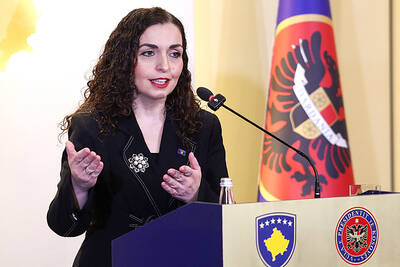
Kosovar President Vjosa Osmani on Friday after dissolving the Kosovar parliament said a snap election should be held as soon as possible to avoid another prolonged political crisis in the Balkan country at a time of global turmoil. Osmani said it is important for Kosovo to wrap up the upcoming election process and form functional institutions for political stability as the war rages in the Middle East. “Precisely because the geopolitical situation is that complex, it is important to finish this electoral process which is coming up,” she said. “It is very hard now to imagine what will happen next.” Kosovo, which declared

MORE BANS: Australia last year required sites to remove accounts held by under-16s, with a few countries pushing for similar action at an EU level and India considering its own ban Indonesia on Friday said it would ban social media access for children under 16, citing threats from online pornography, cyberbullying, online fraud and Internet addiction. “Accounts belonging to children under 16 on high-risk platforms will start to be deactivated, beginning with YouTube, TikTok, Facebook, Instagram, Threads, X, Bigo Live and Roblox,” Indonesian Minister of Communications and Digital Meutya Hafid said. “The government is stepping in so that parents no longer have to fight alone against the giants of the algorithm. Implementation will begin on March 28, 2026,” she said. The social media ban would be introduced in stages “until all platforms fulfill their


 RSS
RSS