

Japan's resurgent opposition yesterday blasted Japanese Prime Minister Shinzo Abe for staying in office despite an election mauling and vowed to fight to stop him extending support to the US military in Afghanistan.
Abe, an outspoken conservative who supports a larger military role for officially pacifist Japan, suffered a major setback on Sunday as voters ousted his party from the upper house of parliament.
But Abe has vowed to stay in office, insisting that voters supported his broader agenda despite their anger over scandals and the creaky pension system.
Abe "is trying to get away with such senseless conduct, trying to keep his Cabinet in charge even after his party lost the majority," said Ichiro Ozawa, leader of the main opposition Democratic Party of Japan.
"I don't think he will gain people's support and understanding by doing something so selfish," Ozawa said at a party meeting.
It was his first appearance since his party's historic win on Sunday over Abe's Liberal Democratic Party (LDP), which has ruled Japan for most of the past half-century. Ozawa, who has a history of health problems, had taken a rest due to fatigue after the election campaign.
The LDP maintains a large majority in the more powerful lower house, meaning it can stay in power and override votes by the opposition-led upper house.
But the opposition made clear it would work against any extension of laws allowing Japanese ships to provide fuel and other logistical support to US-led forces in Afghanistan.
"We have opposed the bills in the past. There is no way we will turn around and support them now," Ozawa said. "If opposition parties cooperate, we could pass a bill that states our position."
Japan has been constitutionally prohibited from using its armed forces since defeat in World War II. Abe, Japan's first prime minister born after the war, has made rewriting the Constitution a priority.
Japan passed laws after the Sept. 11, 2001, attacks that allowed participation in the US-led "war on terrorism," paving the way for the Indian Ocean mission.
Japanese Defense Minister Yuriko Koike has called for Japan to extend the law when it expires on Nov. 1, although the government said no decision has been taken.
"We will decide which direction Japan will take by using our own judgement after taking various factors into account," chief government spokesman Yasuhisa Shiozaki told reporters.
The conservative Yomiuri Shimbun said the legislation on the Indian Ocean mission would be a key test on whether the opposition party was "sensible and responsible."
"If confusion arises from legislative procedures taken to extend the law, it could send the international community a garbled message about Japan's attitude toward the anti-terrorism campaign," the Yomiuri said in an editorial.
The Indian Ocean mission was groundbreaking at the time. Japan later took the historic step of deploying its military to Iraq.
Japan withdrew the troops from Iraq last year but continues to fly goods and personnel into the country on behalf of the US-led coalition and UN.
The Japanese parliament extended the Iraq mission, which the opposition also opposes, just ahead of the election.
Also see story:
Japanese politics taking an unprecedented turn

Philippine Secretary of National Defense Gilberto Teodoro Jr on Tuesday hit out at China at an international forum after a memo asserting Beijing’s position over their longstanding maritime dispute was delivered to him while he was speaking on stage. The unusual incident was captured on video at the Seoul Defense Dialogue as the secretary was responding to a question about “gray zone” coercion in the South China Sea. The video shows what appears to be a conference staffer placing it on the table next to him while speaking. “I have a note here, I think this is from China,” he said, describing

Thai police yesterday said that they arrested a senior Buddhist monk on suspicion of embezzling US$2.8 million intended for his monastery, alongside a suspected female accomplice he was having sex with. The case is the latest scandal to hit the clergy in Buddhist-majority Thailand after a sex and extortion case involving senior monks last year prompted public outrage and calls for greater scrutiny of temple finances. Phra Wachirayan Wi, the 66-year-old abbot of the 14th-century Wat Phutthaisawan in the ancient capital of Ayutthaya, was arrested on Thursday on charges including embezzlement and money laundering, lead police investigator Pattanasak Bupphasuwan said. A 47-year-old woman

SECRET FOOTAGE: A 17-year-old girl told British broadcaster Channel 4 that she had been approached by a man who covertly recorded her and their interaction Calls are growing louder in Europe for action against “pervert” smart glasses after secretly filmed footage of girls and women appeared online — with a petition in Britain demanding a ban on their sale. Anyone wearing smart glasses can take photos, film videos, listen to music, make phone calls, translate text or interact with an artificial intelligence (AI) assistant, with sales now hitting millions. The devices grabbed attention this summer after a marketing tie-up between Kylie Jenner, beauty mogul and member of the Kardashian dynasty, and tech giant Meta. Since smartphones are now embedded in daily life, “big tech” is
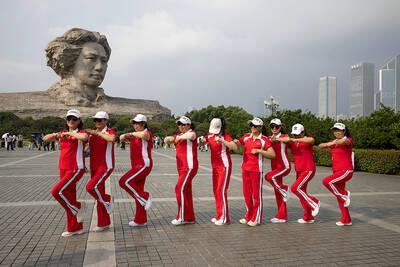
China yesterday marked half a century since the death of Mao Zedong (毛澤東), founder of the People’s Republic, who brought roughly one-quarter of the world’s population under communist rule and whose specter still haunts China’s future. Mao’s death on Sept. 9, 1976, at age 82, mourned by many and welcomed by some who suffered under his nearly three-decade rule, also hastened the end of the Cultural Revolution, a frenzied mass movement he launched in 1966. The party later condemned the Cultural Revolution as a grave error for which Mao bore primary responsibility, but still reveres him, saying his achievements outweigh his mistakes. Mao’s


 RSS
RSS