


Beleaguered Japanese Prime Minister Shinzo Abe pleaded yesterday with voters to trust him to carry out reforms, on the eve of an election predicted to hand a crushing defeat to the conservative leader.
Abe has long championed reforms to erase the legacies of Japan's World War II defeat, including the rewriting of the US-imposed 1947 pacifist Constitution.
But the Liberal Democratic Party (LDP) leader has recently refocused his reformist message on fixing the pension system and other economic issues amid slipping popularity.
"The LDP will continue to keep pushing reforms. Please give us strength. Please give us a victory," Abe shouted by microphone at a rally in one of Tokyo's top shopping districts.
With newspaper headlines blaring "Political confusion inevitable after the polls" and "the LDP in adverse winds," Abe was scheduled to tour bustling urban areas on the last day of campaign in an apparent bid to attract non-affiliated voters.
Ichiro Ozawa, who heads the main opposition Democratic Party, has focused on rural areas in a strategy aimed at appealing to farmers and others who feel left behind by the economic reforms under Abe's predecessor Junichiro Koizumi.
Ozawa was to due to spend the final campaign day in western cities some 600km from the capital.
Polls by the Japanese media showed that Abe's coalition was on course for a major defeat in today's election, which involves the upper house of parliament and not the more powerful lower house.
The lower house selects the prime minister, but upper house votes are usually regarded as a referendum on the government.
Previous premiers have quit after suffering setbacks, although Abe's aides insist he is not considering resignation.
Public interest in today's polls has been high, with absentee voting by July 22 up a sharp 54 percent from the last upper-house elections in 2004.
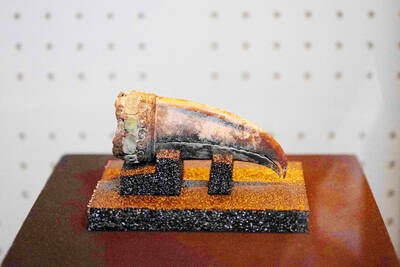
Archeologists in Peru on Thursday said they found the 5,000-year-old remains of a noblewoman at the sacred city of Caral, revealing the important role played by women in the oldest center of civilization in the Americas. “What has been discovered corresponds to a woman who apparently had elevated status, an elite woman,” archeologist David Palomino said. The mummy was found in Aspero, a sacred site within the city of Caral that was a garbage dump for more than 30 years until becoming an archeological site in the 1990s. Palomino said the carefully preserved remains, dating to 3,000BC, contained skin, part of the
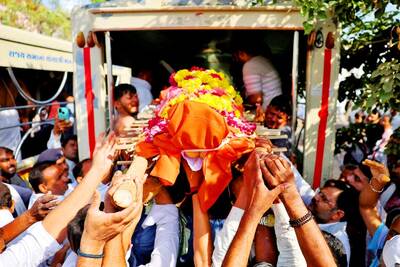
‘WATER WARFARE’: A Pakistani official called India’s suspension of a 65-year-old treaty on the sharing of waters from the Indus River ‘a cowardly, illegal move’ Pakistan yesterday canceled visas for Indian nationals, closed its airspace for all Indian-owned or operated airlines, and suspended all trade with India, including to and from any third country. The retaliatory measures follow India’s decision to suspend visas for Pakistani nationals in the aftermath of a deadly attack by shooters in Kashmir that killed 26 people, mostly tourists. The rare attack on civilians shocked and outraged India and prompted calls for action against their country’s archenemy, Pakistan. New Delhi did not publicly produce evidence connecting the attack to its neighbor, but said it had “cross-border” links to Pakistan. Pakistan denied any connection to

TRUMP EFFECT: The win capped one of the most dramatic turnarounds in Canadian political history after the Conservatives had led the Liberals by more than 20 points Canadian Prime Minister Mark Carney yesterday pledged to win US President Donald Trump’s trade war after winning Canada’s election and leading his Liberal Party to another term in power. Following a campaign dominated by Trump’s tariffs and annexation threats, Carney promised to chart “a new path forward” in a world “fundamentally changed” by a US that is newly hostile to free trade. “We are over the shock of the American betrayal, but we should never forget the lessons,” said Carney, who led the central banks of Canada and the UK before entering politics earlier this year. “We will win this trade war and
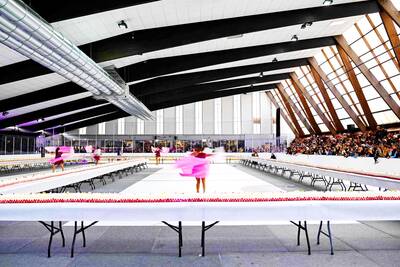
Armed with 4,000 eggs and a truckload of sugar and cream, French pastry chefs on Wednesday completed a 121.8m-long strawberry cake that they have claimed is the world’s longest ever made. Youssef El Gatou brought together 20 chefs to make the 1.2 tonne masterpiece that took a week to complete and was set out on tables in an ice rink in the Paris suburb town of Argenteuil for residents to inspect. The effort overtook a 100.48m-long strawberry cake made in the Italian town of San Mauro Torinese in 2019. El Gatou’s cake also used 350kg of strawberries, 150kg of sugar and 415kg of


 RSS
RSS