


Several journalists sued the Arkansas prisons chief, demanding he let witnesses see the entire execution process and not just when poison flows into condemned inmates.
Arkansas does not allow media and public witnesses to watch as intravenous tubes are inserted and removed from the inmates. The curtains to the execution chamber open to witnesses after the condemned prisoner is already strapped to the gurney, and close once the inmate is dead.
"Witnesses should be allowed to see the entire process, including strapping the condemned down and the insertion of needles," reads the lawsuit, filed on Wednesday in federal court. "The public has a First Amendment right to view executions from the moment the condemned is escorted into the execution chamber."
The procedures vary among US states that have capital punishment. But several, including Virginia and South Carolina, keep the curtains closed while the tubes are inserted.
The lawsuit was filed by the American Civil Liberties Union of Arkansas on behalf of the Northwest Arkansas Chapter of the Society of Professional Journalists, the Arkansas Times Inc and the editor of the Arkansas Times. It was filed against Larry Norris, director of the Arkansas Department of Corrections.
Department spokeswoman Dina Tyler disputed the First Amendment claim.
"The foundation of this lawsuit has a large fault running through it and that is, it assumes that executions in Arkansas are public events, when state law declares them to be exactly the opposite, to be private," she said.
In August 2002, the 9th US Circuit Court of Appeals in San Francisco ruled the public has a constitutional right to view executions from the beginning, including procedures involved with putting an inmate to death. Its decision is not binding on states outside the 9th Circuit, which covers the western states, Alaska and Hawaii.
In early 2003, the California Department of Corrections stopped its legal battle and decided to allow the media to witness the executions in full.
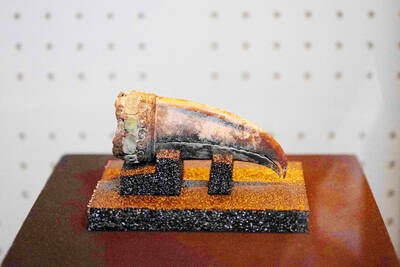
Archeologists in Peru on Thursday said they found the 5,000-year-old remains of a noblewoman at the sacred city of Caral, revealing the important role played by women in the oldest center of civilization in the Americas. “What has been discovered corresponds to a woman who apparently had elevated status, an elite woman,” archeologist David Palomino said. The mummy was found in Aspero, a sacred site within the city of Caral that was a garbage dump for more than 30 years until becoming an archeological site in the 1990s. Palomino said the carefully preserved remains, dating to 3,000BC, contained skin, part of the

TRUMP EFFECT: The win capped one of the most dramatic turnarounds in Canadian political history after the Conservatives had led the Liberals by more than 20 points Canadian Prime Minister Mark Carney yesterday pledged to win US President Donald Trump’s trade war after winning Canada’s election and leading his Liberal Party to another term in power. Following a campaign dominated by Trump’s tariffs and annexation threats, Carney promised to chart “a new path forward” in a world “fundamentally changed” by a US that is newly hostile to free trade. “We are over the shock of the American betrayal, but we should never forget the lessons,” said Carney, who led the central banks of Canada and the UK before entering politics earlier this year. “We will win this trade war and

‘BODIES EVERYWHERE’: The incident occurred at a Filipino festival celebrating an anti-colonial leader, with the driver described as a ‘lone suspect’ known to police Canadian police arrested a man on Saturday after a car plowed into a street party in the western Canadian city of Vancouver, killing a number of people. Authorities said the incident happened shortly after 8pm in Vancouver’s Sunset on Fraser neighborhood as members of the Filipino community gathered to celebrate Lapu Lapu Day. The festival, which commemorates a Filipino anti-colonial leader from the 16th century, falls this year on the weekend before Canada’s election. A 30-year-old local man was arrested at the scene, Vancouver police wrote on X. The driver was a “lone suspect” known to police, a police spokesperson told journalists at the
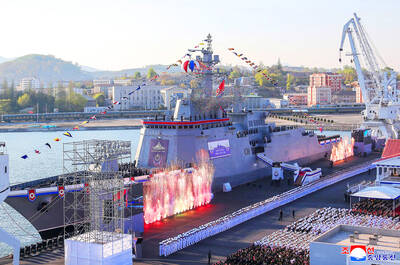
North Korean leader Kim Jong-un has unveiled a new naval destroyer, claiming it as a significant advancement toward his goal of expanding the operational range and preemptive strike capabilities of his nuclear-armed military, state media said yesterday. North Korea’s state-run Korean Central News Agency (KCNA) said Kim attended the launching ceremony for the 5,000-tonne warship on Friday at the western port of Nampo. Kim framed the arms buildup as a response to perceived threats from the US and its allies in Asia, who have been expanding joint military exercises amid rising tensions over the North’s nuclear program. He added that the acquisition


 RSS
RSS