


Documents show that eight US congressional leaders were briefed about the Bush administration's terrorist surveillance program on the eve of its expiration in 2004, contradicting sworn Senate testimony this week by Attorney General Alberto Gonzales.
The documents come as senators consider whether a perjury investigation should be opened into conflicting accounts about the program and a dramatic March 2004 confrontation leading up to its potentially illegal reauthorization.
A spokesman maintained on Wednesday that the attorney general stood by his testimony.
At a heated Senate Judiciary Committee hearing on Tuesday, Gonzales repeatedly testified that the issue at hand was not about the terrorist surveillance program, which allowed the National Security Agency to eavesdrop on suspects in the US without receiving court approval.
Instead, Gonzales said, the emergency meetings on March 10, 2004, focused on a program that he would not describe.
testified
Gonzales, who was then serving as counsel to President George W. Bush, testified that the White House Situation Room briefing sought to inform congressional leaders about the pending expiration of the unidentified program and Justice Department objections to renew it. Those objections were led by then deputy attorney general Jim Comey, who questioned the program's legality.
"The dissent related to other intelligence activities," Gonzales testified at Tuesday's hearing. "The dissent was not about the terrorist surveillance program."
"Not the TSP?" responded Senator Charles Schumer of New York. "Come on. If you say it's about other, that implies not. Now say it or not."
"It was not," Gonzales replied.
"It was about other intelligence activities," he said.
A four-page memo from the national intelligence director's office shows that the White House briefing with the eight lawmakers on March 10, 2004, was about the terror surveillance program.
The memo, dated May 17 last year, and addressed to then House speaker Dennis Hastert, details "the classification of the dates, locations and names of members of Congress who attended briefings on the terrorist surveillance program," wrote then director of National Intelligence John Negroponte.
It shows that the briefing in March 2004 was attended by the Republican and Democratic House and Senate leaders and top Intelligence Committee members, as Gonzales testified.
Bush acknowledged the existence of the classified surveillance program in December 2005 after it was revealed by the New York Times.
Asked for comment on the documents on Wednesday, Justice spokesman Brian Roehrkasse said Gonzales "stands by his testimony."
"The disagreement referenced by Jim Comey in March 2004 was not about the particular intelligence activity that has been publicly described by the president," Roehrkasse said. "It was about other highly classified intelligence activities that have been briefed to the intelligence committees."
confrontation
The disagreement over whether to renew the program led to a dramatic, and highly controversial, confrontation between Gonzales and then attorney general John Ashcroft.
After briefing the congressional leaders, Gonzales testified that he and then White House chief of staff Andy Card headed to a Washington hospital room, where a sedated Ashcroft was recovering from surgery. Ashcroft had already turned over his powers to Comey.
Comey was in the hospital room as well, and recounted to senators in testimony in May that he "thought I just witnessed an effort to take advantage of a very sick man, who did not have the powers of the attorney general because they had been transferred to me."
Ultimately, Ashcroft sided with Comey, and Gonzales and Card left the hospital after a five to six minute conversation.
Gonzales denied he and Card tried to pressure Ashcroft into approving the program over Comey's objections.
"We never had any intent to ask anything of him if we did not feel that he was competent," Gonzales told the Senate. "At the end of his description of the legal issues, he said, `I'm not making this decision. The deputy attorney general is.' And so Andy Card and I thanked him. We told him that we would continue working with the deputy attorney general and we left."
Democrats and Republicans alike expressed disbelief at Gonzales' version of events.

Kouri Richins, a Utah mother who published a children’s book about grief after the death of her husband is to serve a life sentence for his murder without the possibility of parole, a judge ruled on Wednesday. Richins was convicted in March of aggravated murder for lacing a cocktail given to her husband, Eric Richins, with five times the lethal dose of fentanyl at their home near Park City in 2022. A jury also found her guilty of four other felonies, including insurance fraud, forgery and attempted murder for trying to poison her husband weeks earlier on Feb. 14, 2022, with a
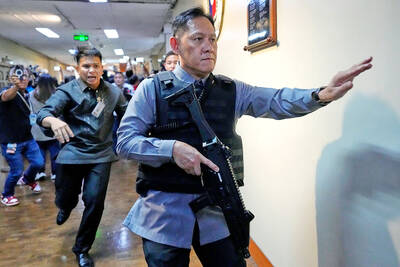
DELA ROSA CASE: The whereabouts of the senator, who is wanted by the ICC, was unclear, while President Marcos faces a political test over the senate situation Philippine authorities yesterday were seeking confirmation of reports that a top politician wanted by the International Criminal Court (ICC) had fled, a day after gunfire rang out at the Philippine Senate where he had taken refuge fearing his arrest. Senator Ronald “Bato” dela Rosa, the former national police chief and top enforcer of former Philippine president Rodrigo Duterte’s “war on drugs,” has been under Senate protection and is wanted for crimes against humanity, the same charges Duterte is accused of. “Several sources confirmed that the senator, Senator Bato, is no longer in the Senate premises, but we are still getting confirmation,” Presidential
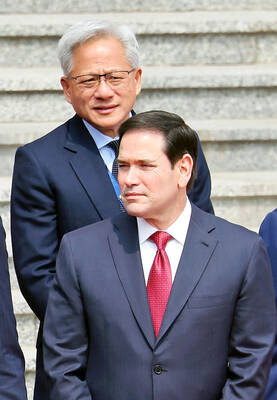
HELP DENIED? The US Department of State said that the Cuban leadership refuses to allow the US to provide aid to Cubans, ‘who are in desperate need of assistance’ US Secretary of State Marco Rubio on Wednesday said that Cuba’s leadership must change, as Washington renewed an offer of US$100 million in aid if the communist nation agrees to cooperate. Cuba has been suffering severe economic tumult led by an energy shortage that plunged 65 percent of the country into darkness on Tuesday. Cuba’s leaders have blamed US sanctions, but Rubio, a Cuban American and critic of the government established by Fidel Castro, said the system was to blame, including corruption by the military. “It’s a broken, nonfunctional economy, and it’s impossible to change it. I wish it were different,” he told

Myanmar yesterday published a parliamentary bill proposing the death sentence for those who detain or violently coerce people into working in online scam centers. Internet fraud factories have flourished in Myanmar, part of Southeast Asia’s scam economy, targeting Internet users worldwide with romance and cryptocurrency investment cons. The multibillion-dollar black market attracts many willing employees, but repatriated foreigners have also reported being trafficked to sites in Myanmar and tortured by scam center operators. The draft legislation would allow capital punishment for “violence, torture, unlawful arrest and detention, or cruel treatment against another person for the purpose of forcing them to commit online scams.” The


 RSS
RSS