


Hezbollah guerrillas possess an arsenal of rockets that can reach "any corner" of the state of Israel, including Tel Aviv, the group's leader said on Monday in a rare interview.
"We could absolutely reach any corner and any point in Occupied Palestine," Sheik Hassan Nasrallah said in an interviewed aired by the pan-Arab al-Jazeera satellite TV channel and Hezbollah's al-Manar television.
The interview marked a year since the month-long war between Israel and Hezbollah. Nasrallah said the conflict did not succeed in diminishing Hezbollah's military capabilities.
Repeating earlier claims, the Hezbollah leader said his group could have fired at Tel Aviv last summer during the conflict, but had avoided doing so.
"Even until the last day of the war, we were ready to fire rockets on Tel Aviv if [central] Beirut was hit," Nasrallah said.
"In July and August 2006, there wasn't a place in Occupied Palestine that the rockets of the resistance could not reach, be it Tel Aviv or other cities," he said.
"We could absolutely do that now," he said.
"We can reach any target and any point in Occupied Palestine," he repeated.
Celebratory gunshots and fireworks erupted in Beirut's southern suburbs for several minutes as the interview began and after it ended. Witnesses said cars and other property were damaged by ricocheting bullets in this largely Shiite Muslim and pro-Hezbollah neighborhood.
In Jerusalem, Israeli Foreign Ministry spokesman Mark Regev said Hezbollah's rearmament "is a direct and grave violation of UN Security Council Resolution 1701," which ended last year's war.
"The international community must hold accountable those governments, namely Syria and Iran, who by supplying weapons to Hezbollah are deliberately trying to undermine the United Nations, the Lebanese government and peace and stability in the region," he said.
Nasrallah boasted about Hezbollah's "strategic" accomplishments during the war, saying: "We succeeded in largely destroying the project of Greater Israel."
He has previously said his group increased its stock of missiles since the war ended, despite attempts to keep arms from being smuggled into southern Lebanon.
In a speech last October, he said the guerrillas had 33,000 rockets -- up from the 22,000 he said they had on Sept. 22.
Nasrallah insisted on Monday that Israel had failed to hit any important Hezbollah cache during the war. "The targets that they hit were not weapons depot," he said. "Those were not hit."
Hezbollah fired as many as 4,000 rockets at northern Israel during the 34-day conflict, including several medium-range missiles that for the first time hit Israel's third-largest city, Haifa.
Nasrallah warned during the war that he had weapons that could reach Tel Aviv. Although the city was never targeted, Hezbollah's targets struck deeper inside Israel than ever before, hitting on at least one occasion the town of Hadera, about 50km north of Tel Aviv.
The war began on July 12 last year after Hezbollah fighters crossed into Israel, killing three soldiers and seizing two.
Israel then invaded southern Lebanon and pounded the country with massive bombardments that destroyed most roads, bridges and other infrastructure.
More than 1,000 Lebanese -- mostly civilians -- were killed in the fighting, while 158 Israelis died, of whom 119 were soldiers.
Nasrallah refused to say on Monday whether the two Israeli soldiers were alive or dead.
French Foreign Minister Bernard Kouchner said that Hezbollah representatives who took part in a meeting of rival Lebanese factions in Paris earlier this month had led him to understand that the two captured soldiers were still alive.
"Not true," Nasrallah said. "Our brothers do not answer to such questions. This is something that is left to negotiations," he said, adding that the group would only give out information in return for a gesture from Israel regarding Lebanese prisoners in Israeli jails.
"Why would we offer information in exchange for nothing?" he asked.
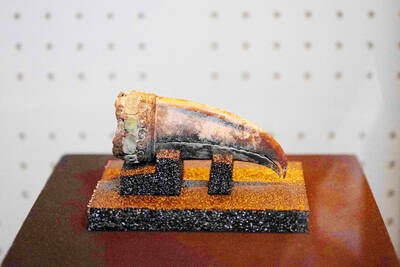
Archeologists in Peru on Thursday said they found the 5,000-year-old remains of a noblewoman at the sacred city of Caral, revealing the important role played by women in the oldest center of civilization in the Americas. “What has been discovered corresponds to a woman who apparently had elevated status, an elite woman,” archeologist David Palomino said. The mummy was found in Aspero, a sacred site within the city of Caral that was a garbage dump for more than 30 years until becoming an archeological site in the 1990s. Palomino said the carefully preserved remains, dating to 3,000BC, contained skin, part of the
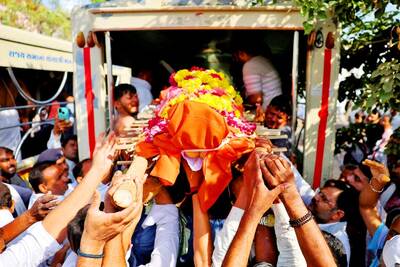
‘WATER WARFARE’: A Pakistani official called India’s suspension of a 65-year-old treaty on the sharing of waters from the Indus River ‘a cowardly, illegal move’ Pakistan yesterday canceled visas for Indian nationals, closed its airspace for all Indian-owned or operated airlines, and suspended all trade with India, including to and from any third country. The retaliatory measures follow India’s decision to suspend visas for Pakistani nationals in the aftermath of a deadly attack by shooters in Kashmir that killed 26 people, mostly tourists. The rare attack on civilians shocked and outraged India and prompted calls for action against their country’s archenemy, Pakistan. New Delhi did not publicly produce evidence connecting the attack to its neighbor, but said it had “cross-border” links to Pakistan. Pakistan denied any connection to

TRUMP EFFECT: The win capped one of the most dramatic turnarounds in Canadian political history after the Conservatives had led the Liberals by more than 20 points Canadian Prime Minister Mark Carney yesterday pledged to win US President Donald Trump’s trade war after winning Canada’s election and leading his Liberal Party to another term in power. Following a campaign dominated by Trump’s tariffs and annexation threats, Carney promised to chart “a new path forward” in a world “fundamentally changed” by a US that is newly hostile to free trade. “We are over the shock of the American betrayal, but we should never forget the lessons,” said Carney, who led the central banks of Canada and the UK before entering politics earlier this year. “We will win this trade war and
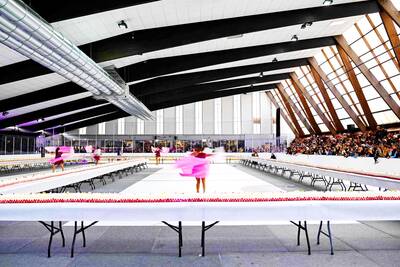
Armed with 4,000 eggs and a truckload of sugar and cream, French pastry chefs on Wednesday completed a 121.8m-long strawberry cake that they have claimed is the world’s longest ever made. Youssef El Gatou brought together 20 chefs to make the 1.2 tonne masterpiece that took a week to complete and was set out on tables in an ice rink in the Paris suburb town of Argenteuil for residents to inspect. The effort overtook a 100.48m-long strawberry cake made in the Italian town of San Mauro Torinese in 2019. El Gatou’s cake also used 350kg of strawberries, 150kg of sugar and 415kg of


 RSS
RSS