


A child of the 1970s, new literary talent Tahmima Anam grew up surrounded by family memories of Bangladesh's bloody war of independence in which thousands were slaughtered by the Pakistan army.
Those memories inspired her much-praised debut novel A Golden Age just published in Bangladesh, which charts the impact of the bitter 1971 conflict on a widowed mother and her family.
For London-based Anam, 31, who heard about the independence struggle from her parents and grandparents, the legacy of the war is never far away in Bangladesh.
"William Faulkner said `the past is never dead, it's not even past' and it is very true about Bangladesh because there has never been a national reckoning about 1971," she said on a recent visit to Dhaka.
"In South Africa, they had a kind of national conversation. It was not perfect but it happened. Here there was no symbolic act of acknowledgement and all these wounds fester," she said.
It has never been established how many people were killed, raped and tortured during the war and according to Anam the years have done little to heal the wounds and divisions it left.
Freedom fighters are still feted as heroes while the Islamists' support for Pakistan -- in the name of Islamic unity -- remains a controversial subject blamed for the religious parties' failure to garner any significant votes in national elections.
The daughter of a leading Bangladeshi newspaper editor and granddaughter of a prominent satirist, Anam was born in Bangladesh but lived abroad for most of her childhood due to her father's early career as a UN official.
After studying social anthropology in the US she settled in London where she kickstarted her writing career by attending a creative writing course.
When she began her research, she was shocked to discover many war veterans had never discussed their experiences with their family.
"Some people were not ready [to talk]. Other people were very open. I think it was because they had a lot of pent-up emotions that they had not been able to express for many years," said Anam.
"One man told me I was the daughter he never had. But in fact he had a daughter, but she was not interested. I found out that a lot of children knew almost nothing of their parents' experiences."
A Golden Age opens in 1959 and follows the family of Rehana Haque as her sons grow up and join the independence movement and become freedom fighters.
For many ordinary Bangladeshis, says Anam, the war's horrors coexisted with an awareness that the conflict also marked a new beginning.
But she says those hopes were betrayed by a political elite whose corruption and misrule failed the country's hard-won democracy.
Since 1975 the impoverished country's history has been punctuated by coups, political assassinations and military dictatorship.
Democracy was restored in 1991 but successive governments succumbed to massive corruption. Those failures culminated in January in a state of emergency under a military-backed government.
The majority of Bangladeshis were so disillusioned with three decades of failed leadership they openly welcomed the suspension of democracy saying their politicians could simply not be trusted.
"I think these dreams have certainly been betrayed to a great extent," Anam said, adding, however, that she was not "totally despondent" about the future.
"The great resource of Bangladesh are the people who work so hard to keep the country developing despite the criminality of the leaders," she said.
She continues to be struck by the reaction to A Golden Age, which was published in London earlier this year to favorable reviews and has just hit bookstands in Dhaka.
"It has brought up so many feelings," she said. "It has become a vehicle through which people have started to remember the war."
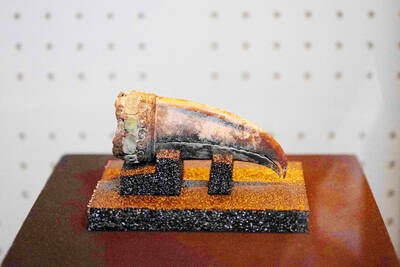
Archeologists in Peru on Thursday said they found the 5,000-year-old remains of a noblewoman at the sacred city of Caral, revealing the important role played by women in the oldest center of civilization in the Americas. “What has been discovered corresponds to a woman who apparently had elevated status, an elite woman,” archeologist David Palomino said. The mummy was found in Aspero, a sacred site within the city of Caral that was a garbage dump for more than 30 years until becoming an archeological site in the 1990s. Palomino said the carefully preserved remains, dating to 3,000BC, contained skin, part of the

TRUMP EFFECT: The win capped one of the most dramatic turnarounds in Canadian political history after the Conservatives had led the Liberals by more than 20 points Canadian Prime Minister Mark Carney yesterday pledged to win US President Donald Trump’s trade war after winning Canada’s election and leading his Liberal Party to another term in power. Following a campaign dominated by Trump’s tariffs and annexation threats, Carney promised to chart “a new path forward” in a world “fundamentally changed” by a US that is newly hostile to free trade. “We are over the shock of the American betrayal, but we should never forget the lessons,” said Carney, who led the central banks of Canada and the UK before entering politics earlier this year. “We will win this trade war and

‘BODIES EVERYWHERE’: The incident occurred at a Filipino festival celebrating an anti-colonial leader, with the driver described as a ‘lone suspect’ known to police Canadian police arrested a man on Saturday after a car plowed into a street party in the western Canadian city of Vancouver, killing a number of people. Authorities said the incident happened shortly after 8pm in Vancouver’s Sunset on Fraser neighborhood as members of the Filipino community gathered to celebrate Lapu Lapu Day. The festival, which commemorates a Filipino anti-colonial leader from the 16th century, falls this year on the weekend before Canada’s election. A 30-year-old local man was arrested at the scene, Vancouver police wrote on X. The driver was a “lone suspect” known to police, a police spokesperson told journalists at the
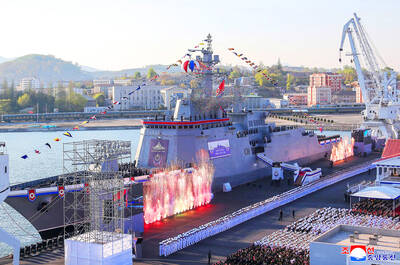
North Korean leader Kim Jong-un has unveiled a new naval destroyer, claiming it as a significant advancement toward his goal of expanding the operational range and preemptive strike capabilities of his nuclear-armed military, state media said yesterday. North Korea’s state-run Korean Central News Agency (KCNA) said Kim attended the launching ceremony for the 5,000-tonne warship on Friday at the western port of Nampo. Kim framed the arms buildup as a response to perceived threats from the US and its allies in Asia, who have been expanding joint military exercises amid rising tensions over the North’s nuclear program. He added that the acquisition


 RSS
RSS