


British Prime Minister Gordon Brown will not be "joined together at the hip" with US President George W. Bush, one of Brown's foreign ministers said in an interview published yesterday.
Lord Mark Malloch-Brown, recently appointed by Brown as the minister for Africa, Asia and the UN, appeared to put fresh strain on London-Washington relations, one day after International Development Secretary Douglas Alexander hinted at a change to transatlantic ties.
And national newspapers mulled over the signs of a more distant partnership and realigned foreign policy under the new prime minister, who took over from Tony Blair on June 27 and has been swift to stake out his own agenda.
Alexander told a Washington audience on Thursday that more emphasis should be placed on "soft power" and multilateralism.
Brown then got his chief of staff to write to all cabinet members on Friday to stress the importance of links with the US -- in what some commentators saw as a damage limitation exercise.
Brown is to meet Bush in Washington within weeks, after talks with French President Nicolas Sarkozy and German Chancellor Angela Merkel.
Malloch-Brown, the UN deputy secretary-general from April to December last year, said Britain needed a more "impartial" foreign policy, forging new links with France, Germany, India and China.
"It is very unlikely that the Brown-Bush relationship is going to go through the baptism of fire and therefore be joined together at the hip like the Blair-Bush relationship was," the Iraq war critic told the Daily Telegraph newspaper.
"That was a relationship born out of being war leaders together. There was an emotional intensity of being war leaders with much of the world against them. That is enough to put you on your knees and get you praying together," he said.
London needs to broaden its international partnerships beyond the "special relationship" with Washington, Malloch-Brown said.
"You need to build coalitions that are lateral, which go beyond the bilateral blinkers of the normal partners. My hope is that foreign policy will become much more impartial," he said.
"We have a whole set of emerging countries. There will be lots of exciting things to do with Sarkozy and Merkel and other European leaders as well as strengthening transatlantic relations," Malloch-Brown said.
"What I really hate is the effort to paint me as anti-American, but I am happy to be described as an anti-neo-con," he said.
He said Washington would find Brown a "sympathetic prime minister who wants a strong relationship."
In its editorial, the Daily Telegraph slammed Malloch-Brown for his "self-importance" and said the prime minister "must not allow his bien pensant [right-minded] namesake to sow suspicion in Washington."
It was not the only newspaper attempting to make sense of Alexander's speech and Brown's answer.
The Independent said Alexander's speech was "an impressive break with the past.
"It seems highly unlikely that Mr Brown will be the uncritical ally of the United States president that his predecessor was," it said.
The Guardian newspaper said a "grenade had been tossed" with Alexander's speech and the appointment of Malloch-Brown showed Brown intended to "rebalance Britain's foreign policy objectives" in a subtle shift.
"Steady, Gordon," said the Sun newspaper, reminding Brown that the US was Britain's "greatest ally."
The tabloid also blasted his "appalling decision" to appoint Malloch-Brown, "a man who delighted in savaging America in his last job at the UN and who has no place in the British government."
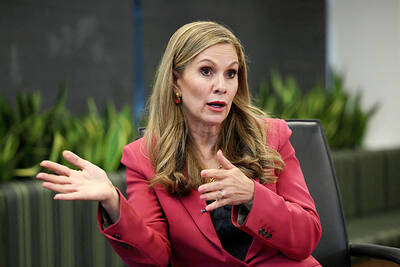
Australians were downloading virtual private networks (VPNs) in droves, while one of the world’s largest porn distributors said it was blocking users from its platforms as the country yesterday rolled out sweeping online age restriction. Australia in December became the first country to impose a nationwide ban on teenagers using social media. A separate law now requires artificial intelligence (AI)-powered chatbot services to keep certain content — including pornography, extreme violence and self-harm and eating disorder material — from minors or face fines of up to A$49.5 million (US$34.6 million). The country also joined Britain, France and dozens of US states requiring
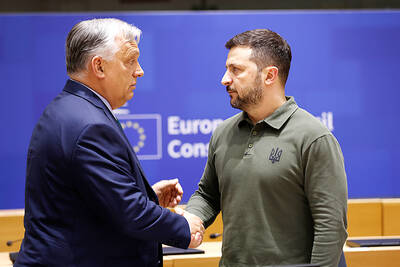
Hungarian authorities temporarily detained seven Ukrainian citizens and seized two armored cars carrying tens of millions of euros in cash across Hungary on suspicion of money laundering, officials said on Friday. The Ukrainians were released on Friday, following their detention on Thursday, but Hungarian officials held onto the cash, prompting Ukraine to accuse Hungary’s Russia-friendly government of illegally seizing the money. “We will not tolerate this state banditism,” Ukrainian Minister of Foreign Affairs Andrii Sybiha said. The seven detained Ukrainians were employees of the Ukrainian state-owned Oschadbank, who were traveling in the two armored cars that were carrying the money between Austria and
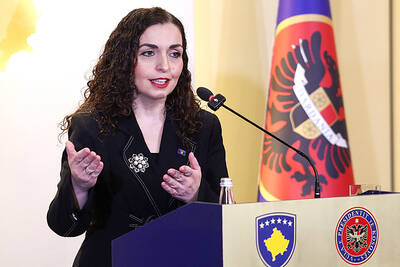
Kosovar President Vjosa Osmani on Friday after dissolving the Kosovar parliament said a snap election should be held as soon as possible to avoid another prolonged political crisis in the Balkan country at a time of global turmoil. Osmani said it is important for Kosovo to wrap up the upcoming election process and form functional institutions for political stability as the war rages in the Middle East. “Precisely because the geopolitical situation is that complex, it is important to finish this electoral process which is coming up,” she said. “It is very hard now to imagine what will happen next.” Kosovo, which declared

MORE BANS: Australia last year required sites to remove accounts held by under-16s, with a few countries pushing for similar action at an EU level and India considering its own ban Indonesia on Friday said it would ban social media access for children under 16, citing threats from online pornography, cyberbullying, online fraud and Internet addiction. “Accounts belonging to children under 16 on high-risk platforms will start to be deactivated, beginning with YouTube, TikTok, Facebook, Instagram, Threads, X, Bigo Live and Roblox,” Indonesian Minister of Communications and Digital Meutya Hafid said. “The government is stepping in so that parents no longer have to fight alone against the giants of the algorithm. Implementation will begin on March 28, 2026,” she said. The social media ban would be introduced in stages “until all platforms fulfill their


 RSS
RSS