


Iran has scaled back its uranium enrichment program, the head of the International Atomic Energy Agency (IAEA) said on Monday, suggesting the move on the part of Tehran could signal willingness to resolve the international standoff over its nuclear defiance.
IAEA chief Mohamed ElBaradei spoke at the end of a special meeting of his agency's 35-nation board that approved sending an agency team to North Korea as well as agreeing on the IAEA's 2008-2009 budget.
While expressing hope that Iran might go as far as totally freezing enrichment activities -- as demanded by the UN Security Council -- ElBaradei told reporters that there had been a "marked slowdown" in centrifuges on line and in using them to turn out enriched uranium.
IAEA Deputy Director General Olli Heinonen was to leave for Tehran yesterday to explore how willing Iran is to make good on pledges that it is ready to answer all outstanding questions about activities that could be linked to a nuclear weapons program.
If Iran honored that promise and froze all enrichment activities, "this would influence the actions" of the six nations -- the five permanent council members and Germany, ElBaradei said, suggesting that the council would desist from approving new sanctions as a result.
He repeated a call for the US to speak directly to Iran over the nuclear standoff.
ElBaradei said: "I think that would help ... in many ways for us to make progress. You need to understand where each other is coming from."
In a report to the IAEA board last month, ElBaradei said that Tehran had assembled just under 2,000 centrifuges in links or cascades of 164 machines each -- the configuration needed to enrich. Diplomats subsequently said that the Iranian technicians were linking up one cascade every two weeks and running their assemblies at their underground facility in Natanz to produce minute quantities of the low-enriched uranium, suitable for generating power.
The enrichment facility is housed near the city of Natanz in halls built underground -- apparently to protect it from attack. Both Israel and the US have not ruled out aerial strikes should Tehran continue to expand the program.
But a diplomat familiar with the issue said Monday that centrifuge assembly ``had significantly slowed'' since ElBaradei met late last month with chief Iranian nuclear envoy Ali Larijani who strengthened a pledge to come up with answers long sought by the agency.
ElBaradei believes that Tehran recognized that moving the enrichment program forward would only provoke the council into passing new sanctions. ElBaradei held out hope Tehran might go even further.
"At this delicate stage, ideally they would even freeze what they have at the present stage," he said.
On the linked issue -- Iran's pledge to be forthright with the agency -- ElBaradei said progress there could go a long way in defusing the crisis.
"If we are able to ... clarify these issues and be able to provide assurances about [the peaceful nature] of Iran's nuclear program, that, obviously, will influence the actions of the Security Council," he said.
The IAEA began investigating Iran's nuclear activities only four years ago, after a dissident group revealed nearly two decades of a clandestine atomic program.
On North Korea, and the return of an agency team to the secretive communist country, ElBaradei cautioned that the IAEA mission -- which is tasked with shutting down the country's plutonium-producing Yongbyon facility -- was only beginning.
"It's going to be a long and complex process, but I welcome the return of the DPRK to the verification process," he said.
ElBaradei said timing for the visit depended on when the North Koreans issued an invitation, perhaps "in the next week or two."
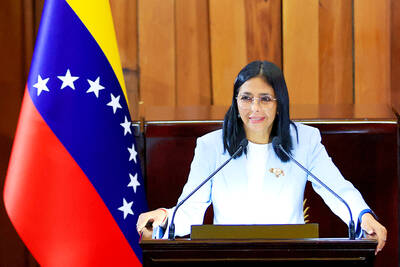
VAGUE: The criteria of the amnesty remain unclear, but it would cover political violence from 1999 to today, and those convicted of murder or drug trafficking would not qualify Venezuelan Acting President Delcy Rodriguez on Friday announced an amnesty bill that could lead to the release of hundreds of prisoners, including opposition leaders, journalists and human rights activists detained for political reasons. The measure had long been sought by the US-backed opposition. It is the latest concession Rodriguez has made since taking the reins of the country on Jan. 3 after the brazen seizure of then-Venezuelan president Nicolas Maduro. Rodriguez told a gathering of justices, magistrates, ministers, military brass and other government leaders that the ruling party-controlled Venezuelan National Assembly would take up the bill with urgency. Rodriguez also announced the shutdown

Civil society leaders and members of a left-wing coalition yesterday filed impeachment complaints against Philippine Vice President Sara Duterte, restarting a process sidelined by the Supreme Court last year. Both cases accuse Duterte of misusing public funds during her term as education secretary, while one revives allegations that she threatened to assassinate former ally Philippine President Ferdinand Marcos Jr. The filings come on the same day that a committee in the House of Representatives was to begin hearings into impeachment complaints against Marcos, accused of corruption tied to a spiraling scandal over bogus flood control projects. Under the constitution, an impeachment by the
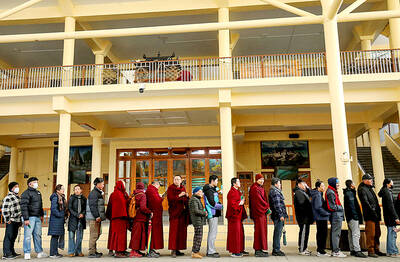
Exiled Tibetans began a unique global election yesterday for a government representing a homeland many have never seen, as part of a democratic exercise voters say carries great weight. From red-robed Buddhist monks in the snowy Himalayas, to political exiles in megacities across South Asia, to refugees in Australia, Europe and North America, voting takes place in 27 countries — but not China. “Elections ... show that the struggle for Tibet’s freedom and independence continues from generation to generation,” said candidate Gyaltsen Chokye, 33, who is based in the Indian hill-town of Dharamsala, headquarters of the government-in-exile, the Central Tibetan Administration (CTA). It

A Virginia man having an affair with the family’s Brazilian au pair on Monday was found guilty of murdering his wife and another man that prosecutors say was lured to the house as a fall guy. Brendan Banfield, a former Internal Revenue Service law enforcement officer, told police he came across Joseph Ryan attacking his wife, Christine Banfield, with a knife on the morning of Feb. 24, 2023. He shot Ryan and then Juliana Magalhaes, the au pair, shot him, too, but officials argued in court that the story was too good to be true, telling jurors that Brendan Banfield set


 RSS
RSS