


Zimbabwe's economy veered closer to the brink on Monday with no end in sight to chronic shortages of food and gasoline, and predictions of a standstill in routine business within days.
Police and government inspectors continued cracking down on shopkeepers and sales managers accused of defying orders to slash prices by half in a desperate attempt to halt rampant inflation.
Shelves were bare of cornmeal, bread, meat and other staples, and witnesses said many shops and suppliers were cleaned out by convoys of ruling party supporters coming in after police and inspectors began enforcing the price cuts on June 26.
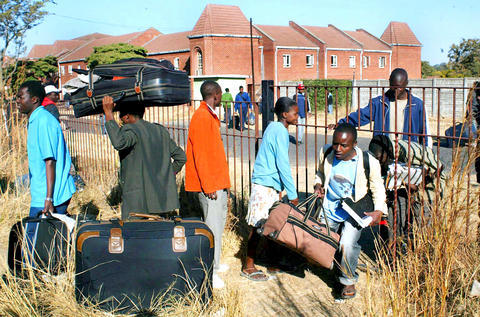
PHOTO: AFP
"The crunch can't be far off," said economist John Robertson.
Factories, stores and gas stations have been unable to replace goods sold at below the original cost. The sudden drop in prices has sparked panic buying, stampedes and near-riots by impoverished Zimbabweans.
Fuel stock have run out, putting an end to the long lines of cars at gas stations. On Monday, the government ordered private commuter buses to cut fares by three-fourths, promising bus owners they would be able to buy subsidized fuel from the state oil procurement agency.
But many ignored the directive and simply abandoned their routes. Businesses reported higher absenteeism, with workers failing to arrive at their jobs.
"We are incurring huge losses. We can't go on like this for much longer," one industrialist said. "We won't be able to pay our VAT [value added tax], which runs into the billions each month. We'll have to lay off quite a number of our people very soon," he said. "We've shot ourselves in the foot this time."
He asked not to be identified.
President Robert Mugabe said on Friday that the government would target uncooperative managers and seize factories that scaled down their operations.
More than 1,300 businesses have been charged and fined over the past two weeks for defying orders to slash prices in half or hoarding goods, police said.
Several of 33 top company executives arrested in recent days were fined up to Z$100 million (US$6,600), court officials said on Monday.
Economists predicted that shortages would worsen dramatically across the board.
"Retailers who can't recover the money they spent on their goods are not going to carry them anymore, and manufacturers who are not allowed to charge more than their production costs are going to stop making them," Robertson said.
By the end of next week, "we won't have much mobility anywhere and we will have run out of options" as gasoline tanks run dry and gas stations and stores go out of business, he said.
Last week, the government announced it was reviving the long-defunct State Trading Corp to run businesses that had collapsed or were commandeered. The corporation itself collapsed in the 1980s through mismanagement.
Police spokesman Oliver Mandipaka said the crackdown was "not a gimmick and will be sustained at all costs to stop consumers being ripped off," state radio said.
Mandipaka appealed to rural villagers and farmers "to compliment government efforts by reducing prices of cattle so butcheries can operate viably," radio said.
Beef, a traditional favorite in the diet of Zimbabweans, disappeared from shops more than a week ago.
Cattle herds already have shrunk drastically since the seizures of thousands of white-owned farms disrupted Zimbabwe's agriculture-based economy in 2000.
Cattle are a status symbol in rural communities and often are used as a dowry. It was unlikely villagers who have resettled on former white-owned land would heed Mandipaka's appeal.
Live goats were being sold in Harare but goat meat has not appeared in butcheries and supermarkets. Local women snapped up cabbages at one open air market.
"It's something to put on the table anyway," said one woman who only gave her name as Olivia.
Official inflation is running at 4,500 percent -- the highest in the world -- though independent financial institutions estimate real inflation is closer to 9,000 percent.
The government is accusing business leaders of being part of a political and economic campaign of "regime change" to bring down Mugabe.
It has admitted to printing extra money to pay its way -- seen as a main cause of inflation and an obstacle to reports that South Africa could shore up Zimbabwe's collapsing dollar by pegging it to the South African currency.
Regional proposals to admit Zimbabwe to the southern African Common Monetary Area of South Africa's neighbors would entail fundamental market-linked economic reforms that Mugabe has rejected.
"I think the government will finally unleash the impatience and the anger of our normally agreeable and passive population," Robertson said.

VAGUE: The criteria of the amnesty remain unclear, but it would cover political violence from 1999 to today, and those convicted of murder or drug trafficking would not qualify Venezuelan Acting President Delcy Rodriguez on Friday announced an amnesty bill that could lead to the release of hundreds of prisoners, including opposition leaders, journalists and human rights activists detained for political reasons. The measure had long been sought by the US-backed opposition. It is the latest concession Rodriguez has made since taking the reins of the country on Jan. 3 after the brazen seizure of then-Venezuelan president Nicolas Maduro. Rodriguez told a gathering of justices, magistrates, ministers, military brass and other government leaders that the ruling party-controlled Venezuelan National Assembly would take up the bill with urgency. Rodriguez also announced the shutdown
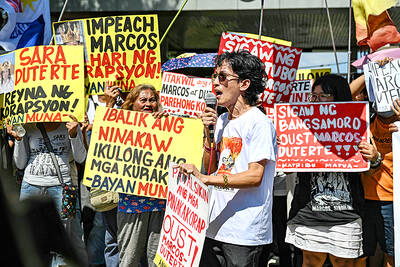
Civil society leaders and members of a left-wing coalition yesterday filed impeachment complaints against Philippine Vice President Sara Duterte, restarting a process sidelined by the Supreme Court last year. Both cases accuse Duterte of misusing public funds during her term as education secretary, while one revives allegations that she threatened to assassinate former ally Philippine President Ferdinand Marcos Jr. The filings come on the same day that a committee in the House of Representatives was to begin hearings into impeachment complaints against Marcos, accused of corruption tied to a spiraling scandal over bogus flood control projects. Under the constitution, an impeachment by the
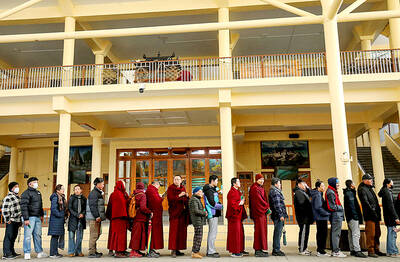
Exiled Tibetans began a unique global election yesterday for a government representing a homeland many have never seen, as part of a democratic exercise voters say carries great weight. From red-robed Buddhist monks in the snowy Himalayas, to political exiles in megacities across South Asia, to refugees in Australia, Europe and North America, voting takes place in 27 countries — but not China. “Elections ... show that the struggle for Tibet’s freedom and independence continues from generation to generation,” said candidate Gyaltsen Chokye, 33, who is based in the Indian hill-town of Dharamsala, headquarters of the government-in-exile, the Central Tibetan Administration (CTA). It

A Virginia man having an affair with the family’s Brazilian au pair on Monday was found guilty of murdering his wife and another man that prosecutors say was lured to the house as a fall guy. Brendan Banfield, a former Internal Revenue Service law enforcement officer, told police he came across Joseph Ryan attacking his wife, Christine Banfield, with a knife on the morning of Feb. 24, 2023. He shot Ryan and then Juliana Magalhaes, the au pair, shot him, too, but officials argued in court that the story was too good to be true, telling jurors that Brendan Banfield set


 RSS
RSS