


In a country where perhaps the most popular national pasttime is puffing on a water pipe or chain smoking while drinking tea, new legislation designed to curb smoking is receiving a skeptical response.
Egypt's 76 million people smoke billions of cigarettes a year -- one of the highest rates in the Middle East. Smoke-filled offices are the norm here, along with taxi drivers who light one cigarette after another while stuck in Cairo's treacherous traffic. Nonsmoking sections in restaurants are unheard of, while water-pipe filled cafes often overflow onto sidewalks, leaving the sweet smell of fruit-flavored tobacco lingering on the streets.
But some lawmakers and doctors want to change Egypt's smoking culture. The country's parliament recently passed laws banning tobacco advertising and smoking in some public places including government buildings, schools and hospitals.
The law also calls for health warning labels to be put on cigarette packs and allows the government to increase the price of tobacco, according to parliament member Hamdi el-Sayyed, who proposed the new laws.
If individuals break the law, they could be fined up to 100 Egyptian pounds. Establishments could be forced to pay up to 20,000 Egyptian pounds if they don't follow the law, said el-Sayyed, who heads Egypt's Doctor's Syndicate.
"Part of the objective is to keep children and young people from becoming smoking addicts," he said.
But in a country where a massive government bureaucracy often keeps reform moving at snail's pace and bribing officials is common, there is much doubt that the laws will be enforced.
El-Sayyed said Egypt is trying to address the lack of enforcement by calling for the creation of a tobacco control agency.
But skepticism over how Egypt -- a country burdened by poverty and high unemployment -- would be able to force people not to smoke remains high.
Soliman Mahmoud said that he quit smoking 20 years ago but others have not followed his example.
"People here have been trying for a long time to get people not to smoke, but people here don't follow," said Mahmoud while standing on the corner of a congested downtown Cairo street.
Mustafa Ahmed, 25, said laws to curb smoking are a good idea in principle but are not realistic.
"Smoking is popular in Egypt. There is a lot of pressure on people here, especially because the economy is bad. People smoke because they think it will relax them," Ahmed said as he sat on a chair holding a cigarette outside the downtown travel agency where he works.
Sherif Omar, a parliament member and professor emeritus with Cairo University's National Cancer Institute, also has doubt over the new laws. He said education was the only way to get young people to put down the water pipe and cigarettes, but anti-smoking education is not part of school curriculum here.
"Law by themselves do not work well unless you have education in schools and in the media," he said.
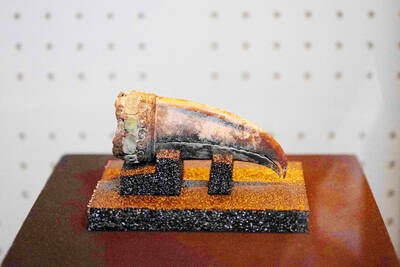
Archeologists in Peru on Thursday said they found the 5,000-year-old remains of a noblewoman at the sacred city of Caral, revealing the important role played by women in the oldest center of civilization in the Americas. “What has been discovered corresponds to a woman who apparently had elevated status, an elite woman,” archeologist David Palomino said. The mummy was found in Aspero, a sacred site within the city of Caral that was a garbage dump for more than 30 years until becoming an archeological site in the 1990s. Palomino said the carefully preserved remains, dating to 3,000BC, contained skin, part of the

TRUMP EFFECT: The win capped one of the most dramatic turnarounds in Canadian political history after the Conservatives had led the Liberals by more than 20 points Canadian Prime Minister Mark Carney yesterday pledged to win US President Donald Trump’s trade war after winning Canada’s election and leading his Liberal Party to another term in power. Following a campaign dominated by Trump’s tariffs and annexation threats, Carney promised to chart “a new path forward” in a world “fundamentally changed” by a US that is newly hostile to free trade. “We are over the shock of the American betrayal, but we should never forget the lessons,” said Carney, who led the central banks of Canada and the UK before entering politics earlier this year. “We will win this trade war and
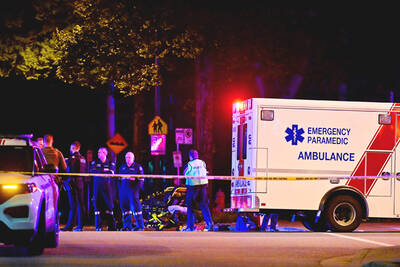
‘BODIES EVERYWHERE’: The incident occurred at a Filipino festival celebrating an anti-colonial leader, with the driver described as a ‘lone suspect’ known to police Canadian police arrested a man on Saturday after a car plowed into a street party in the western Canadian city of Vancouver, killing a number of people. Authorities said the incident happened shortly after 8pm in Vancouver’s Sunset on Fraser neighborhood as members of the Filipino community gathered to celebrate Lapu Lapu Day. The festival, which commemorates a Filipino anti-colonial leader from the 16th century, falls this year on the weekend before Canada’s election. A 30-year-old local man was arrested at the scene, Vancouver police wrote on X. The driver was a “lone suspect” known to police, a police spokesperson told journalists at the

North Korean leader Kim Jong-un has unveiled a new naval destroyer, claiming it as a significant advancement toward his goal of expanding the operational range and preemptive strike capabilities of his nuclear-armed military, state media said yesterday. North Korea’s state-run Korean Central News Agency (KCNA) said Kim attended the launching ceremony for the 5,000-tonne warship on Friday at the western port of Nampo. Kim framed the arms buildup as a response to perceived threats from the US and its allies in Asia, who have been expanding joint military exercises amid rising tensions over the North’s nuclear program. He added that the acquisition


 RSS
RSS