


It was the largest seizure of cash in the history of drug enforcement: US$207 million, mostly in crisp US$100 bills, stuffed into walls, closets and suitcases in the Mexico City home of a Chinese-born businessman, Zhenli Ye Gon.
Ye Gon said that most of the money belonged to Mexico's ruling party. He said party officials delivered it last summer in duffel bags stuffed with US$5 million apiece and threatened to kill him unless he guarded their cash.
In a statement on Sunday night, the Mexican government called his tale "a perverse blackmail attempt" aimed at getting himself off on drug, weapons and money-laundering charges and at blunting Mexican President Felipe Calderon's war on drugs, which has mobilized the army and extradited a record number of top-level traffickers.
The government says Ye Gon made millions supplying traffickers with the raw material to make a pure, highly addictive form of methamphetamine that has flooded US markets, and said his story "is not only false, it is ridiculous."
The statement from the attorney general's office, which was a response to a letter sent by Zhenli's US lawyer to the Mexican embassy in Washington, said the lawyer demanded special treatment for Ye Gon and suggested he would go public with his accusations against the National Action Party.
Eleven people, including several of Ye Gon's relatives, have been charged with drug trafficking and organized crime in Mexico.
Ye Gon met with reporters recently at his lawyer's New York office. A soft-spoken, polite, well-dressed 44-year-old, Ye Gon calmly recounted his version of events, complete with mysterious guards and blood-chilling threats. Most of his story about his alleged relationship with the ruling party hinges on claims that are hard to prove.
If true, Ye Gon fell victim to one the most bizarre schemes ever concocted, forced to accept stewardship of huge amounts of cash from strangers who didn't spend the money despite being locked in the closing days of the tightest presidential race in Mexican history.
In May last year, he said, a ruling-party official told him: "It's time to work with the government."
Ye Gon said the official made a slashing motion across his throat and warned him: "Cooperate or be killed."
More than a dozen times over the course of that summer, Ye Gon said, a party henchman dropped satchels full of money at his house. Last August, he said, they brought four cases containing shoulder-fired anti-aircraft missiles, but he refused to take them in.
Ye Gon said he had no prior relationship with the party and has no idea why he was chosen to hold the cash. And the name he gave as his main campaign contact doesn't match that of anyone who worked on Calderon's campaign team.
Born in Shanghai, Ye Gon migrated to Mexico in 1990 and became a citizen in 2002. He imported textiles, clothing and shoes, and made a fortune as a reseller of commodities seized by Mexican customs.
He founded a pharmaceutical company, Unimed, in 1997. He said he became one of Mexico's largest importers of pseudoephedrine, an ingredient in cold medicines that is also used to make methamphetamine. After 2004, however, Ye Gon said he stopped importing pseudoephedrine because of the controls placed on the chemical by the Mexican government.
He said he has never sold illegal drugs and doesn't even know what meth looks like.
"I never see this," he insisted. "I never touch any milligram of this."
Mexico says otherwise. Agents intercepted a ship from China last year that purportedly carried more than 17 tonnes of pseudoephedrine acetate, all of it illegally imported by Ye Gon, the government said. Officials say he was building a massive factory in Mexico to process the component into a form usable to traffickers.
Mexican labs already supply about 80 percent of the meth in the US market.
Ye Gon said the substance on the ship was another, proprietary chemical used in cold medicines, and that Mexican officials botched the laboratory analysis. He supplied reporters with reports from two US chemists, including a former official with the US Drug Enforcement Administration (DEA), who said the testing procedures were severely flawed.
What isn't in dispute about Ye Gon is that he lived the life of a high roller. Between 1997 and last year, he lost nearly US$41 million while gambling in the US, according to a police affidavit filed in Las Vegas.
His high-rolling ways have been curtailed dramatically since the raid on his home. He said all of his bank accounts, including those in Hong Kong and the US, are frozen.
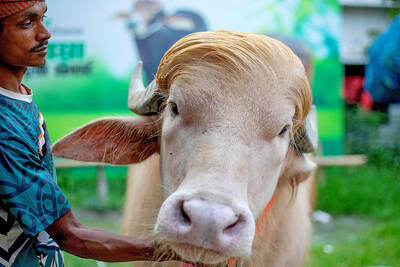
Crowds in Bangladesh are flocking to snap photographs with an unlikely social media star — an albino buffalo with flowing blond hair nicknamed “Donald Trump” that is due to be sacrificed within days. Owner Zia Uddin Mridha, 38, said his brother named the 700kg bull over its flowing helmet of hair resembling the signature look of the US president. “My younger brother picked this name because of the buffalo’s extraordinary hair,” he said at his farm in Narayanganj, just outside the capital, Dhaka. Mridha said that a constant stream of curious visitors — social media fans, onlookers and children — have come throughout

It began as a satirical online project. Now millions of young people in India are flocking to it as an outlet for their frustration. A parody political party called the Cockroach Janta Party, with the insect as its symbol, has exploded across India’s social media by turning absurdist humor into protest. Memes and short videos mocking corruption, joblessness and political dysfunction have flooded social media sites, where millions of users are embracing the cockroach — known for its ability to survive harsh conditions — as a tongue-in-cheek symbol of endurance. The online movement’s rise has been unusually rapid. The Cockroach Janta Party (CJP)

BIGGER ROLE: Beijing has said it maintains an impartial stance on the war in Ukraine, but by training Russian troops, China is far more involved than previously known China’s armed forces secretly trained about 200 Russian military personnel in China late last year, and some have since returned to fight in Ukraine, according to three European intelligence agencies and documents seen by Reuters. While China and Russia have held a number of joint military exercises since Moscow’s full-scale invasion of Ukraine in 2022, Beijing has repeatedly said that it is neutral in the conflict and presents itself as a peace mediator. The covert training sessions, which predominantly focused on the use of drones, were outlined in a dual-language Russian-Chinese agreement signed by senior Russian and Chinese officers in Beijing on
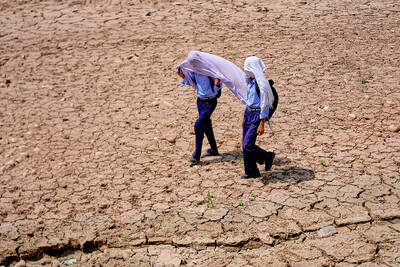
HOTTER: While Indians are accustomed to summer heat, climate change has caused northwestern India to warm faster than other parts of the country, an academic said Roads and markets have emptied during afternoons and some farmers have switched to nighttime work to avoid scorching temperatures as a heat wave grips large parts of India. The India Meteorological Department forecast maximum temperatures for yesterday of about 45°C in the capital, New Delhi, where authorities have opened temporary “cooling zones” to help people cope. The weather department warned that conditions would likely persist across several northern regions in the coming days, with temperatures staying well above seasonal averages. Authorities urged people to stay indoors during the hottest hours and take precautions against heat-related illnesses. India declares a heat wave whenever maximum temperatures


 RSS
RSS