


Singers Britney Spears, Paul McCartney, Sting and Paul Simon have all traveled to Sri Lanka for a big-bucks taste of tropical luxury.
But an escalating war with Tamil Tiger rebels and increasingly gruesome headlines on the human- rights situation means that the rich are now staying away -- and rooms in the island's boutique hotels are going for a song.
"They [tourists] have known for years that terrorism here is centered around military targets," said Gehan Wijeratne, director of Jetwing Group which runs a chain of 10 hotels, including three properties catering to the deep-pocketed visitor.

PHOTO: AFP
"But travelers don't like lawlessness, where there are extra-judicial killings, abductions. It sends shivers down their spine. Human rights are emerging as a bigger concern, people starting to brand us as a dirty destination," he said.
One example of luxury rooms going cheap is at Jetwing's Vil Uyana, or Water World -- a resort built over a wetland in Sigiriya, 170km north of Colombo.
From the outside, the 25 thatched roof huts built over lush green rice paddy fields are a throw-back to an early civilization, but the interiors are designed to pamper to every whim of the most discerning traveler.
"It's like living in a private nature reserve," British banker Michael Maillou said as he worked on his tan, sipped fresh mango juice and took in a view of lakes and reed beds populated by monkeys and wild elephants.
"This is paradise, to relax among hundreds of birds, butterflies, two crocodiles and get a piece of history," he said waving to the nearby 5th-century Sigiriya rock fortress, a world heritage site.
Near the stunning fortress, once the seat of a playboy king, are frescoes of women and a spread of ruins of the island's ancient royal kingdoms.
And thanks to the grim headlines on Sri Lanka putting off many potential visitors, Maillou can also savor one of the best buys in the tropics -- rather than the usual daily rate of US$400, the picture-postcard eco-lodges are going for US$125.
Famed for its hills of tea plantations, golden beaches, abundance of wildlife and ancient religious sites, the teardrop island of Sri Lanka is now crying out for tourists.
The problem is, as the Tamil Tigers once again step up their fight for an independent ethnic homeland in the north and east, and as government forces respond with equal veracity, the frontline is never far away.
After an all-too brief lull in fighting following a 2002 ceasefire agreement and the 2004 Asian tsunami, the Tigers have attacked in Colombo, the south, the east -- almost everywhere on the tiny island.
The Tigers have even managed to smuggle light aircraft into their northern mini-state, adding air power to their deadly arsenal of suicide bombers and forcing Sri Lanka's sole international airport to shut up shop at night for fear of more nocturnal raids.
Mounting "disappearances" have also been reported, with mutilated bodies turning up on a regular basis.
"Tourists with deep pockets are our mainstay, but we can't attract enough because of the macro situation in the country," Vil Uyana's manager, Tissa Wickramasuriya, said of the fighting.
Hotels as a whole are now reporting only 30 percent to 40 percent occupancy, as even aid workers -- who packed rooms following the tsunami -- are rare because of increasing donor fatigue and the intractable conflict.
Places like Vil Uyana can still manage to pull in the odd guest, but similar boutique resorts are standing empty.
For Geoffrey Dobbs, a British national who worked in Sri Lanka's hospitality industry for 12 years, things have never looked so bleak.
"Things are really bad. We attract the high-end clientele who can have a peaceful holiday in any part of the world," said Dobbs, who runs five small luxury hotels, including a private island in the south.
"I see a lot of bankruptcy," Dobbs said. "Sadly it's going to get worse before it gets better."
At present, hotel industry workers say the luxury sector is struggling to score the 40 percent occupancy rates needed to cover operating costs.
But even that is no longer good enough, as owners of boutique hotels -- including tea plantation mansions and colonial-era homes converted into expensive villas -- need to pay off debts and retain bored staff.
Falling prices also threaten to damage the image of Sri Lanka's luxury resorts, which have been marketed on the premise that the high tariffs at least guarantee the rich -- and possibly very famous -- a bit of peace and quiet.
At the same time, keeping prices too high means no visitors.

‘IN A DIFFERENT PLACE’: The envoy first visited Shanghai, where he attended a Chinese basketball playoff match, and is to meet top officials in Beijing tomorrow US Secretary of State Antony Blinken yesterday arrived in China on his second visit in a year as the US ramps up pressure on its rival over its support for Russia while also seeking to manage tensions with Beijing. The US diplomat tomorrow is to meet China’s top brass in Beijing, where he is also expected to plead for restraint as Taiwan inaugurates president-elect William Lai (賴清德), and to raise US concerns on Chinese trade practices. However, Blinken is also seeking to stabilize ties, with tensions between the world’s two largest economies easing since his previous visit in June last year. At the
Nearly half of China’s major cities are suffering “moderate to severe” levels of subsidence, putting millions of people at risk of flooding, especially as sea levels rise, according to a study of nationwide satellite data released yesterday. The authors of the paper, published by the journal Science, found that 45 percent of China’s urban land was sinking faster than 3mm per year, with 16 percent at more than 10mm per year, driven not only by declining water tables, but also the sheer weight of the built environment. With China’s urban population already in excess of 900 million people, “even a small portion

UNSETTLING IMAGES: The scene took place in front of TV crews covering the Trump trial, with a CNN anchor calling it an ‘emotional and unbelievably disturbing moment’ A man who doused himself in an accelerant and set himself on fire outside the courthouse where former US president Donald Trump is on trial has died, police said yesterday. The New York City Police Department (NYPD) said the man was declared dead by staff at an area hospital. The man was in Collect Pond Park at about 1:30pm on Friday when he took out pamphlets espousing conspiracy theories, tossed them around, then doused himself in an accelerant and set himself on fire, officials and witnesses said. A large number of police officers were nearby when it happened. Some officers and bystanders rushed
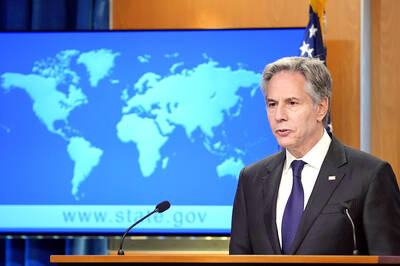
Beijing is continuing to commit genocide and crimes against humanity against Uyghurs and other Muslim minorities in its western Xinjiang province, U.S. Secretary of State Antony Blinken said in a report published on Monday, ahead of his planned visit to China this week. The State Department’s annual human rights report, which documents abuses recorded all over the world during the previous calendar year, repeated language from previous years on the treatment of Muslims in Xinjiang, but the publication raises the issue ahead of delicate talks, including on the war in Ukraine and global trade, between the top U.S. diplomat and Chinese


 RSS
RSS