


Today's domestic cats can be traced to wild progenitors that interbred well over 100,000 years ago, new research indicates.
"House cats -- which includes fancy breeds and feral cats -- those cats all form a genetic group that is virtually indistinguishable from ones in the Middle East," said Stephen O'Brien of the National Cancer Institute (NCI).
"So, domestication, for sure, took place in the Middle East where those cats live today," added O'Brien, co-author of a paper appearing in this week's online edition of the journal Science.
Carlos Driscoll, of Oxford University and NCI, and an international team of researchers studied the origins of cats.
"It's serious research, because cats are a model for some human genetic diseases, such as polycystic kidney disease and retinal atrophy," Driscoll explained in a telephone interview.
In addition, the work is expected to assist in conservation efforts for wild cats, he said.
The ancestry of cats was traced to five types of wild cats, Driscoll said. Rather than being domesticated five times, these five types managed to interbreed at various times, with the result being Felis silvestris lybica, which appears to be the ancestor of modern house cats.
Cats may have been domesticated once or many times, he said, adding that the most likely case is they were domesticated once and other wild cats bred with the domesticated ones.
"I wasn't there, but all the data supports that," he said.
The researchers found the other Felis silvestris subspecies long associated with cat origins.
"Since the DNA samples were taken from cats in remote desert areas there would be less likelihood of hybridization occurring," he said. "I would like to know more about these cats."
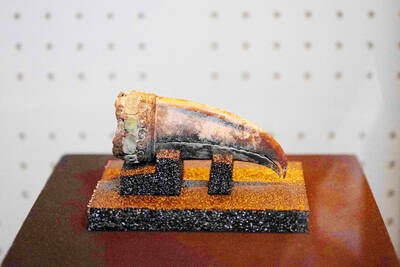
Archeologists in Peru on Thursday said they found the 5,000-year-old remains of a noblewoman at the sacred city of Caral, revealing the important role played by women in the oldest center of civilization in the Americas. “What has been discovered corresponds to a woman who apparently had elevated status, an elite woman,” archeologist David Palomino said. The mummy was found in Aspero, a sacred site within the city of Caral that was a garbage dump for more than 30 years until becoming an archeological site in the 1990s. Palomino said the carefully preserved remains, dating to 3,000BC, contained skin, part of the
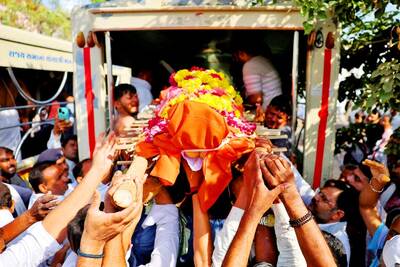
‘WATER WARFARE’: A Pakistani official called India’s suspension of a 65-year-old treaty on the sharing of waters from the Indus River ‘a cowardly, illegal move’ Pakistan yesterday canceled visas for Indian nationals, closed its airspace for all Indian-owned or operated airlines, and suspended all trade with India, including to and from any third country. The retaliatory measures follow India’s decision to suspend visas for Pakistani nationals in the aftermath of a deadly attack by shooters in Kashmir that killed 26 people, mostly tourists. The rare attack on civilians shocked and outraged India and prompted calls for action against their country’s archenemy, Pakistan. New Delhi did not publicly produce evidence connecting the attack to its neighbor, but said it had “cross-border” links to Pakistan. Pakistan denied any connection to

TRUMP EFFECT: The win capped one of the most dramatic turnarounds in Canadian political history after the Conservatives had led the Liberals by more than 20 points Canadian Prime Minister Mark Carney yesterday pledged to win US President Donald Trump’s trade war after winning Canada’s election and leading his Liberal Party to another term in power. Following a campaign dominated by Trump’s tariffs and annexation threats, Carney promised to chart “a new path forward” in a world “fundamentally changed” by a US that is newly hostile to free trade. “We are over the shock of the American betrayal, but we should never forget the lessons,” said Carney, who led the central banks of Canada and the UK before entering politics earlier this year. “We will win this trade war and

Armed with 4,000 eggs and a truckload of sugar and cream, French pastry chefs on Wednesday completed a 121.8m-long strawberry cake that they have claimed is the world’s longest ever made. Youssef El Gatou brought together 20 chefs to make the 1.2 tonne masterpiece that took a week to complete and was set out on tables in an ice rink in the Paris suburb town of Argenteuil for residents to inspect. The effort overtook a 100.48m-long strawberry cake made in the Italian town of San Mauro Torinese in 2019. El Gatou’s cake also used 350kg of strawberries, 150kg of sugar and 415kg of


 RSS
RSS