


Russia successfully tested a new sea-based ballistic missile after several previous failures, a naval spokesman said, in the nation's second major test of new missile technologies in a month.
Captain Igor Dygalo said that the Bulava missile hit its target on the Pacific peninsula of Kamchatka, about 6,700km east of Moscow, after being launched on Thursday from the submarine Dmitry Donskoi in northern Russia's White Sea.
Russian President Vladimir Putin has hailed the Bulava as a key component of the nation's nuclear forces for years to come and boasted about its ability to penetrate any prospective missile defenses.
However, three earlier tests of the Bulava in recent years ended in failure, raising doubts about the missile's future.
Pavel Felgenhauer, an independent military analyst, said a successful launch would be good for the future of Russia's missile forces, but he said he had doubts, given the missile's past track record and the military's penchant for secrecy.
A Bulava test failure last December was not publicly announced by the military, leaking out only in newspaper reports.
Russian media speculated that military was trying to not embarrass Sergei Ivanov, the former defense minister who is now a first deputy prime minister and is widely considered a leading candidate to succeed Putin in next year's presidential election.
design
According to published Russian reports, the Bulava is designed to have a range of 10,000km and to carry six individually targeted nuclear warheads. It is expected to equip three new Borei-class nuclear submarines that are under construction.
The missile is being developed by the Moscow-based Thermal Technology Institute, which designed the ground-based Topol-M missile and had no previous experience in building submarine-based missiles.
Thursday's test comes amid an aggressive Russian effort to upgrade its missile forces and technologies after years of underfunding and a lack of testing.
preliminary test
On May 29, the Strategic Rocket Forces reported that it tested an intercontinental ballistic missile capable of carrying multiple independent warheads. A "preliminary" test was also carried out of a tactical cruise missile that Ivanov said could fly farther than existing, similar weapons.
US plans to deploy a missile defense system in Poland and the Czech Republic have also sparked increasingly belligerent comments from Putin and other top military and government officials in Moscow. Both nations are former Warsaw Pact members who are now a part of NATO.

‘IN A DIFFERENT PLACE’: The envoy first visited Shanghai, where he attended a Chinese basketball playoff match, and is to meet top officials in Beijing tomorrow US Secretary of State Antony Blinken yesterday arrived in China on his second visit in a year as the US ramps up pressure on its rival over its support for Russia while also seeking to manage tensions with Beijing. The US diplomat tomorrow is to meet China’s top brass in Beijing, where he is also expected to plead for restraint as Taiwan inaugurates president-elect William Lai (賴清德), and to raise US concerns on Chinese trade practices. However, Blinken is also seeking to stabilize ties, with tensions between the world’s two largest economies easing since his previous visit in June last year. At the

UNSETTLING IMAGES: The scene took place in front of TV crews covering the Trump trial, with a CNN anchor calling it an ‘emotional and unbelievably disturbing moment’ A man who doused himself in an accelerant and set himself on fire outside the courthouse where former US president Donald Trump is on trial has died, police said yesterday. The New York City Police Department (NYPD) said the man was declared dead by staff at an area hospital. The man was in Collect Pond Park at about 1:30pm on Friday when he took out pamphlets espousing conspiracy theories, tossed them around, then doused himself in an accelerant and set himself on fire, officials and witnesses said. A large number of police officers were nearby when it happened. Some officers and bystanders rushed

Beijing is continuing to commit genocide and crimes against humanity against Uyghurs and other Muslim minorities in its western Xinjiang province, U.S. Secretary of State Antony Blinken said in a report published on Monday, ahead of his planned visit to China this week. The State Department’s annual human rights report, which documents abuses recorded all over the world during the previous calendar year, repeated language from previous years on the treatment of Muslims in Xinjiang, but the publication raises the issue ahead of delicate talks, including on the war in Ukraine and global trade, between the top U.S. diplomat and Chinese
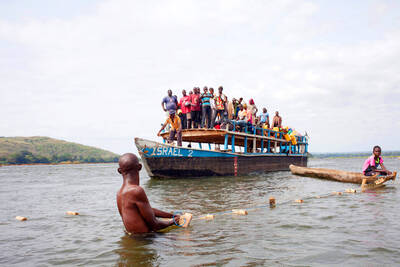
RIVER TRAGEDY: Local fishers and residents helped rescue people after the vessel capsized, while motorbike taxis evacuated some of the injured At least 58 people going to a funeral died after their overloaded river boat capsized in the Central African Republic’s (CAR) capital, Bangui, the head of civil protection said on Saturday. “We were able to extract 58 lifeless bodies,” Thomas Djimasse told Radio Guira. “We don’t know the total number of people who are underwater. According to witnesses and videos on social media, the wooden boat was carrying more than 300 people — some standing and others perched on wooden structures — when it sank on the Mpoko River on Friday. The vessel was heading to the funeral of a village chief in


 RSS
RSS