


The melting of nearby glaciers or cracks in the ground caused by an earthquake were proposed by scientists on Thursday as possible causes for the disappearance of a 2-hectare glacial lake in southern Chile.
The disappearance of the lake in Bernardo O'Higgins National Park was discovered late last month by park rangers, who were stunned to find a 40m-deep crater where a large lake had been just two months earlier, when they last visited the area.
Officials said a clear explanation of why the lake vanished would likely not be known until experts visit the remote region in Chile's southern Andes.
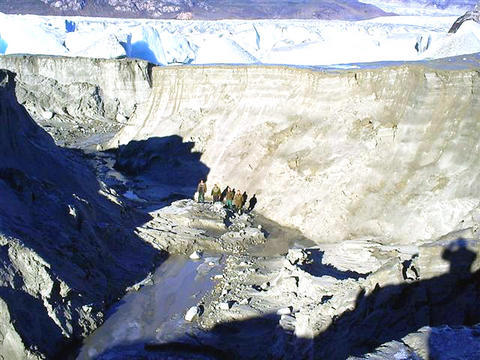
PHOTO: AFP
Juan Jose Romero, head of Chile's National Forest Service in the region, said by telephone that it would take geologists and other experts about two or three weeks to reach the remote area 2,000km south of Santiago.
But, based on pictures from the site, experts were discussing hypotheses related to global warming and seismic activity.
Gino Casassa, a glaciologist at the Center for Scientific Studies, said the cause may have been a phenomenon known as glacial lake outburst floods.
As glaciers retreat, glacial lakes form behind natural dams of ice or moraine. These relatively weak dams can be breached suddenly, causing the lake to drain. Possible causes include a sudden input of water into the lake, an earthquake or avalanches of ice or rock.
Casassa said the Chilean lake was fed by two glaciers, the Bernardo and the Tempano, "and both are receding."
The water level of the lake could have risen with the increasing flow from the melting glaciers.
"At the same time, the increased amount of water opens a tunnel under the ice, emptying the lake," Casassa said.
Another glaciologist, Andres Rivera, said that "most glaciers in the region are receding as a result of the global warming."
This may both create new lakes or cause others empty, he said.
Casassa said glaciers can recede for other reasons than global warming. It can be the result of the natural dynamic of glaciers, which recede or grow.
"But I am convinced that in this case, it is the result of global warming," he said.
The empty lake is about 1,500m above sea level.
Romero said another theory is that the water disappeared through huge cracks at the bottom of the crater. He said the cracks may have been caused by the strong quake that rocked the region on April 21.
Archeologists in Peru on Thursday said they found the 5,000-year-old remains of a noblewoman at the sacred city of Caral, revealing the important role played by women in the oldest center of civilization in the Americas. “What has been discovered corresponds to a woman who apparently had elevated status, an elite woman,” archeologist David Palomino said. The mummy was found in Aspero, a sacred site within the city of Caral that was a garbage dump for more than 30 years until becoming an archeological site in the 1990s. Palomino said the carefully preserved remains, dating to 3,000BC, contained skin, part of the

‘WATER WARFARE’: A Pakistani official called India’s suspension of a 65-year-old treaty on the sharing of waters from the Indus River ‘a cowardly, illegal move’ Pakistan yesterday canceled visas for Indian nationals, closed its airspace for all Indian-owned or operated airlines, and suspended all trade with India, including to and from any third country. The retaliatory measures follow India’s decision to suspend visas for Pakistani nationals in the aftermath of a deadly attack by shooters in Kashmir that killed 26 people, mostly tourists. The rare attack on civilians shocked and outraged India and prompted calls for action against their country’s archenemy, Pakistan. New Delhi did not publicly produce evidence connecting the attack to its neighbor, but said it had “cross-border” links to Pakistan. Pakistan denied any connection to

TRUMP EFFECT: The win capped one of the most dramatic turnarounds in Canadian political history after the Conservatives had led the Liberals by more than 20 points Canadian Prime Minister Mark Carney yesterday pledged to win US President Donald Trump’s trade war after winning Canada’s election and leading his Liberal Party to another term in power. Following a campaign dominated by Trump’s tariffs and annexation threats, Carney promised to chart “a new path forward” in a world “fundamentally changed” by a US that is newly hostile to free trade. “We are over the shock of the American betrayal, but we should never forget the lessons,” said Carney, who led the central banks of Canada and the UK before entering politics earlier this year. “We will win this trade war and

Armed with 4,000 eggs and a truckload of sugar and cream, French pastry chefs on Wednesday completed a 121.8m-long strawberry cake that they have claimed is the world’s longest ever made. Youssef El Gatou brought together 20 chefs to make the 1.2 tonne masterpiece that took a week to complete and was set out on tables in an ice rink in the Paris suburb town of Argenteuil for residents to inspect. The effort overtook a 100.48m-long strawberry cake made in the Italian town of San Mauro Torinese in 2019. El Gatou’s cake also used 350kg of strawberries, 150kg of sugar and 415kg of


 RSS
RSS