


After a decade of complaints about persistent headaches and sick children, one of the world's most polluted towns met on Wednesday for the first time with a company whose former battery recycling plant is blamed for dangerously high lead levels in the townspeople.
The result: a promise of new studies on how to clean up the mess.
"We're beyond bickering, and starting to confront this problem," said Richard Fuller, president of the New York-based Blacksmith Institute, which last year listed Haina on its list of the 10 most polluted places in the world.
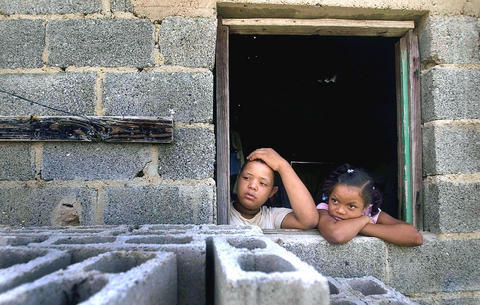
PHOTO: AP
Dominican government officials and a company accused of leaving fields strewn with lead powder from the shuttered recycling plant agreed to have a team of experts from the University of Idaho evaluate the site next month to determine what is necessary to remove the pollution. Several months after that, they'll meet again to discuss how to pay for it, participants said.
Government officials in the Caribbean nation have said they do not have the money. The company that ran the battery plant from 1979 to 1997, Metales y Oxido SA, says it is not entirely to blame.
"Haina is an industrial zone," company vice president Juan Arturo Biaggi said after the meeting. "There were a lot of factories there, not just us."
Omar Dotel, who represented the company known as Metaloxa at the meeting, said it acknowledges some responsibility and is "extremely willing to take whatever steps the government and the parties agree are necessary."
Sandra Castillo, a 33-year-old neighborhood activist, said she "saw a lot of positive things come out of the meeting," but had hoped for more.
Castillo began campaigning to shut the factory and clean up the site when her daughter was stricken with bouts of vomiting and her son began experiencing seizures. Doctors told her it was a result of lead poisoning, which can cause irreversible brain and tissue damage.
Metaloxa buried the remaining material, but it was uncovered several years later by rain, wind and scavengers seeking scrap metal.
The Dominican government said in 1999 that the site would be cleaned up, but little was done.
In 1997, New York-based Friends of Lead-Free Children, found that 91 percent of neighborhood children had lead levels considered to be dangerous by the World Health Organization (WHO). And when WHO researchers returned last year, they found soil samples that were 50 percent lead, creating toxic sludge that inundates homes at the bottom of a hill when it rains, Null said.
"It never occurred to us that when the government said it was cleaned up, that they just buried everything," Null said.
Zoila Gonzalez, an environment ministry official, said the government has lacked the money for a proper cleanup because of other pressing needs.
"The secretary is very concerned about this problem, but it is one of many," Gonzalez said.
Bienvenida Bautista, a fourth-and fifth-grade teacher in the town's public school, said she sees more students with severe learning disabilities and physical deformities than in other places she has taught.
"Children who have the lead don't learn anything. Their future will be ugly," she said.

‘CROSSING THE LINE’: China’s embassy in Seoul criticized US Forces Korea Commander General Xavier Brunson, asking if his ‘hostile’ remarks were authorized by Washington South Korea and the US are in talks over recent public remarks by the commander of US Forces Korea, Seoul’s presidential office said yesterday, after the comments drew sharp criticism from China. In a recent podcast interview, US Forces Korea Commander General Xavier Brunson described South Korea as “the dagger in the heart of Asia” from China’s east coast, prompting the Chinese embassy in Seoul to say that he had “truly crossed the line.” The interview came amid growing speculation that Washington might seek to expand the role of US Forces Korea in countering the growing regional influence of China, a key

Through the noise of rushing papers and whirring belts at a print factory in Kyoto, two creators watch their photo essay come to life in broadsheet form — part of an effort to win new audiences in the age of artificial intelligence (AI). Despite the decline of the publishing industry, self-publication and handmade “zine” magazines are growing in popularity in Japan, reflecting the nation’s enduring love of paper in the digital era. While speaking to Agence France-Presse at the plant, his hands black with ink, one of the creators, Kazuma Obara, said: “I think [paper] is a medium that engages all five

Australian researchers have trained lab-grown brain cells on a silicon computer chip to play the 1990s shooter game Doom and said they are just scratching the surface of what the neurons could be capable of doing. It is the science-fiction work of biotech boffins at Cortical Labs, who researched and developed the technology that harnesses the workings of the brain’s networking system. Each so-called “biological computer” contains about 200,000 living human brain cells, grown from stem cells that were harvested from blood donations. Having mastered the simple computer game Pong, where a paddle is moved up and down to send a ball

France experienced its hottest spring on record, the French weather service said on Tuesday, after an exceptional early heat wave that also broke highs for the season in England and Wales. Meteo-France said the average nationwide temperature over March to May was 13.8°C — about 1.7°C above the norm, and surpassing records set in 2011 and 2020. “The warmest spring since records began in 1900,” it said in a bulletin. All three months were warmer than average, but the onset of an “unprecedented heatwave” late last month pushed the mercury to highs typically seen at the height of the summer. “Our country had never


 RSS
RSS