


A breakthrough agreement to deploy a UN peacekeeping force in Darfur risks being undermined by a shortfall of up to US$1 billion in US contributions to the costs of global peacekeeping, campaigners said on Monday.
A UN delegation announced on Sunday that Sudanese President Omar al-Bashir had agreed at talks in Khartoum to allow the deployment of a 20,000-strong UN and African Union hybrid force by next year.
The deal ended months of wrangling and followed a direct threat by US President George W. Bush to impose additional sanctions on the Sudanese government.

PHOTO: EPA
At least 200,000 people have died in Darfur, in western Sudan, and an estimated 2.5 million have been displaced, since fighting between government-backed militias and rebel forces erupted in 2003.
Diplomats who attended the Khartoum talks said they expected the new Darfur force under UN command would be paid for from the UN peacekeeping budget.
But former Colorado senator Timothy Wirth, president of the UN Foundation, warned Congress last week that the proposed Darfur deployment, and other current or future UN operations, were being jeopardized by mounting US debts.
"As of June 2007 the US was US$569 million in permanent arrears to the UN for UN peacekeeping," Wirth said.
"The administration's budget request for the UN peacekeeping account for fiscal year 2008 [beginning in October this year] was found to be short by an additional estimated US$500 million," he said.
"If this is left unaddressed, US arrears to the UN will exceed US$1 billion by the end of 2007 for peacekeeping alone," Wirth said.
Deborah Derrick, executive director of the Better World Campaign, said the new Darfur agreement was being threatened by the Bush administration's failure to pay its dues.
"If the plan is to put pressure on Sudan's government but the US is unwilling to back it up, it absolutely undermines the credibility of the whole operation," Derrick said.
Public pressure on the government to pay was growing, she added. More than 32,000 people from all 50 US states had signed an online petition calling on Congress to pay its UN dues at www.priceofpeace.org.
A state department spokesman said last week that US Secretary of State Condoleezza Rice regarded paying off US peacekeeping debts as "one of her highest priorities over the next couple of years."
But Derrick said that when administration officials were asked when the cash would be handed over, "they look at their toes and say nothing."
Wirth said persistent US debts sat uncomfortably with the Bush administration's growing enthusiasm for UN peacekeeping missions, such as that launched on the Israel-Lebanon border last year and another that the US is proposing in Somalia.
More UN peacekeepers than ever before -- in excess of 80,000 -- were deployed globally last year, a study by the Center on International Cooperation at New York University said.
"The event you can probably most anticipate is the phase-out of the US presence in Iraq," Wirth said.
The White House would soon be asking for a UN mission to Baghdad, too, he said.
He also noted that developing countries, which provide the majority of peacekeeping troops, were footing the bill for richer countries."
"Bangladesh holds a US$77 million unpaid invoice because donor nations, the US in particular, are not paying their bills in full," he said.
A new global survey published by Foreign Policy magazine has underlined how high the stakes are. It named Sudan as the country most likely to become a failed state if internal conflict and deteriorating conditions were not halted.
Seven other sub-Saharan African countries are placed among the 10 most vulnerable states.
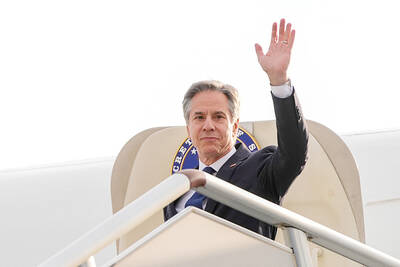
‘IN A DIFFERENT PLACE’: The envoy first visited Shanghai, where he attended a Chinese basketball playoff match, and is to meet top officials in Beijing tomorrow US Secretary of State Antony Blinken yesterday arrived in China on his second visit in a year as the US ramps up pressure on its rival over its support for Russia while also seeking to manage tensions with Beijing. The US diplomat tomorrow is to meet China’s top brass in Beijing, where he is also expected to plead for restraint as Taiwan inaugurates president-elect William Lai (賴清德), and to raise US concerns on Chinese trade practices. However, Blinken is also seeking to stabilize ties, with tensions between the world’s two largest economies easing since his previous visit in June last year. At the
Nearly half of China’s major cities are suffering “moderate to severe” levels of subsidence, putting millions of people at risk of flooding, especially as sea levels rise, according to a study of nationwide satellite data released yesterday. The authors of the paper, published by the journal Science, found that 45 percent of China’s urban land was sinking faster than 3mm per year, with 16 percent at more than 10mm per year, driven not only by declining water tables, but also the sheer weight of the built environment. With China’s urban population already in excess of 900 million people, “even a small portion

UNSETTLING IMAGES: The scene took place in front of TV crews covering the Trump trial, with a CNN anchor calling it an ‘emotional and unbelievably disturbing moment’ A man who doused himself in an accelerant and set himself on fire outside the courthouse where former US president Donald Trump is on trial has died, police said yesterday. The New York City Police Department (NYPD) said the man was declared dead by staff at an area hospital. The man was in Collect Pond Park at about 1:30pm on Friday when he took out pamphlets espousing conspiracy theories, tossed them around, then doused himself in an accelerant and set himself on fire, officials and witnesses said. A large number of police officers were nearby when it happened. Some officers and bystanders rushed

Beijing is continuing to commit genocide and crimes against humanity against Uyghurs and other Muslim minorities in its western Xinjiang province, U.S. Secretary of State Antony Blinken said in a report published on Monday, ahead of his planned visit to China this week. The State Department’s annual human rights report, which documents abuses recorded all over the world during the previous calendar year, repeated language from previous years on the treatment of Muslims in Xinjiang, but the publication raises the issue ahead of delicate talks, including on the war in Ukraine and global trade, between the top U.S. diplomat and Chinese


 RSS
RSS