


British Prime Minister Tony Blair agreed to commit British troops to battle in Iraq in the full knowledge that Washington had failed to make adequate preparations for the postwar reconstruction of the country.
In a devastating account of the chaotic preparations for the war, which comes as Blair enters his final full week in No. 10 Downing Street, key aides and friends have revealed that Blair repeatedly and unsuccessfully raised his concerns with the White House.
He also agreed to commit troops to the conflict even though US President George Bush had personally said Britain could help "some other way".
The disclosures, in a two-part documentary on Britain's Channel 4 television about Blair's decade in power, will raise questions about Blair's public assurances in 2003 that he was satisfied with the post-war planning.
In one of the most significant interviews in the program, Peter Mandelson says that Blair knew the preparations were inadequate but said he was powerless to do more about it.
"Obviously more attention should have been paid to what happened after," Mandelson tells the political commentator, Andrew Rawnsley, who is the presenter in the documentary.
"But I remember him saying at the time: `Look, you know, I can't do everything. That's chiefly America's responsibility, not ours.'" Mandelson said of Blair.
"Well, I'm afraid that, as we now see, wasn't good enough," he said.
Blair's most senior foreign affairs adviser at the time of the war makes clear that Blair was "exercised" on the exact issue raised by the war's opponents.
"It's hard to know exactly what happened over the post-war planning. I can only say that I remember the PM raising this many months before the war began. He was very exercised about it," Sir David Manning, now Britain's ambassador to Washington, said in the program.
Manning recalled that Blair was so concerned that he sent him to Washington in March 2002, a full year before the invasion.
On his return to London, Manning immediately wrote a highly-critical secret memo to Blair.
"I think there is a real risk that the [Bush] administration underestimates the difficulties," it said. "They may agree that failure isn't an option, but this does not mean that they will avoid it."
Within a year Britain lost any hope of a proper reconstruction in Iraq when post-war planning was handed to the Pentagon at the beginning of 2003.
Sir Jeremy Greenstock, British envoy to postwar administration in Baghdad, says Blair was distressed.
"There were moments of throwing his hands in the air," he said.
Secretary of State Condoleezza Rice, then Bush's national security adviser, confirms that Bush offered Blair a way out.
"Perhaps there's some other way that Britain can be involved," Rice said Bush said to Blair.
"No, I'm with you," Rice said Blair replied.
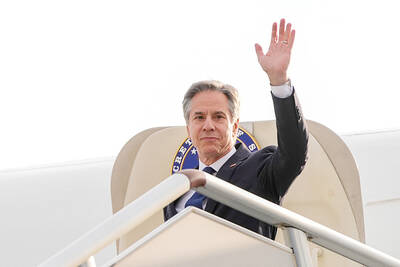
‘IN A DIFFERENT PLACE’: The envoy first visited Shanghai, where he attended a Chinese basketball playoff match, and is to meet top officials in Beijing tomorrow US Secretary of State Antony Blinken yesterday arrived in China on his second visit in a year as the US ramps up pressure on its rival over its support for Russia while also seeking to manage tensions with Beijing. The US diplomat tomorrow is to meet China’s top brass in Beijing, where he is also expected to plead for restraint as Taiwan inaugurates president-elect William Lai (賴清德), and to raise US concerns on Chinese trade practices. However, Blinken is also seeking to stabilize ties, with tensions between the world’s two largest economies easing since his previous visit in June last year. At the

UNSETTLING IMAGES: The scene took place in front of TV crews covering the Trump trial, with a CNN anchor calling it an ‘emotional and unbelievably disturbing moment’ A man who doused himself in an accelerant and set himself on fire outside the courthouse where former US president Donald Trump is on trial has died, police said yesterday. The New York City Police Department (NYPD) said the man was declared dead by staff at an area hospital. The man was in Collect Pond Park at about 1:30pm on Friday when he took out pamphlets espousing conspiracy theories, tossed them around, then doused himself in an accelerant and set himself on fire, officials and witnesses said. A large number of police officers were nearby when it happened. Some officers and bystanders rushed
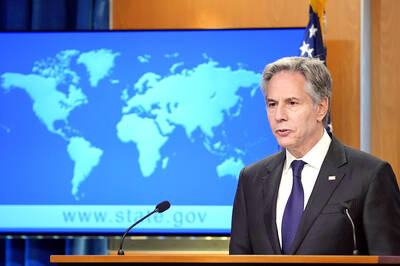
Beijing is continuing to commit genocide and crimes against humanity against Uyghurs and other Muslim minorities in its western Xinjiang province, U.S. Secretary of State Antony Blinken said in a report published on Monday, ahead of his planned visit to China this week. The State Department’s annual human rights report, which documents abuses recorded all over the world during the previous calendar year, repeated language from previous years on the treatment of Muslims in Xinjiang, but the publication raises the issue ahead of delicate talks, including on the war in Ukraine and global trade, between the top U.S. diplomat and Chinese
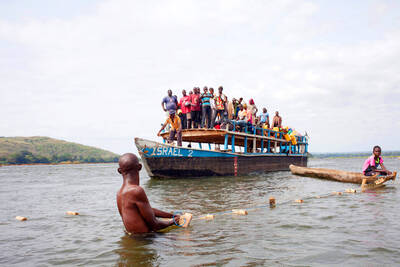
RIVER TRAGEDY: Local fishers and residents helped rescue people after the vessel capsized, while motorbike taxis evacuated some of the injured At least 58 people going to a funeral died after their overloaded river boat capsized in the Central African Republic’s (CAR) capital, Bangui, the head of civil protection said on Saturday. “We were able to extract 58 lifeless bodies,” Thomas Djimasse told Radio Guira. “We don’t know the total number of people who are underwater. According to witnesses and videos on social media, the wooden boat was carrying more than 300 people — some standing and others perched on wooden structures — when it sank on the Mpoko River on Friday. The vessel was heading to the funeral of a village chief in


 RSS
RSS