


With the four-month-old "surge" in US troops showing only modest success in curbing insurgent attacks, US commanders are turning to another strategy they acknowledge is fraught with risk: arming Sunni Arab groups that have promised to fight al-Qaeda-linked militants who have been their allies in the past.
US commanders say they have successfully tested the strategy in Anbar Province and have held talks with Sunni groups suspected of prior assaults on US units, or of links to groups that have attacked US units in at least four other areas where the insurgency has been strong.
In some cases, the US commanders say, these groups have been provided, usually through Iraqi military units allied with the US, with arms, ammunition, cash, fuel and other supplies.
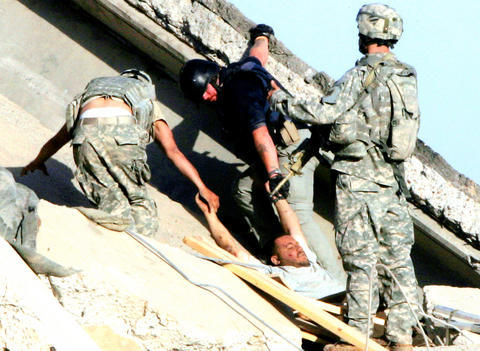
PHOTO: AP
US officials who have engaged in what they call "outreach" to the Sunni groups say the groups are mostly linked to al-Qaeda but disillusioned with al-Qaeda's extremist tactics, particularly suicide bombings that have killed thousands of Iraqi civilians.
In exchange for US backing, these official say, the Sunni groups have agreed to fight al-Qaeda and halt attacks on US units.
Commanders who have undertaken these negotiations say that in some cases Sunni groups have agreed to alert US troops to the location of roadside bombs and other lethal boobytraps.
But critics of the strategy, including some US officers, say it could amount to the US arming both sides in a future civil war.
The US has spent more than US$15 billion in building up Iraq's new army and police, whose 350,000 members are heavily Shiite.
With a US troop drawdown increasingly likely in the next year and little sign of a political accommodation between Shiite and Sunni politicians in Baghdad, the critics say, there is a strong prospect that any weapons given to Sunni groups will eventually be used against Shiites.
US commanders met this month in Baghdad with General David Petraeus, the top US commander in Iraq, to discus the conditions Sunni groups would have to meet to win US assistance.
Senior officers who attended the meeting said that Petraeus and the operational commander who is the second-ranking US officer here, Lieutenant General Raymond Odierno, gave cautious approval to field commanders to negotiate with Sunni groups in their areas.
Meanwhile, Iraq's leading political blocs agreed on Sunday to replace the speaker of parliament, Mahmoud Mashadani, a Sunni, after accusations that his bodyguards assaulted a Shiite lawmaker as the speaker cursed him and then dragged him to the speaker's office.
Four lawmakers and an aide confirmed the details of the skirmish and the effort to remove Mashadani, including Saleem Abdullah, a parliament member and spokesman for Mashadani's bloc, the Iraqi Consensus Front
Abdullah said the new speaker of the 275-member Iraqi Council of Representatives would be likely be another Sunni Arab.
"We are now in negotiations to find another candidate," he said. If carried out, the move would come at an already difficult time for Iraq's largest elected body. Mashadani's tenure, which began after the December 2005 election, has been characterized by personal volatility, sectarian division among members and legislative inertia.
The scuffle on Sunday was the third time this year that Mashadani or members of his staff have been accused of physically assaulting members of parliament. The most recent incident was last month, when Mashadani slapped a Sunni lawmaker who questioned the speaker's decision to rush out of a legislative session in disgust after a Shiite colleague questioned the government's sensitivity to the plight of displaced Shiite families.
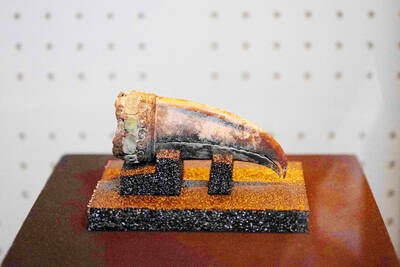
Archeologists in Peru on Thursday said they found the 5,000-year-old remains of a noblewoman at the sacred city of Caral, revealing the important role played by women in the oldest center of civilization in the Americas. “What has been discovered corresponds to a woman who apparently had elevated status, an elite woman,” archeologist David Palomino said. The mummy was found in Aspero, a sacred site within the city of Caral that was a garbage dump for more than 30 years until becoming an archeological site in the 1990s. Palomino said the carefully preserved remains, dating to 3,000BC, contained skin, part of the

TRUMP EFFECT: The win capped one of the most dramatic turnarounds in Canadian political history after the Conservatives had led the Liberals by more than 20 points Canadian Prime Minister Mark Carney yesterday pledged to win US President Donald Trump’s trade war after winning Canada’s election and leading his Liberal Party to another term in power. Following a campaign dominated by Trump’s tariffs and annexation threats, Carney promised to chart “a new path forward” in a world “fundamentally changed” by a US that is newly hostile to free trade. “We are over the shock of the American betrayal, but we should never forget the lessons,” said Carney, who led the central banks of Canada and the UK before entering politics earlier this year. “We will win this trade war and

‘BODIES EVERYWHERE’: The incident occurred at a Filipino festival celebrating an anti-colonial leader, with the driver described as a ‘lone suspect’ known to police Canadian police arrested a man on Saturday after a car plowed into a street party in the western Canadian city of Vancouver, killing a number of people. Authorities said the incident happened shortly after 8pm in Vancouver’s Sunset on Fraser neighborhood as members of the Filipino community gathered to celebrate Lapu Lapu Day. The festival, which commemorates a Filipino anti-colonial leader from the 16th century, falls this year on the weekend before Canada’s election. A 30-year-old local man was arrested at the scene, Vancouver police wrote on X. The driver was a “lone suspect” known to police, a police spokesperson told journalists at the
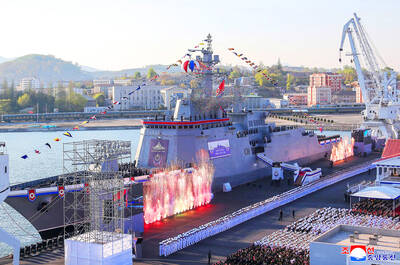
North Korean leader Kim Jong-un has unveiled a new naval destroyer, claiming it as a significant advancement toward his goal of expanding the operational range and preemptive strike capabilities of his nuclear-armed military, state media said yesterday. North Korea’s state-run Korean Central News Agency (KCNA) said Kim attended the launching ceremony for the 5,000-tonne warship on Friday at the western port of Nampo. Kim framed the arms buildup as a response to perceived threats from the US and its allies in Asia, who have been expanding joint military exercises amid rising tensions over the North’s nuclear program. He added that the acquisition


 RSS
RSS