


Belgians headed to the polls yesterday in legislative and senate elections widely expected to dash Prime Minister Guy Verhofstadt's hopes for a third four-year term in office.
As always in linguistically divided Belgium's politics, the country's language faultline will play a key role, with the party that comes out on top in the northern Dutch-speaking Flanders likely to pick the next prime minister.
Polls opened at 8am and traditional paper ballot voting was due to close at 1pm. Electronic voting will finish at 3pm. First results were not expected until 5pm and complete results were due in around midnight.
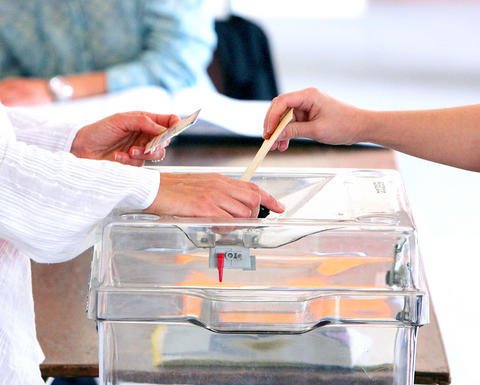
PHOTO: AP
Since no party fields candidates in both of Belgium's two main regions, winning in Flanders, where 60 percent of the population live, is key to national success.
Polls have consistently shown the Flemish Christian Democrats winning the most votes in Flanders, making it likely that the regional leader and party heavyweight Yves Leterme, 46, will emerge as the next prime minister.
But while Leterme's platform of more power for regional bodies goes down well in Flanders, he has in the past angered French-speakers in the southern region of Wallonia by disparaging their failure to learn Dutch.
While perfectly bilingual thanks to his francophone father and Flemish mother, it is far from certain that Leterme will be able to bridge the linguistic divide in Belgian politics and life.
Although the Flemish Christian Democracts look set to play the key role in the next government, a round of tough horse-trading is likely before a coalition is agreed, which can take months.
FRENCH POLLS
The French headed back to the polls yesterday in a parliamentary election tipped to give right-wing President Nicolas Sarkozy the majority he needs to push through an ambitious reform program.
Sarkozy's UMP (Union for a Popular Movement) has been riding high on the president's popularity since he was elected last month vowing to put an end to high unemployment, poor economic growth and social discontent in high-immigration suburbs.
The UMP has ruled for the last five years in an unpopular government, but opinion polls predict that thanks to Sarkozy's electoral appeal it will increase its majority and emasculate the already weakened Socialist Party.
Polls opened across France at 8am for the first round of voting, with round two to be held next Sunday. They close 12 hours later, with normally reliable result projections due out immediately.
Sarkozy, confident of another electoral victory, has promised a special parliamentary session for next month to push through a raft of reforms, including tougher sentencing rules, restrictions on immigration and more autonomy for universities.
Voters are returning to the polls to choose the 577 members of the National Assembly, the lower house of parliament.
ITALIAN BALLOTS
Italians return to the polls yesterday and today for run-off elections in cities and provinces where the center-right opposition hopes to build on gains made two weeks ago.
"If the left were to lose the province of Genoa, that could be a decisive turning point" bringing down the government, opposition leader and former prime minister Silvio Berlusconi said on Friday.
The center-left held on to the city of Genoa, the biggest city at stake in the election, in the first round.
Among the 69 cities holding run-off mayoral contests are north-central Parma and Tarento in the south, but the center-left incumbents are expected to prevail.
Some 10 million Italians, about one-fifth of the electorate, were eligible to vote, but turnout in the first round fell compared to similar polls five years ago, from 77 percent to 74.8 percent in the municipal elections and from 64.4 percent to 57.4 percent in the gubernatorial races.
The voting concerned 856 municipalities of a total of about 8,000, as well as the governors of seven of the country's 104 provinces.
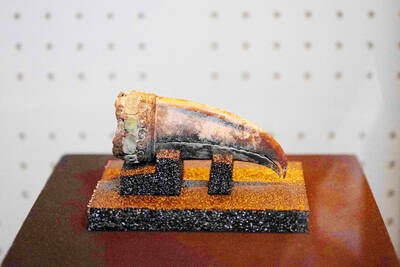
Archeologists in Peru on Thursday said they found the 5,000-year-old remains of a noblewoman at the sacred city of Caral, revealing the important role played by women in the oldest center of civilization in the Americas. “What has been discovered corresponds to a woman who apparently had elevated status, an elite woman,” archeologist David Palomino said. The mummy was found in Aspero, a sacred site within the city of Caral that was a garbage dump for more than 30 years until becoming an archeological site in the 1990s. Palomino said the carefully preserved remains, dating to 3,000BC, contained skin, part of the
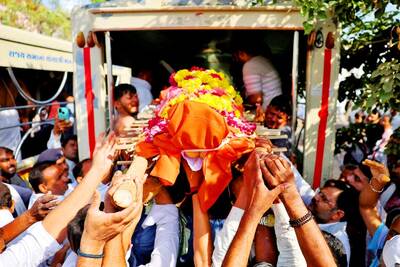
‘WATER WARFARE’: A Pakistani official called India’s suspension of a 65-year-old treaty on the sharing of waters from the Indus River ‘a cowardly, illegal move’ Pakistan yesterday canceled visas for Indian nationals, closed its airspace for all Indian-owned or operated airlines, and suspended all trade with India, including to and from any third country. The retaliatory measures follow India’s decision to suspend visas for Pakistani nationals in the aftermath of a deadly attack by shooters in Kashmir that killed 26 people, mostly tourists. The rare attack on civilians shocked and outraged India and prompted calls for action against their country’s archenemy, Pakistan. New Delhi did not publicly produce evidence connecting the attack to its neighbor, but said it had “cross-border” links to Pakistan. Pakistan denied any connection to

TRUMP EFFECT: The win capped one of the most dramatic turnarounds in Canadian political history after the Conservatives had led the Liberals by more than 20 points Canadian Prime Minister Mark Carney yesterday pledged to win US President Donald Trump’s trade war after winning Canada’s election and leading his Liberal Party to another term in power. Following a campaign dominated by Trump’s tariffs and annexation threats, Carney promised to chart “a new path forward” in a world “fundamentally changed” by a US that is newly hostile to free trade. “We are over the shock of the American betrayal, but we should never forget the lessons,” said Carney, who led the central banks of Canada and the UK before entering politics earlier this year. “We will win this trade war and
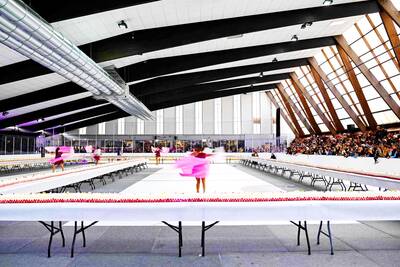
Armed with 4,000 eggs and a truckload of sugar and cream, French pastry chefs on Wednesday completed a 121.8m-long strawberry cake that they have claimed is the world’s longest ever made. Youssef El Gatou brought together 20 chefs to make the 1.2 tonne masterpiece that took a week to complete and was set out on tables in an ice rink in the Paris suburb town of Argenteuil for residents to inspect. The effort overtook a 100.48m-long strawberry cake made in the Italian town of San Mauro Torinese in 2019. El Gatou’s cake also used 350kg of strawberries, 150kg of sugar and 415kg of


 RSS
RSS