


The Bush administration attempted to wipe the slate clean on the Iraq war on Friday and chart a new way forward with the surprise announcement that it was replacing General Peter Pace as chairman of the Joint Chiefs of Staff.
US Secretary of Defense Robert Gates said he had reluctantly decided on the reshuffle -- despite his initial support for Pace -- to avoid a "divisive ordeal" at the Senate which would have had to approve an extension of the general's term.
"The focus of this confirmation process would have been on the past rather than on the future," Gates said at the press conference. "There was a very real prospect that the process would be quite contentious."
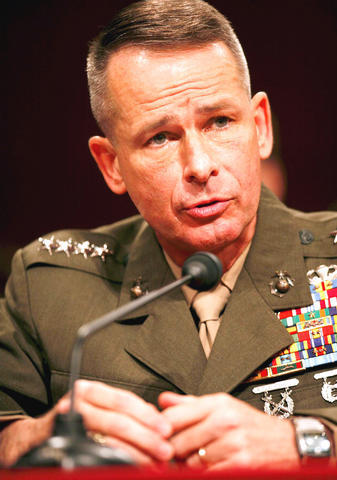
PHOTO: EPA
Gates said he had nominated Admiral Mike Mullen, who is currently chief of naval operations, to replace Pace.
In another house-cleaning move, the vice chairman of the Joint Chiefs of Staff, Admiral Edmund Gambastiani, also announced his retirement on Friday.
A career Marine, Pace has been at the center of military decision-making by the Bush administration on Afghanistan and Iraq for the last six years.
As vice chairman and then chairman of the Joint Chiefs of Staff, he was a key architect of the 2003 invasion to remove former Iraqi president Saddam Hussein, as well as the post-war planning.
The decision not to fight for Pace was seen as a sign of the administration's eagerness to open a new chapter in the Iraq war, and so help rebuild wavering Republican support for troop increases.
Gates denied any doubts about Pace's performance.
"I am disappointed that the circumstances make this kind of decision necessary," Gates said. "I wish that were not the case."
The secretary said the political figures he had conferred with were unanimous in their respect for Pace -- and unanimous in their feeling that a change in Pentagon leadership was needed.
It was also seen as an extraordinary retreat for an administration which had earlier prided itself on its resolve in pursuing policy matters, as well as loyalty to personnel. Gates told the press conference that conversations in recent weeks with both Republican and Democratic senators had convinced him that a confirmation process would have shone the spotlight on the prosecution of the war.
That spectacle could have proved devastating at a time when the White House is fighting hard to maintain Republican support for additional troops in Iraq. Republican leaders have warned the White House repeatedly that they need to see concrete results from the surge by September if they are to continue to justify their support to a war-weary public.
That task grew even more difficult in recent days as the death toll among US troops serving in Iraq reached a grim milestone of 3,500.
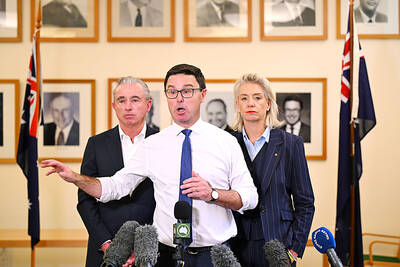
BACKLASH: The National Party quit its decades-long partnership with the Liberal Party after their election loss to center-left Labor, which won a historic third term Australia’s National Party has split from its conservative coalition partner of more than 60 years, the Liberal Party, citing policy differences over renewable energy and after a resounding loss at a national election this month. “Its time to have a break,” Nationals leader David Littleproud told reporters yesterday. The split shows the pressure on Australia’s conservative parties after Prime Minister Anthony Albanese’s center-left Labor party won a historic second term in the May 3 election, powered by a voter backlash against US President Donald Trump’s policies. Under the long-standing partnership in state and federal politics, the Liberal and National coalition had shared power

A Croatian town has come up with a novel solution to solve the issue of working parents when there are no public childcare spaces available: pay grandparents to do it. Samobor, near the capital, Zagreb, has become the first in the country to run a “Grandmother-Grandfather Service,” which pays 360 euros (US$400) a month per child. The scheme allows grandparents to top up their pension, but the authorities also hope it will boost family ties and tackle social isolation as the population ages. “The benefits are multiple,” Samobor Mayor Petra Skrobot told reporters. “Pensions are rather low and for parents it is sometimes

CONTROVERSY: During the performance of Israel’s entrant Yuval Raphael’s song ‘New Day Will Rise,’ loud whistles were heard and two people tried to get on stage Austria’s JJ yesterday won the Eurovision Song Contest, with his operatic song Wasted Love triumphing at the world’s biggest live music television event. After votes from national juries around Europe and viewers from across the continent and beyond, JJ gave Austria its first victory since bearded drag performer Conchita Wurst’s 2014 triumph. After the nail-biting drama as the votes were revealed running into yesterday morning, Austria finished with 436 points, ahead of Israel — whose participation drew protests — on 357 and Estonia on 356. “Thank you to you, Europe, for making my dreams come true,” 24-year-old countertenor JJ, whose

A documentary whose main subject, 25-year-old photojournalist Fatima Hassouna, was killed in an Israeli airstrike in Gaza weeks before it premiered at Cannes stunned viewers into silence at the festival on Thursday. As the cinema lights came back on, filmmaker Sepideh Farsi held up an image of the young Palestinian woman killed with younger siblings on April 16, and encouraged the audience to stand up and clap to pay tribute. “To kill a child, to kill a photographer is unacceptable,” Farsi said. “There are still children to save. It must be done fast,” the exiled Iranian filmmaker added. With Israel


 RSS
RSS