


US Republican presidential hopefuls hammered Democrats on Iraq on Tuesday and began to split with beleaguered US President George W. Bush in their third 2008 campaign debate.
Ten candidates vying for the party's presidential nomination also turned on one another over illegal immigration as they crammed onto the same stage in New Hampshire as their Democratic rivals two nights earlier.
However, they agreed that Iran must not develop atomic weapons even if a tactical nuclear strike is needed to stop it and accused Democrats of being soft on the issue.
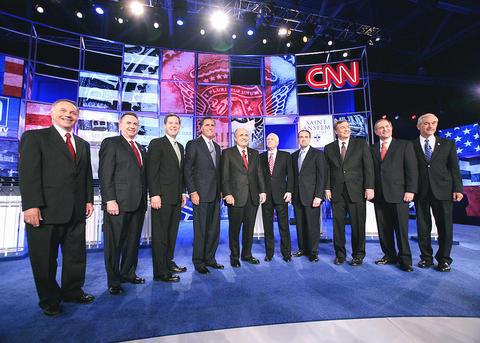
PHOTO: AFP
The Manchester debate was the latest step in the gruelling campaign running up to caucus and primary contests early next year for both party nominations.
It was notable for one man who was not there -- actor and former senator Fred Thompson, expected to leap into the top-tier of the field when he formally enters the race within weeks.
Leading candidates Senator John McCain, former Massachusetts governor Mitt Romney and the ex-mayor of New York Rudolph Giuliani avoided major gaffes, and none of the long-shot contenders appeared to break out.
"The Democrats are in denial," said Giuliani, adding that the US decision to invade Iraq in 2003 was "absolutely the right thing to do."
"It's unthinkable to leave Saddam Hussein in charge of Iraq and be able to fight the war on terror," he said.
McCain took direct aim at Democratic front-runner Senator Hillary Clinton, who like her party rivals has vowed to end the war if she is elected president.
"When Senator Clinton says this is Mr. Bush's war, that this is President Bush's war -- when President Clinton was in power, I didn't say that Bosnia, our intervention there was President Clinton's war," McCain said.
"When we intervened in Kosovo, I didn't say it was President Clinton's war," he said.
Romney condemned Democratic Senate Majority leader Harry Reid for his comment last month that "the war in Iraq is lost."
"Harry Reid was wrong. We did not lose the war in Iraq. And that's not the sort of thing you say when you have men and women in harm's way," Romney said.
There were also signs Republican candidates were beginning to edge away from Bush, and his bottom-rung approval ratings, on Iraq, and other issues.
"We did, however, not do a great job after we knocked down Saddam Hussein and won the war to take him down and his military," Romney said. "I think we made mistakes following the conduct or the collapse of Saddam's government."
McCain went further, saying the problem in Iraq was "the misman-agement of the conflict."
Longshot candidate Representative Tom Tancredo accused Bush of presiding over a new era of bloated and profligate government in Washington.
"The president ran as a conservative and governed as a liberal," he said.
When asked whether a tactical nuclear strike against Iran might be necessary, Giuliani said: "You shouldn't take any options off the table."
A second-tier candidate, California Representative Duncan Hunter, was more direct, saying the US reserved the right to dissuade Iran militarily.
"I would authorize the use of tactical nuclear weapons if there was no other way to preempt those particular centrifuges," he said, while noting it could probably be done with conventional weapons.
But Texas Representative Ron Paul, a candidate drawing about 2 percent in opinion polls, opposed a nuclear strike on moral grounds and because he believed Iran was no threat to US national security.
There were fiery exchanges as candidates sparred on a new bill in Congress on immigration which would grant a course to citizenship for up to 12 million illegal workers and has infuriated conservatives.
As well as Tancredo, other long-shot candidates were former Arkansas governor Mike Huckabee, former Virginia governor Jim Gilmore, Senator Sam Brownback and former Wisconsin governor Tommy Thompson.
While national polls have Giuliani in the lead, his advantage has eroded in recent weeks. Romney has shot into the lead in some polls in Iowa, home of the first nominating caucus next January, and McCain has been running strongly in New Hampshire.
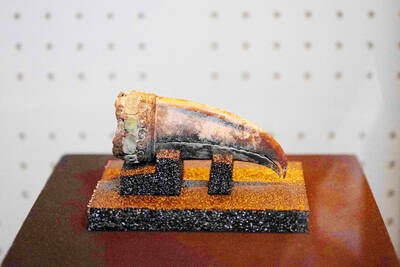
Archeologists in Peru on Thursday said they found the 5,000-year-old remains of a noblewoman at the sacred city of Caral, revealing the important role played by women in the oldest center of civilization in the Americas. “What has been discovered corresponds to a woman who apparently had elevated status, an elite woman,” archeologist David Palomino said. The mummy was found in Aspero, a sacred site within the city of Caral that was a garbage dump for more than 30 years until becoming an archeological site in the 1990s. Palomino said the carefully preserved remains, dating to 3,000BC, contained skin, part of the
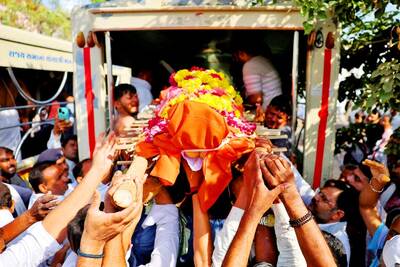
‘WATER WARFARE’: A Pakistani official called India’s suspension of a 65-year-old treaty on the sharing of waters from the Indus River ‘a cowardly, illegal move’ Pakistan yesterday canceled visas for Indian nationals, closed its airspace for all Indian-owned or operated airlines, and suspended all trade with India, including to and from any third country. The retaliatory measures follow India’s decision to suspend visas for Pakistani nationals in the aftermath of a deadly attack by shooters in Kashmir that killed 26 people, mostly tourists. The rare attack on civilians shocked and outraged India and prompted calls for action against their country’s archenemy, Pakistan. New Delhi did not publicly produce evidence connecting the attack to its neighbor, but said it had “cross-border” links to Pakistan. Pakistan denied any connection to

TRUMP EFFECT: The win capped one of the most dramatic turnarounds in Canadian political history after the Conservatives had led the Liberals by more than 20 points Canadian Prime Minister Mark Carney yesterday pledged to win US President Donald Trump’s trade war after winning Canada’s election and leading his Liberal Party to another term in power. Following a campaign dominated by Trump’s tariffs and annexation threats, Carney promised to chart “a new path forward” in a world “fundamentally changed” by a US that is newly hostile to free trade. “We are over the shock of the American betrayal, but we should never forget the lessons,” said Carney, who led the central banks of Canada and the UK before entering politics earlier this year. “We will win this trade war and

Armed with 4,000 eggs and a truckload of sugar and cream, French pastry chefs on Wednesday completed a 121.8m-long strawberry cake that they have claimed is the world’s longest ever made. Youssef El Gatou brought together 20 chefs to make the 1.2 tonne masterpiece that took a week to complete and was set out on tables in an ice rink in the Paris suburb town of Argenteuil for residents to inspect. The effort overtook a 100.48m-long strawberry cake made in the Italian town of San Mauro Torinese in 2019. El Gatou’s cake also used 350kg of strawberries, 150kg of sugar and 415kg of


 RSS
RSS