


Russian President Vladimir Putin's threat to aim missiles at Europe was a rational Russian response to US missile defense plans and other deployments that call Washington's stated intentions into question, analysts say.
His recent rhetorical offensive also marks a "line in the sand" to halt what Moscow sees as a pattern of thwarted expectations and broken promises by the US since the 1991 Soviet collapse that have left Russia feeling isolated and threatened, they say.
"The US has literally changed its military deployment in Europe," said Bob Ayers, a former US intelligence officer specializing in intelligence and security policy as an associate fellow with the London-based international policy think tank Chatham House.
"They're moving forces into bases in Poland and countries that were former members of the Warsaw Pact. In Russian eyes, here's the US superpower drawing closer and closer to their borders," he said.
"Even if the Russians were not paranoid they would have to be asking the question: Why are you doing this?" he said.
"We're not seeing a Russian action here. We're seeing a Russian reaction -- to things that we have done," he said.
Despite controversy over US plans to deploy components of a new missile shield in Poland and the Czech Republic, Washington insists the system is only to protect against missiles from "rogue states" like Iran or North Korea and in no way dilutes the potency of Russia's strategic deterrent.
Indeed no one claims that the 10 simple interceptor missiles Washington wants to place in Poland themselves constitute a viable defense against Russia's missile forces. But the claim that deployment of the new system "poses no threat" to Russia is disingenuous at best, analysts say.
"Any missile defense system is de facto an element of the strategic balance in the world," explained Gennady Evstafiev, former head of the proliferation department in the Russian SVR foreign intelligence service and a retired general accredited to the Russia-NATO Council until 2003.
"The Americans say `well, it's just these 10 little rockets.' But this is not the issue -- of course these things are not a threat to us," Evstafiev said. "The real issue is that no one knows what comes next. What do the Americans plan to do after that?"
It is precisely that uncertainty about how the US will proceed after it has set up the missile shield in central Europe that most worries Russia, experts say.
In his interview with newspapers from the G8 countries on the eve of this week's summit, Putin explicitly underscored the linkage between the ostensibly "harmless" US missile defense shield to be deployed in Europe and Washington's strategic nuclear deterrent.
The US plan "simply alters the entire international security configuration," Putin said.
US officials reject Putin's analysis and insist Russia has nothing to worry about.
"This missile shield is directed at other nations," White House spokesman Gordon Johndroe said last week.
US Secretary of State Condoleezza Rice has repeatedly -- and, in the eyes of Russian policymakers, arrogantly -- termed Russia's concerns over the missile shield "ludicrous."
But Evstafiev, now a senior adviser with the Center for Policy Studies, an independent Moscow-based security think tank, echoed comments from top Russian officials who say they do not consider their own worries to be ludicrous.
He said that in addition to the basing of 10 interceptor missiles in Poland, the US plan to install a powerful radar outside Prague was a source of major concern in Russian strategic planning circles.
"This radar is linked to space-based elements and will survey Russian territory as far east as the Urals," he said, adding that it would give the US unprecedented intelligence on Russian missile deployments and ballistic trajectories.
Other analysts agree and say Washington would do well to find a way to definitively calm Russia's worry over the missile shield.
"Missile defense locks us in confrontational mentality, imposing Cold War schemes on the US-Russian relationship," said Pavel Podvig, an international security expert at Stanford University.
"This is what Rice should have termed `purely ludicrous,'" he said in an article published recently by the specialist nuclear security journal Bulletin of the Atomic Scientists.
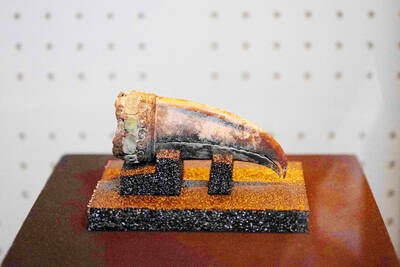
Archeologists in Peru on Thursday said they found the 5,000-year-old remains of a noblewoman at the sacred city of Caral, revealing the important role played by women in the oldest center of civilization in the Americas. “What has been discovered corresponds to a woman who apparently had elevated status, an elite woman,” archeologist David Palomino said. The mummy was found in Aspero, a sacred site within the city of Caral that was a garbage dump for more than 30 years until becoming an archeological site in the 1990s. Palomino said the carefully preserved remains, dating to 3,000BC, contained skin, part of the

‘WATER WARFARE’: A Pakistani official called India’s suspension of a 65-year-old treaty on the sharing of waters from the Indus River ‘a cowardly, illegal move’ Pakistan yesterday canceled visas for Indian nationals, closed its airspace for all Indian-owned or operated airlines, and suspended all trade with India, including to and from any third country. The retaliatory measures follow India’s decision to suspend visas for Pakistani nationals in the aftermath of a deadly attack by shooters in Kashmir that killed 26 people, mostly tourists. The rare attack on civilians shocked and outraged India and prompted calls for action against their country’s archenemy, Pakistan. New Delhi did not publicly produce evidence connecting the attack to its neighbor, but said it had “cross-border” links to Pakistan. Pakistan denied any connection to

TRUMP EFFECT: The win capped one of the most dramatic turnarounds in Canadian political history after the Conservatives had led the Liberals by more than 20 points Canadian Prime Minister Mark Carney yesterday pledged to win US President Donald Trump’s trade war after winning Canada’s election and leading his Liberal Party to another term in power. Following a campaign dominated by Trump’s tariffs and annexation threats, Carney promised to chart “a new path forward” in a world “fundamentally changed” by a US that is newly hostile to free trade. “We are over the shock of the American betrayal, but we should never forget the lessons,” said Carney, who led the central banks of Canada and the UK before entering politics earlier this year. “We will win this trade war and
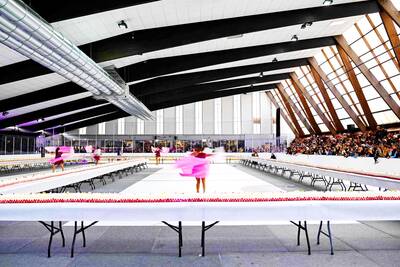
Armed with 4,000 eggs and a truckload of sugar and cream, French pastry chefs on Wednesday completed a 121.8m-long strawberry cake that they have claimed is the world’s longest ever made. Youssef El Gatou brought together 20 chefs to make the 1.2 tonne masterpiece that took a week to complete and was set out on tables in an ice rink in the Paris suburb town of Argenteuil for residents to inspect. The effort overtook a 100.48m-long strawberry cake made in the Italian town of San Mauro Torinese in 2019. El Gatou’s cake also used 350kg of strawberries, 150kg of sugar and 415kg of


 RSS
RSS