


New testing on the type of ammunition used in the 1963 assassination of US president John F. Kennedy raises questions about whether Lee Harvey Oswald acted alone, according to a study by researchers at Texas A&M University.
Lead research Cliff Spiegelman stressed, however, that the research does not necessarily support conspiracy theorists who for decades have doubted Oswald was the lone gunman.
"We're not saying there was a conspiracy. All we're saying is the evidence that was presented as a slam dunk for a single shooter is not a slam dunk," said Spiegelman, a Texas A&M statistics professor and an expert in bullet-lead analysis.
The Warren Commission concluded in 1964 that Oswald fired three shots at Kennedy's motorcade from the Texas School Book Depository in Dallas. The US House Select Committee on Assassinations agreed in 1979 and found that the two bullets that hit Kennedy came from Oswald's rifle.
The committee's findings were based in part on the testimony of forensic chemist Vincent Guinn, who said recovered fragments came from only two bullets. Guinn testified that the bullets Oswald used, Western-Winchester Cartridge Co Mannlicher-Carcano bullets, were unique and that it would be possible to distinguish one from another even if they both came from the same box.
But Spiegelman and his fellow researchers, who tested 30 of the same type of bullets, found that fragments were not nearly so rare and that bullets within the same box could match one another. One of the test bullets also matched one or more of the assassination fragments.
"This finding means that the bullet fragments from the assassination that match could have come from three or more separate bullets," the researchers wrote in a paper detailing their study, set to be published later this year by the journal Annals of Applied Statistics.
"If the assassination fragments are derived from three or more separate bullets, then a second assassin is likely, as the additional bullet would not be attributable to the main suspect, Mr Oswald," they wrote.
The bullets Spiegelman's team used were from two of only four lots ever produced of the ammunition. The researchers were able to test for more elements than Guinn and used better quality control techniques, Spiegelman said.
Gary Mack, curator of the Sixth Floor Museum in Dallas, which focuses on Kennedy's life and assassination, questioned the study's methods.
"Their study can't answer anything about the assassination," he said. "That's my understanding of it because they didn't test the actual fragments. They tested similar fragments and found that the test itself is flawed."
Spiegelman advocates for the bullet fragments from the assassination to undergo more rigorous analysis. Further testing of the fragments would be up to the National Archives and Records Administration, the legal custodian of the projectiles and other evidence used by the Warren Commission.
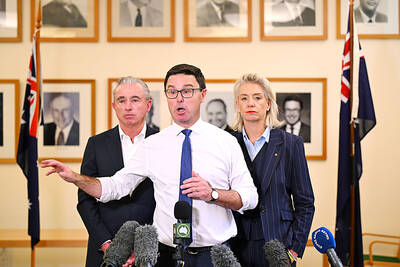
BACKLASH: The National Party quit its decades-long partnership with the Liberal Party after their election loss to center-left Labor, which won a historic third term Australia’s National Party has split from its conservative coalition partner of more than 60 years, the Liberal Party, citing policy differences over renewable energy and after a resounding loss at a national election this month. “Its time to have a break,” Nationals leader David Littleproud told reporters yesterday. The split shows the pressure on Australia’s conservative parties after Prime Minister Anthony Albanese’s center-left Labor party won a historic second term in the May 3 election, powered by a voter backlash against US President Donald Trump’s policies. Under the long-standing partnership in state and federal politics, the Liberal and National coalition had shared power

CONTROVERSY: During the performance of Israel’s entrant Yuval Raphael’s song ‘New Day Will Rise,’ loud whistles were heard and two people tried to get on stage Austria’s JJ yesterday won the Eurovision Song Contest, with his operatic song Wasted Love triumphing at the world’s biggest live music television event. After votes from national juries around Europe and viewers from across the continent and beyond, JJ gave Austria its first victory since bearded drag performer Conchita Wurst’s 2014 triumph. After the nail-biting drama as the votes were revealed running into yesterday morning, Austria finished with 436 points, ahead of Israel — whose participation drew protests — on 357 and Estonia on 356. “Thank you to you, Europe, for making my dreams come true,” 24-year-old countertenor JJ, whose
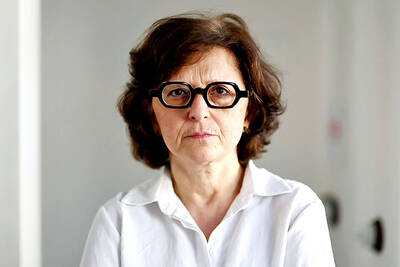
A documentary whose main subject, 25-year-old photojournalist Fatima Hassouna, was killed in an Israeli airstrike in Gaza weeks before it premiered at Cannes stunned viewers into silence at the festival on Thursday. As the cinema lights came back on, filmmaker Sepideh Farsi held up an image of the young Palestinian woman killed with younger siblings on April 16, and encouraged the audience to stand up and clap to pay tribute. “To kill a child, to kill a photographer is unacceptable,” Farsi said. “There are still children to save. It must be done fast,” the exiled Iranian filmmaker added. With Israel
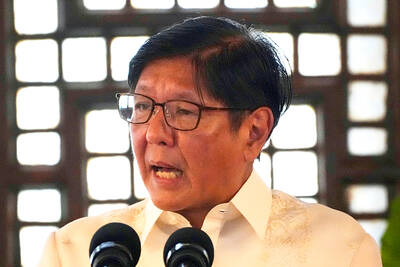
NO EXCUSES: Marcos said his administration was acting on voters’ demands, but an academic said the move was emotionally motivated after a poor midterm showing Philippine President Ferdinand Marcos Jr yesterday sought the resignation of all his Cabinet secretaries, in a move seen as an attempt to reset the political agenda and assert his authority over the second half of his single six-year term. The order came after the president’s allies failed to win a majority of Senate seats contested in the 12 polls on Monday last week, leaving Marcos facing a divided political and legislative landscape that could thwart his attempts to have an ally succeed him in 2028. “He’s talking to the people, trying to salvage whatever political capital he has left. I think it’s


 RSS
RSS