


Japan should cut greenhouse gas emissions from households and transportation to meet carbon dioxide reduction targets required under the Kyoto global warming pact, the head of an environmental panel said yesterday.
Japan is falling far behind in its struggle to meet its obligation under the Kyoto Protocol to reduce its greenhouse gas emissions by 6 percent below its 1990 levels by 2012. It currently emits 14 percent more gases than in 1990.
Industrial emissions have remained flat, but emission of gases -- primarily carbon dioxide -- have soared up to 40 percent since 1990 in the services and household sectors, said Akio Morishima, the head of the government panel.
"We need to think about what to do in areas that were not previously regulated ... like households and transportation," said Morishima, who chairs the Institute for Global Environmental Strategies.
Morishima heads a special 16-member panel working on ways to cut emissions.
Task force
The panel's work will be used by a task force that is headed by Japanese Prime Minister Shinzo Abe working on specific steps the country will take to meet the Kyoto requirements.
Japan could cut 20 percent of carbon emissions from households with steps such as offering subsidies or tax-breaks for using solar energy, or reinforcing insulation in homes to conserve heat, Morishima said.
"We need to accelerate the current measures that are being taken, strengthen those that will lead to further cuts in emissions and immediately study additional measures that are certain to be effective," he told reporters.
Kyoto obligations
The focus on meeting the Kyoto obligations comes after Abe announced a proposal on Thursday to cut global greenhouse gas emissions in half by 2050 as the basis of an international climate pact to take over from the Kyoto agreement, which expires in 2012.
Kyoto requires some 36 industrialized countries to cut greenhouse gas emissions by 5 percent overall under 1990 levels.
The US, however, has rejected the pact, which also does not require leading polluters such as China or India to reduce emissions.
Broad outline
Abe said the aim of the new proposal was to lay out a broad outline that all nations could agree on, and then work out the details.
"In order to make the new framework more effective than the current Kyoto Protocol, we need to first broaden the platform and include a large number of countries," Japanese Chief Cabinet Secretary Yasuhisa Shiozaki said.
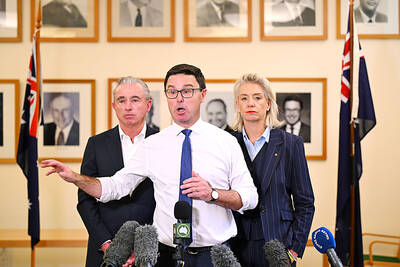
BACKLASH: The National Party quit its decades-long partnership with the Liberal Party after their election loss to center-left Labor, which won a historic third term Australia’s National Party has split from its conservative coalition partner of more than 60 years, the Liberal Party, citing policy differences over renewable energy and after a resounding loss at a national election this month. “Its time to have a break,” Nationals leader David Littleproud told reporters yesterday. The split shows the pressure on Australia’s conservative parties after Prime Minister Anthony Albanese’s center-left Labor party won a historic second term in the May 3 election, powered by a voter backlash against US President Donald Trump’s policies. Under the long-standing partnership in state and federal politics, the Liberal and National coalition had shared power

CONTROVERSY: During the performance of Israel’s entrant Yuval Raphael’s song ‘New Day Will Rise,’ loud whistles were heard and two people tried to get on stage Austria’s JJ yesterday won the Eurovision Song Contest, with his operatic song Wasted Love triumphing at the world’s biggest live music television event. After votes from national juries around Europe and viewers from across the continent and beyond, JJ gave Austria its first victory since bearded drag performer Conchita Wurst’s 2014 triumph. After the nail-biting drama as the votes were revealed running into yesterday morning, Austria finished with 436 points, ahead of Israel — whose participation drew protests — on 357 and Estonia on 356. “Thank you to you, Europe, for making my dreams come true,” 24-year-old countertenor JJ, whose
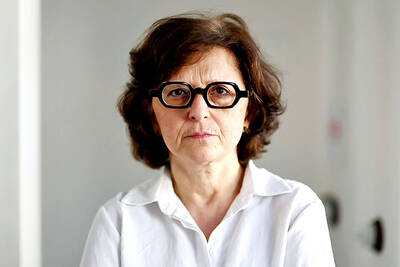
A documentary whose main subject, 25-year-old photojournalist Fatima Hassouna, was killed in an Israeli airstrike in Gaza weeks before it premiered at Cannes stunned viewers into silence at the festival on Thursday. As the cinema lights came back on, filmmaker Sepideh Farsi held up an image of the young Palestinian woman killed with younger siblings on April 16, and encouraged the audience to stand up and clap to pay tribute. “To kill a child, to kill a photographer is unacceptable,” Farsi said. “There are still children to save. It must be done fast,” the exiled Iranian filmmaker added. With Israel
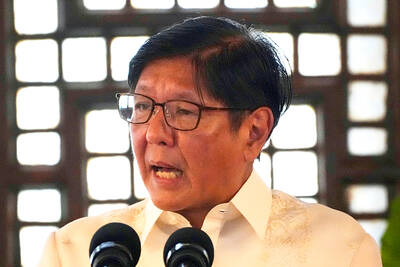
NO EXCUSES: Marcos said his administration was acting on voters’ demands, but an academic said the move was emotionally motivated after a poor midterm showing Philippine President Ferdinand Marcos Jr yesterday sought the resignation of all his Cabinet secretaries, in a move seen as an attempt to reset the political agenda and assert his authority over the second half of his single six-year term. The order came after the president’s allies failed to win a majority of Senate seats contested in the 12 polls on Monday last week, leaving Marcos facing a divided political and legislative landscape that could thwart his attempts to have an ally succeed him in 2028. “He’s talking to the people, trying to salvage whatever political capital he has left. I think it’s


 RSS
RSS