


A body recovered by Iraqi police from the Euphrates River south of Baghdad was identified as one of three US soldiers abducted in an ambush claimed by al-Qaeda, a relative said.
A second body was also found in the area, but there was no immediate word if it was also one of the missing soldiers, according to a US military official who requested anonymity on Wednesday because the information has not yet been released.
Despite the discovery of the bodies, thousands of US and Iraqi soldiers combed fields and searched homes south of Baghdad for a 13th day yesterday, hoping to turn up clues about the soldiers.
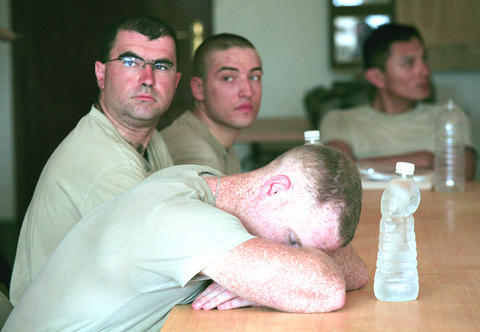
PHOTO: AP
"The search continues," said Lieutenant Colonel Christopher Garver, a US military spokesman.
Military officials told the family of Private first class Joseph Anzack that a commanding officer identified the remains recovered from the river, but that DNA tests were still pending.
"They told us, `We're sorry to inform you the body we found has been identified as Joe,'" the soldier's aunt, Debbie Anzack, said on Wednesday. "I'm in disbelief."
Anzack, 20, vanished along with the two others after their combat team was ambushed on May 12 about 32km outside Baghdad. Five others, including an Iraqi, were killed in the ambush, subsequently claimed by al-Qaeda.
The other missing soldiers are Specialist Alex Jimenez, 25, and Private Byron Fouty, 19.
US forces also disclosed nine more deaths on Wednesday, raising to 20 the number of US troops killed in four days.
The increase in US deaths and the discovery of the bodies come at a difficult moment for Washington, where the administration of President George W. Bush and Congress are struggling to agree on funding for the unpopular war. The search for the captured soldiers has also taken thousands of troops out of the pool of forces for the Baghdad security crackdown.
Nationwide, at least 104 people were killed in sectarian violence or found dead on Wednesday. Thirty-two died in suicide bombings.
Iraqi Prime Minister Nouri al-Maliki, meanwhile, announced he was ready to fill six Cabinet seats vacated by politicians loyal to radical anti-US Shiite cleric Moqtada al-Sadr in a mass resignation last month.
Al-Sadr, who went into hiding in Iran at the start of the Baghdad security crackdown, ordered his ministers to quit the government over al-Maliki's refusal to call for a timetable for US withdrawal.
One of Wednesday's suicide bombings hit a cafe in the town of Mandali, on the Iranian border 96km east of Baghdad. The attacker walked into the packed cafe and blew himself up, killing 22 people and wounding 13, police said.
The cafe in the mixed Sunni, Shiite and Kurdish city was popular with police officers -- but none was there at the time, police said. A man in his 30s wearing a heavy jacket despite the heat was seen walking into the cafe seconds before the blast, according to police.
In the second suicide assault, a bomber blew himself up in the house of two brothers who were supporting a Sunni alliance opposed to al-Qaeda in Anbar Province, killing 10 people, including the men, their wives and children, police Lieutenant Colonel Jabar Rasheed Nayef said.
The attacker, a 17-year-old neighbor, broke into the house of the two men, Sheik Mohammed Ali and police Lieutenant Colonel Abed Ali, and detonated his bomb belt late Tuesday in Albo Obaid, about 96km west of Baghdad.
The targeted men were part of the Anbar Salvation Council, a group of Sunni tribal leaders backing the government's fight against al-Qaeda.
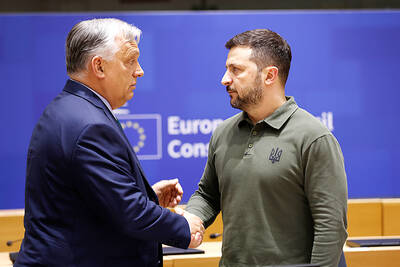
Hungarian authorities temporarily detained seven Ukrainian citizens and seized two armored cars carrying tens of millions of euros in cash across Hungary on suspicion of money laundering, officials said on Friday. The Ukrainians were released on Friday, following their detention on Thursday, but Hungarian officials held onto the cash, prompting Ukraine to accuse Hungary’s Russia-friendly government of illegally seizing the money. “We will not tolerate this state banditism,” Ukrainian Minister of Foreign Affairs Andrii Sybiha said. The seven detained Ukrainians were employees of the Ukrainian state-owned Oschadbank, who were traveling in the two armored cars that were carrying the money between Austria and
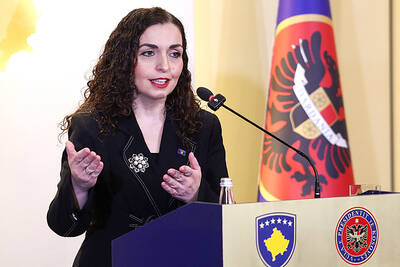
Kosovar President Vjosa Osmani on Friday after dissolving the Kosovar parliament said a snap election should be held as soon as possible to avoid another prolonged political crisis in the Balkan country at a time of global turmoil. Osmani said it is important for Kosovo to wrap up the upcoming election process and form functional institutions for political stability as the war rages in the Middle East. “Precisely because the geopolitical situation is that complex, it is important to finish this electoral process which is coming up,” she said. “It is very hard now to imagine what will happen next.” Kosovo, which declared

MORE BANS: Australia last year required sites to remove accounts held by under-16s, with a few countries pushing for similar action at an EU level and India considering its own ban Indonesia on Friday said it would ban social media access for children under 16, citing threats from online pornography, cyberbullying, online fraud and Internet addiction. “Accounts belonging to children under 16 on high-risk platforms will start to be deactivated, beginning with YouTube, TikTok, Facebook, Instagram, Threads, X, Bigo Live and Roblox,” Indonesian Minister of Communications and Digital Meutya Hafid said. “The government is stepping in so that parents no longer have to fight alone against the giants of the algorithm. Implementation will begin on March 28, 2026,” she said. The social media ban would be introduced in stages “until all platforms fulfill their
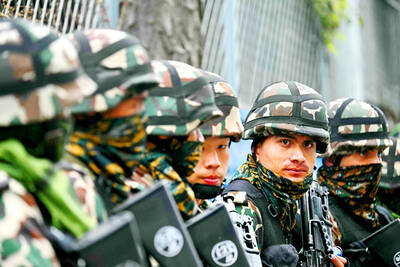
Counting was under way in Nepal yesterday, after a high-stakes parliamentary election to reshape the country’s leadership following protests last year that toppled the government. Key figures vying for power include former Nepalese prime minister K. P. Sharma Oli, rapper-turned-mayor Balendra Shah, who is bidding for the youth vote, and newly elected Nepali Congress party leader Gagan Thapa. In Kathmandu’s tea shops and city squares, people were glued to their phones, checking results as early trends flashed up — suggesting Shah’s centrist Rastriya Swatantra Party (RSP) was ahead. Nepalese Election Commission spokesman Prakash Nyupane said the counting was ongoing “in a peaceful manner”


 RSS
RSS