


The US is treating the globe as one giant battlefield for its war on terror, eroding rights worldwide, a leading human rights group said yesterday.
Amnesty International secretary-general Irene Khan said the US and its allies' behavior was setting a destructive example for other nations, and that countries across the world were using the war on terror as an excuse to violate human rights and stifle dissent.
"One of the biggest blows to human rights has been the attempt of Western democratic states to roll back some fundamental principles of human rights — like the prohibition of torture," Khan said, speaking before the launch of her organization's annual report on the global state of human rights.
The report condemned the US response to international terrorism, saying it had done little to reduce the threat, while deepening mistrust between Muslims and non-Muslims and undermining the rule of law. The Bush administration's policy of extraordinary rendition — the alleged practice of secretly flying terror suspects to countries where they could be tortured — came in for particularly scathing condemnation.
"The US administration's double speak has been breathtakingly shameless," the report said. "It is unrepentant about the global web of abuse it has spun in the name of counterterrorism."
The US' unique position on the world stage justified the criticism, Khan said.
"If we focus on the US it's because we believe that the US is a country whose enormous influence and power has to be used constructively," she said. "When countries like the US are seen to undermine or ignore human rights, it sends a very powerful message to others."
European countries were attacked for failing to challenge the US rendition scheme, while US allies Britain, Australia, and Japan were singled out for passing harsh new anti-terror or anti-immigration laws.
Russia's crackdown on journalists also attracted Amnesty's ire, as did the deteriorating human rights situation in Zimbabwe, and, above all else, the continuing violence in Darfur, which Khan called "a bleeding wound on world conscience."
"The authoritarian drift in Russia has been devastating for journalists and human rights defenders," the report said, noting the assassination of journalist Anna Politkovskaya and new laws clamping down on rights organizations.
The report also criticized China's role in shielding Sudan from UN action, saying that the Chinese government and companies showed little regard for their "human rights footprint" on the African continent.
But the weakened moral authority of those pushing for international intervention was also to blame, Khan said.
"On the one hand distrust, and on the other hand double dealing has made the UN Security Council dysfunctional on Darfur," she said.
The report did sound some positive notes, saying that a change of the political guard in the US, and the growth of informal networks of activists were grounds for hope.
Khan compared their struggle to the fight against climate change.
"Just as global warming requires global action based on international cooperation, the human rights meltdown can only be tackled through global solidarity and respect for international law," she said.

SPEAKING OUT: After Siranudh Scott’s allegations surfaced, celebrities and public figures took to social media to share their own experiences of sexual misconduct and abuse A high-profile alleged sexual abuse case within a wealthy Thai beer brewing family has prompted a wave of painful accounts from survivors of unconnected abuse in the conservative nation. Siranudh Scott, a member of the billionaire Thai family that founded the ubiquitous Singha beer brand, posted an emotional video this month accusing his elder brother Sunit of repeatedly abusing him when he was a teenager. Sunit, who is in his 30s, later denied the allegations in a video posted online, but Singha parent Boonrawd dismissed him from his executive role with the company on Tuesday last week. “I felt I needed to speak
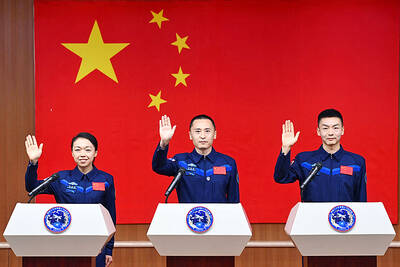
A Hong Kong astronaut is to join a Chinese space mission for the first time as part of a three-person crew launching today, as Beijing edges closer to its goal of landing people on the moon. The Tiangong space station — crewed by teams of three astronauts that are typically rotated every six months — is the crown jewel of China’s space program, boosted by billions in state investment in a bid to catch up with the US and Russia. The Shenzhou-23 mission is to blast off at 11:08pm from the Jiuquan Satellite Launch Center in northwestern China, carrying three astronauts to
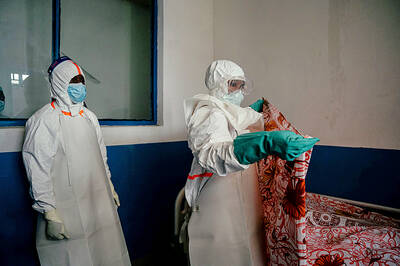
UPGRADED ALERT: The risk inside DR Congo is now considered ‘very high,’ while neighboring countries face a ‘high’ threat as the outbreak continues, the WHO said Ebola is spreading faster than responders can track it in eastern Congo, where health workers managed to follow up with barely one in five identified contacts in a single day. Authorities in the Democratic Republic of the Congo (DR Congo) reported 83 confirmed infections, 746 suspected cases and 1,603 identified contacts as of Thursday, but health workers were able to follow up on only 342 contacts that day — about 21 percent of the total under monitoring — data released by the DR Congo Ministry of Public Health on Friday showed. The figures suggest the response is falling behind the outbreak itself,
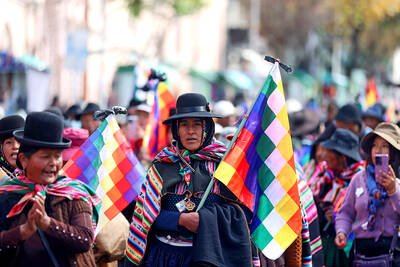
SEEKING ORDER: Rodrigo Paz said that ‘anyone who wants to destroy the nation will have to deal with this president and the full force of the constitution’ Bolivian President Rodrigo Paz on Wednesday said that the nation was at a “breaking point” after nearly a month of protests that have caused shortages of food, fuel and medicine. Paz, who took office six months ago amid the worst economic crisis there in four decades, is battling a groundswell of fury over his policies. The political capital, La Paz, has been besieged by low-income workers and members of the indigenous majority calling for his resignation. “The country needs order and is reaching breaking point,” the 58-year-old said at a public event in La Paz, renewing his appeal for dialogue. On Tuesday, the Bolivian


 RSS
RSS