


One boat took Jean-Baptiste Metellus away from Haiti, far from his dying farming village and to within a few hundred meters of a better life. Another boat brought him back on Saturday, his body wrapped in a plastic bag marked "John Doe" and stacked in a shipping container with dozens more corpses.
The remains of the 59 migrants, killed on May 4 when their boat capsized off the nearby Turks and Caicos Islands, were buried in a common grave in the northern Haitian city of Cap-Haitien after officials said most had decayed beyond recognition. The decision angered relatives who were denied the chance to identify their loved ones.
"God will welcome each one of you, our compatriots. You should not have had to take to the seas and leave your country," the Reverend Hubert Constant, the archbishop of Cap-Haitien, said after blessing the 28 male and 31 female victims, whose bodies arrived by cargo ship, stored in black plastic bags labeled either "John Doe" or "Jane Doe."
More than 160 migrants were believed to have been aboard the overloaded sloop when it capsized minutes from the Turks and Caicos' shore, pitching passengers overboard, most of whom didn't know how to swim.
The bodies of 61 migrants were recovered and more than a dozen are missing and presumed dead. Some had been eaten by sharks. Two bodies were buried in Turks and Caicos.
The 78 survivors claim a Turks and Caicos boat rammed their vessel twice before it capsized, but the British territory's government says the migrants were being towed to shore when the boat flipped in rough waters. A British-led investigation is due to be complete in a few weeks.
The number of Haitian migrants intercepted on their way to US shores has shot up recently, with nearly as many stopped last month as in all of last year, according to the US Coast Guard.
"It's like trying to fly across the Atlantic in an airplane that hasn't had an oil change in four years. It's extremely dangerous and not worth the risk," US Coast Guard Petty Officer James Judge said of the migrant voyages.
But many Haitians say they have little choice but take that risk given their grim circumstances.
Haiti has suffered through repeated coups, a brutal right-wing military regime and a bloody 2004 uprising that toppled president Jean-Bertrand Aristide. Unemployment and despair are rife, leading thousands to flee in rickety boats each year.
"There's no factories here, no jobs, no nothing," said 25-year-old taxi driver Newton Ambroise, who said he had several friends of the ill-fated boat, all of whom survived.
Metellus wasn't as lucky. The 36-year-old father of two scraped earned US$3 a day selling lottery tickets in rural Trou-Du-Nord, a jobless, ramshackle farming town in northeastern Haiti.
One day earlier this month he told his family he was traveling to Cap-Haitien for a friend's first communion. They never saw him again. When he got to town, he boarded the boat and set out to join a godfather living in the Turks and Caicos.
"Now he's gone and he didn't leave anything for his children. His wife is at home crying. She can't do anything," said Adius Basil, a half brother of Metallus who traveled by bus to recover his body.
Instead, he was told that all the remains had to buried immediately because most were already badly decomposed.
"We never would have wanted him to be buried this way," said another brother, Max Metellus, said as workers lowered the coffins into a common grave, one stacked on another, in Cap-Haitien's St. Philomene cemetary as hundreds looked on.
Fifty-nine unmarked white crosses were placed above the grave, one for each victim.
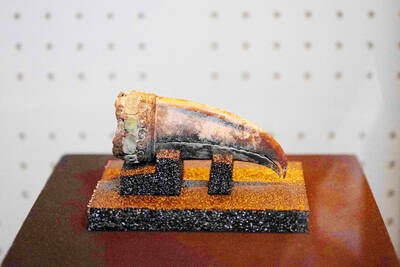
Archeologists in Peru on Thursday said they found the 5,000-year-old remains of a noblewoman at the sacred city of Caral, revealing the important role played by women in the oldest center of civilization in the Americas. “What has been discovered corresponds to a woman who apparently had elevated status, an elite woman,” archeologist David Palomino said. The mummy was found in Aspero, a sacred site within the city of Caral that was a garbage dump for more than 30 years until becoming an archeological site in the 1990s. Palomino said the carefully preserved remains, dating to 3,000BC, contained skin, part of the

TRUMP EFFECT: The win capped one of the most dramatic turnarounds in Canadian political history after the Conservatives had led the Liberals by more than 20 points Canadian Prime Minister Mark Carney yesterday pledged to win US President Donald Trump’s trade war after winning Canada’s election and leading his Liberal Party to another term in power. Following a campaign dominated by Trump’s tariffs and annexation threats, Carney promised to chart “a new path forward” in a world “fundamentally changed” by a US that is newly hostile to free trade. “We are over the shock of the American betrayal, but we should never forget the lessons,” said Carney, who led the central banks of Canada and the UK before entering politics earlier this year. “We will win this trade war and

‘BODIES EVERYWHERE’: The incident occurred at a Filipino festival celebrating an anti-colonial leader, with the driver described as a ‘lone suspect’ known to police Canadian police arrested a man on Saturday after a car plowed into a street party in the western Canadian city of Vancouver, killing a number of people. Authorities said the incident happened shortly after 8pm in Vancouver’s Sunset on Fraser neighborhood as members of the Filipino community gathered to celebrate Lapu Lapu Day. The festival, which commemorates a Filipino anti-colonial leader from the 16th century, falls this year on the weekend before Canada’s election. A 30-year-old local man was arrested at the scene, Vancouver police wrote on X. The driver was a “lone suspect” known to police, a police spokesperson told journalists at the
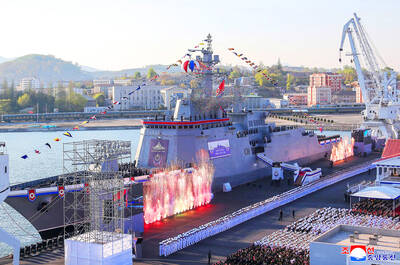
North Korean leader Kim Jong-un has unveiled a new naval destroyer, claiming it as a significant advancement toward his goal of expanding the operational range and preemptive strike capabilities of his nuclear-armed military, state media said yesterday. North Korea’s state-run Korean Central News Agency (KCNA) said Kim attended the launching ceremony for the 5,000-tonne warship on Friday at the western port of Nampo. Kim framed the arms buildup as a response to perceived threats from the US and its allies in Asia, who have been expanding joint military exercises amid rising tensions over the North’s nuclear program. He added that the acquisition


 RSS
RSS