


Romanian President Traian Basescu, suspended by parliament for alleged abuse of power, easily survived a referendum on his impeachment, exit polls showed.
Three-quarters of voters in Saturday's referendum said they did not want Basescu ousted from office, according to one exit poll conducted by Insomar Metro Media. A second poll, conducted by CURS, put the figure at 78.1 percent.
Just last month, parliament suspended Basescu -- who has been locked in a political standoff with the prime minister and lawmakers -- saying he violated the Constitution by usurping the role of the prime minister and criticizing the courts.
Basescu, an outspoken ex-mayor who is a strong proponent of anti-corruption reforms for the new EU member, said Saturday's referendum showed that the Romanian people, too, back the reforms.
"Romanians want justice, and we have an obligation to give them what they want," he told supporters. "I appeal to parliament to cooperate in taking into account today's vote."
Prime Minister Calin Popescu Tariceanu said late on Saturday that he would work with Basescu.
"Romanians gave Traian Basescu a second chance," he said. "I respect this decision and will act in a spirit of collaboration with the president."
Tariceanu is expected to come under pressure from his Liberal Party base to work more closely with Basescu, after exit polls showed that a majority of Liberal supporters voted for the president.
Hundreds of Basescu supporters gathered in a central square in Bucharest to celebrate, carrying orange flags and banners.
They chanted the president's name and called for Tariceanu's resignation. Basescu joined the celebrations and told supporters he would do "everything possible" to modernize the country.
"I will not negotiate the people's hopes for a modern country, a new Romania that is different than the one which emerged during the transition" from communism, he said.
"Nobody wants a Romania owned by oligarchs anymore," he added, referring to the wealthy businessmen and politicians who he said took control of the country during the transition from communism.
The prime minister and Basescu, former allies, had clashed on policy and had attacked one another in the media. Last month, Tariceanu expelled several Cabinet ministers seen as being close to Basescu, including reformist Justice Minister Monica Macovei.
The dispute between the two leaders was seized upon by the left-wing opposition Social Democratic Party, which proposed impeaching Basescu, who had ousted it from power in 2004. Four other ruling and opposition parties, including Tariceanu's joined in voting to suspend the president last month despite a court ruling that Basescu did not abuse his powers.
Social Democrat leader Mircea Geoana acknowledged defeat, but warned that Basescu had "won a victory without glory," because turnout had been relatively low. Geoana said his party, which is the largest in parliament, would return to people's priorities such as pensions and health care.
"We must learn our lessons," he said.

Through the noise of rushing papers and whirring belts at a print factory in Kyoto, two creators watch their photo essay come to life in broadsheet form — part of an effort to win new audiences in the age of artificial intelligence (AI). Despite the decline of the publishing industry, self-publication and handmade “zine” magazines are growing in popularity in Japan, reflecting the nation’s enduring love of paper in the digital era. While speaking to Agence France-Presse at the plant, his hands black with ink, one of the creators, Kazuma Obara, said: “I think [paper] is a medium that engages all five
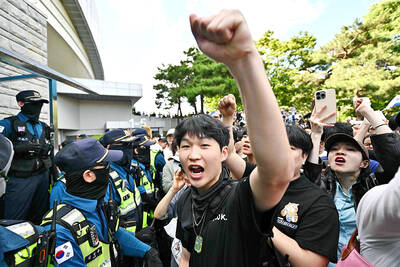
‘ABSURD MISTAKE’: The election commission said that there had been a failure to anticipate turnout after 14 polling stations ran short of ballot papers South Korean riot police yesterday cleared protesters from a Seoul polling station after a 35-hour blockade sparked by a shortage of ballot papers during local elections earlier this week. Wednesday’s election was the first nationwide vote since South Korean President Lee Jae-myung took office following the ouster of Yoon Suk-yeol over his short-lived martial law declaration. Lee’s ruling Democratic Party swept most races, but failed to flip the crucial Seoul mayoral seat. The South Korean National Election Commission apologized, blaming a failure to anticipate turnout after 14 polling stations in Seoul ran short of ballot papers. Some polling stations stayed open until 10pm to

Australian researchers have trained lab-grown brain cells on a silicon computer chip to play the 1990s shooter game Doom and said they are just scratching the surface of what the neurons could be capable of doing. It is the science-fiction work of biotech boffins at Cortical Labs, who researched and developed the technology that harnesses the workings of the brain’s networking system. Each so-called “biological computer” contains about 200,000 living human brain cells, grown from stem cells that were harvested from blood donations. Having mastered the simple computer game Pong, where a paddle is moved up and down to send a ball

France experienced its hottest spring on record, the French weather service said on Tuesday, after an exceptional early heat wave that also broke highs for the season in England and Wales. Meteo-France said the average nationwide temperature over March to May was 13.8°C — about 1.7°C above the norm, and surpassing records set in 2011 and 2020. “The warmest spring since records began in 1900,” it said in a bulletin. All three months were warmer than average, but the onset of an “unprecedented heatwave” late last month pushed the mercury to highs typically seen at the height of the summer. “Our country had never


 RSS
RSS