


Vietnamese yesterday voted for a new national assembly in a five-yearly election that will bring new faces to the legislature while maintaining the Communist Party's grip on power.
More than 50 million eligible voters out of Vietnam's 84 million people were due to elect 500 new deputies from a field of 875 hopefuls -- including 150 who are not members of the ruling party and 30 self-nominated candidates.
Vietnam has said it wants to broaden public participation in the assembly, but ultimately about 90 percent of seats are guaranteed to go to the party, whose affiliate the Fatherland Front also screened all other candidates.
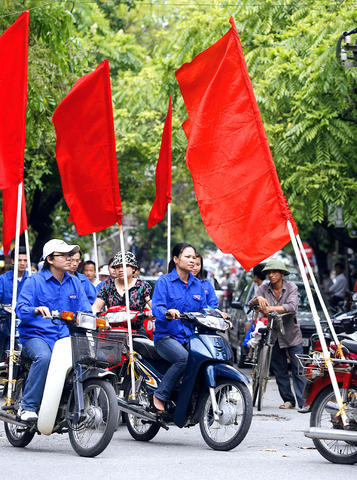
PHOTO: AFP
Final results are expected within seven to 10 days after voting.
Communist Party chief Nong Duc Manh was among the first to cast his ballot, in Hanoi's government district of Ba Dinh, as propaganda messages starting at 6am urged people to come out quickly and vote as required by law.
"Go to the polls and express the will and the aspirations of the people," said a typical loudspeaker message echoing through the streets of the capital.
"Electing a new and good national assembly serves our cause of industrialization and modernization of the country because deputies will be the bridge between the national assembly and the people," the message said.
The legislature has changed in recent years from being a purely rubber-stamp body into a debating forum that has occasionally grilled top officials in sessions broadcast on national television.
Deputies have complained loudly of corruption and passed laws that bring the country in line with the rules of the WTO, which Vietnam, a low-income but rapidly growing economy, joined early this year.
Manh said the 12th assembly's task would be to push forward reforms with the aim of "bringing Vietnam out of the list of less developed countries by 2010 and becoming a modern industrialized country by 2020."
Vietnamese leaders have made clear that they will tolerate no open challenge to the sole rule of the party which has dominated public life in unified Vietnam since the end of the "American War" in 1975.
In recent months, Vietnam has tried and jailed several political dissidents who had urged an election boycott or called for a multi-party political system, triggering protests from the US and the EU.
In yesterday's election, no controversial candidates were likely to be elected as all of them had to gain the support of their workplaces and neighborhoods, which have their own party cells, as well as the Fatherland Front.
Meanwhile, women, ethnic minorities and key institutions such as the police, army and farmers' unions were all guaranteed blocks of seats in advance.
Vietnam specialist Carl Thayer of the Australian Defence Force Academy said that although more non-party members and self-nominated candidates were running than in the past, the elections "remain a highly contrived affair."
"Central authorities determine in advance the ideal structure and composition of the National Assembly," he said.
In the run-up to the poll, the leadership urged citizens to hoist the national flag. Yesterday, public loud-speakers started playing patriotic songs at dawn, also hailing late revolutionary leader Ho Chi Minh.
Official turnout was expected to top 90 percent, as in the 2002 vote.
In an election where there is no doubt about which party will win, the contest is often between wards who compete to be first to finish voting.
At the polling stations, heads of families often cast proxy votes for their relatives, typically with a choice to elect three deputies from five candidates, whose pictures and brief resumes were provided at polling booths.
"I saw that most people casting their ballots are older people," complained one 78-year-old retiree in Hanoi. "They vote for the whole family. It seems that the young voters are lazy."

ACTIONABLE ADVICE: The majority of chatbots tested provided guidance on weapons, tactics and target selections, with Perplexity and Meta AI deemed to be the least safe From school shootings to synagogue bombings, leading artificial intelligence (AI) chatbots helped researchers plot violent attacks, according to a study published on Wednesday that highlighted the technology’s potential for real-world harm. Researchers from the nonprofit watchdog Center for Countering Digital Hate and CNN posed as 13-year-old boys in the US and Ireland to test 10 chatbots, including ChatGPT, Google Gemini, Perplexity, Deepseek and Meta AI. Eight of the chatbots assisted the make-believe attackers in more than half the responses, providing advice on “locations to target” and “weapons to use” in an attack, the study said. The chatbots had become a “powerful accelerant for

Australians were downloading virtual private networks (VPNs) in droves, while one of the world’s largest porn distributors said it was blocking users from its platforms as the country yesterday rolled out sweeping online age restriction. Australia in December became the first country to impose a nationwide ban on teenagers using social media. A separate law now requires artificial intelligence (AI)-powered chatbot services to keep certain content — including pornography, extreme violence and self-harm and eating disorder material — from minors or face fines of up to A$49.5 million (US$34.6 million). The country also joined Britain, France and dozens of US states requiring

Hungarian authorities temporarily detained seven Ukrainian citizens and seized two armored cars carrying tens of millions of euros in cash across Hungary on suspicion of money laundering, officials said on Friday. The Ukrainians were released on Friday, following their detention on Thursday, but Hungarian officials held onto the cash, prompting Ukraine to accuse Hungary’s Russia-friendly government of illegally seizing the money. “We will not tolerate this state banditism,” Ukrainian Minister of Foreign Affairs Andrii Sybiha said. The seven detained Ukrainians were employees of the Ukrainian state-owned Oschadbank, who were traveling in the two armored cars that were carrying the money between Austria and

Kosovar President Vjosa Osmani on Friday after dissolving the Kosovar parliament said a snap election should be held as soon as possible to avoid another prolonged political crisis in the Balkan country at a time of global turmoil. Osmani said it is important for Kosovo to wrap up the upcoming election process and form functional institutions for political stability as the war rages in the Middle East. “Precisely because the geopolitical situation is that complex, it is important to finish this electoral process which is coming up,” she said. “It is very hard now to imagine what will happen next.” Kosovo, which declared


 RSS
RSS